

Basic Pasta
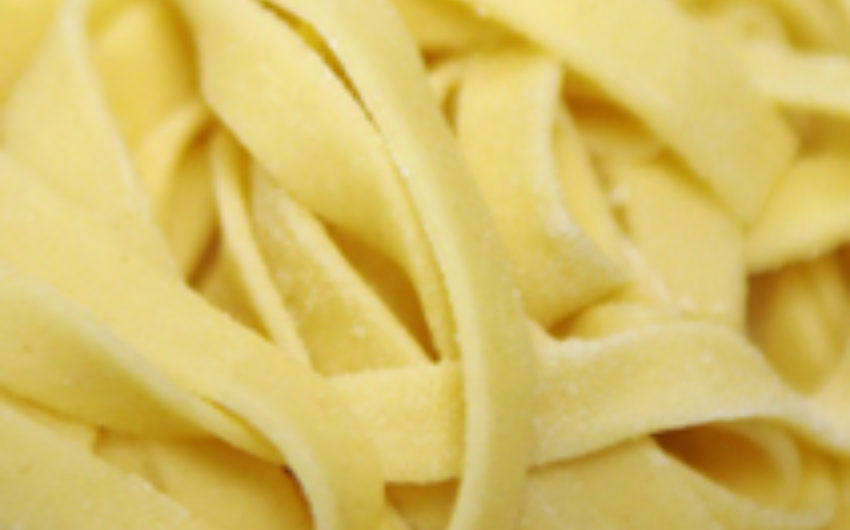
This basic pasta recipe is your gateway to learning how to make pasta from scratch. We have Peter Robertson from RP’s Pasta to thank for this recipe and detailed how-to instructions.
Ingredients
2 cups organic "all-purpose" flour
2 local, organic eggs
Water as needed
Directions
Place eggs in a small bowl, gently whisk and set aside.
Place flour in a large mixing bowl or freestanding mixer. Make a well in the center of the flour and add the whisked eggs. If mixing by hand, use a fork to stir the eggs into the flour using a circular motion; if using a freestanding mixer, use the paddle attachment.
Mix the flour and eggs until the dough starts to clump. Feel it for moisture by pressing a few clumps together. If it is somewhat sticky, take it into your hands and form a ball of dough. If the dough feels dry and resists forming, add a little water. Only a small amount of water is typically needed, so be mindful of making the dough too wet. For those of you who bake, the dough should have the consistency of pie dough.
Using your hands, form the dough ball into a disk, then cut the disk into five sections of equal thickness. If using a pasta maker, move one section at a time through the roller. The dough will likely be rough and crumbly after the first pass because the gluten strands have yet to form. Typical of most pasta makers, the dough is first moved through the roller on setting one, and with each additional pass, the setting is increased until the dough is uniform, smooth and at your desired thickness. (Be sure to follow the directions included with your pasta maker.) Thicker dough is better for shapes and thinner dough is better for pasta sheets that will be cut into fettuccini, lasagna or ravioli.
Place each rolled sheet of dough on a well-floured surface.
(If kneading and shaping by hand, fold the dough over itself, rotate and repeat a handful of times until the dough stiffens. Let the dough rest for several minutes until it becomes smooth and elastic. Use a rolling pin to roll the dough into long, narrow 5- to 6-inch wide sheets. Place the sheets on a well-floured surface.)
Once the dough is rolled out, you can shape it into any number of creative handmade shapes. You can also thin the sheets out further and use a knife or pasta cutter to cut fettuccini, lasagna or ravioli.
For ravioli, either purchase a ravioli pasta mold and assemble as directed, or make it by hand by doing the following: Place one pasta sheet on a well-floured surface and drop one tablespoon of filling two to three inches apart. When the sheet is full, lay a second sheet of dough directly on top of the bottom sheet. Using your fingers, gently press out any air around each pocket of filling, starting in the center and moving outward. Then use a knife or pasta cutter to cut around each pocket of filling, leaving at least one-half inch to one inch of dough space around each pocket.
To cook the pasta, add it to lightly salted boiling water. Pasta noodles like fettuccini need to cook for only one minute when fresh. Ravioli should cook at a high simmer for approximately three minutes depending on the thickness of the pasta and size of the ravioli. Pasta that is frozen and dry should be cooked for eight to ten minutes.
If the pasta will not be cooked immediately, it can be kept in the refrigerator for up to seven days or frozen on a sheet tray and placed in a plastic storage bag or other freezer-safe container for up to three months.
More Recipes



Edible in your mailbox
