

Squash and Pumpkin Seed Pesto Pizza
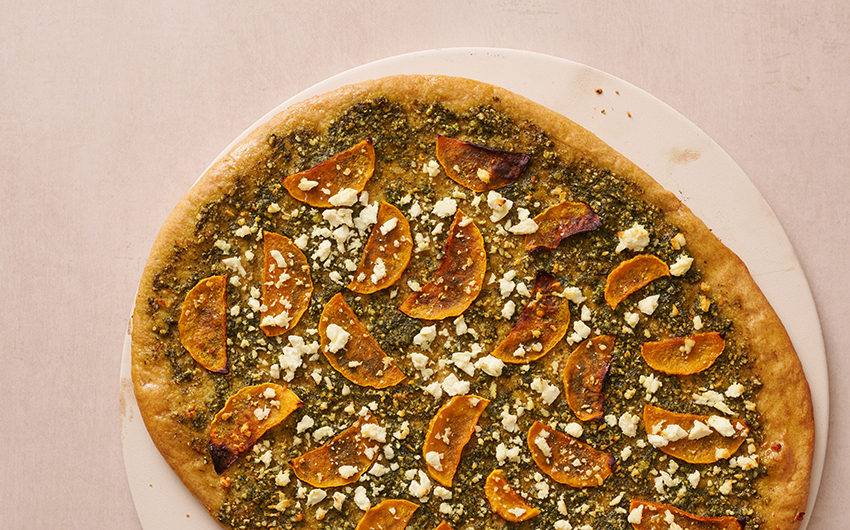
Allison Pfaff Harris’s passion is to make local food the norm for more people rather than the exception. While there are many barriers to overcome in that struggle, an important one is learning how to cook what is locally available seasonally. Pizza makes a fantastic and flexible vehicle for many ingredients, especially what is available during fall in Wisconsin. Below is one suggestion of toppings that features colorful slices of butternut squash paired with a basil pumpkin seed pesto, but the sky is the limit! Pfaff Harris encourages you to try new things when it comes to your pizza toppings, and don’t be afraid to try again if it doesn’t work out.
Ingredients
For Pizza Dough
3¼ cup Meadowlark Organics bolted bread flour
2 tablespoons granulated sugar
1 tablespoon dried yeast
1¼ cup ice water
2 teaspoons kosher salt
1 tablespoon olive oil
For Pizza
1 recipe pizza dough
½–1 pound butternut squash, peeled and sliced thinly
4 tablespoons olive oil, divided
2–3 cups fresh basil
½ cup shredded Parmesan cheese
½ cup pumpkin seeds
8 ounces feta, crumbled
Salt and pepper to taste
Directions
For Pizza Dough
In the bowl of a stand mixer with the dough hook attachment, blend together the bread flour, granulated sugar and yeast. Add the ice water and gently mix with the dough hook until a shaggy dough forms. (You can also use a large mixing bowl and a wooden spoon if you do not have a stand mixer.) Rest the dough for 15 minutes.
In the stand mixer or mixing bowl, begin mixing the dough again. Slowly add the salt and olive oil and keep mixing for about 90 seconds; the dough should start forming into a smooth ball. Continue to knead using the dough hook or by hand on a lightly floured surface for about 15–20 minutes. The dough will become smooth and tacky but not overly sticky. To test if enough gluten has developed, break off a small piece of dough and gently stretch it. If you can stretch it until it is thin enough to see your fingers through, it is ready. (This is called the windowpane test.) Note that fresh milled flours such as Meadowlark’s bread flour can take longer to develop a strong matrix of gluten than commercially available flours, but the improved taste is worth it!
Place the dough in a bowl and cover with a light drizzle of olive oil. Cover the bowl with a damp tea towel and allow to rise for 2 hours.
Divide the dough into two balls. Pinch any seams together and roll each ball on a lightly floured surface to form a tight ball. Cover the dough balls with a lightly floured tea towel and allow to rise for an additional 1–2 hours.
For Pizza
While the dough is rising, preheat the oven to 450 degrees F.
Place the sliced butternut squash on a baking sheet. Drizzle with 1 tablespoon of olive oil and add the salt and pepper to taste. Toss to coat, then spread out in a single layer. Bake for about 10–20 minutes or until the squash is barely tender. Allow to cool.
Place a pizza stone (if you have one) in the oven and increase the heat to 475 degrees F. Allow the oven and stone (if using) to preheat for 30–60 minutes.
Make the basil pumpkin seed pesto: add the fresh basil leaves to a food processor with the Parmesan cheese, pumpkin seeds and a pinch of salt. While running the food processor, slowly drizzle in the remaining 2 tablespoons of olive oil, or until you reach your desired texture. Taste and adjust the seasoning to your preference.
Working with one ball of dough at a time, gently stretch the dough into a circle. You might find it helpful to use a rolling pin to start, then drape the dough over your knuckles and rotate until the desired size is reached. Stretch the dough until it is nearly as thin as you can get it—about 12 inches diameter. Place the dough on a baking sheet. Repeat with the remaining ball of dough.
Spread a thin layer of the basil pumpkin seed pesto on each pizza dough, then top with the cooled slices of butternut squash. Sprinkle crumbled feta on top.
Bake the pizzas on the baking sheet or pizza stone (if using) until the crust is risen and golden, about 10–15 minutes.

Edible in your mailbox
