

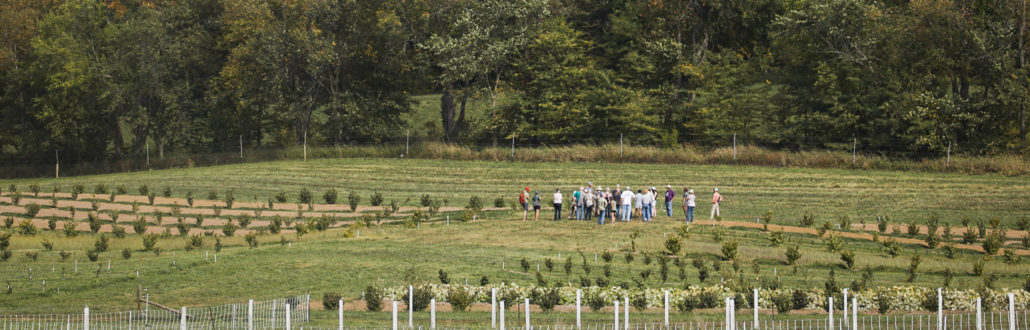
On a hillside farm near Spring Green, the boundary between fields and forests is growing fuzzy. The farm is a demonstration site for agroforestry, or the use of trees and woody shrubs for agriculture. The trees and shrubs growing on this land provide a suite of environmental and economic benefits, as well as new flavors of locally sourced, healthy foods.
“Agroforestry products are some of the most delicious and companionable foods that I know,” says Odessa Piper, a deep-roots food advocate and founder of L'Etoile, a pioneering farm-to-table restaurant in Madison. Piper has partnered with the Savanna Institute, a nonprofit organization working to expand agroforestry in the Midwest, to demonstrate uses for perennial crops such as chestnuts, hazelnuts, persimmons and several berry species noted for their health benefits.
“It’s essential to get cooks and producers and marketers all in the same room tasting these foods,” says Piper. “We need to bring them all into conversation if we’re going to make people more aware of these nutritious perennial foods and their planet-friendly, soil-building capabilities.”
Agroforestry introduces new crops and flavors to the region. Chestnuts, a carbohydrate-rich nut, are nutritionally similar to brown rice, but with twice the protein. Persimmons are the most nutritionally dense native fruit in the US, containing 19 of 20 amino acids. Black currants are a good source of antioxidants, with three times as much vitamin C as oranges. Each of these agroforestry crops can be successfully grown in temperate Midwest climates and soils.
“Black currants are the ‘secret sauce’ of so much of my cooking,” Piper says. At one of the Savanna Institute’s demonstration farms outside Spring Green, gently curving rows of chestnut trees and hazelnut bushes grow in a field that had previously been used for short-lived, shallow-rooted annual crops. Sheep graze between the trees, and in other areas, vegetables and perennial grains are cultivated between the rows.

“Tree crops are a good option for people looking to make their land more resilient long-term,” says Barbara Decré, Assistant Director of Agroforestry Adoption at the Savanna Institute. Perennial crops have deep root structures that promote soil health, and woody plants are particularly good at capturing and storing carbon from the atmosphere. Integrating tree crops on farmland is consistently ranked among the top global climate solutions.
Agroforestry can also be used to reduce runoff and improve water quality. Deep-rooted perennial plants help water soak into the ground, reducing erosion and nutrient losses during heavy rains. Agroforestry systems increase on-farm biodiversity, both by increasing the diversity of crops growing on a farm and by providing habitat and protection for wildlife.
Want to learn more about agroforestry taking root in our region? Savanna Institute’s Perennial Farm Gathering will take place October 6–8 at Monona Terrace in Madison, bringing together experts and enthusiasts around food, farming, forestry, finance and more. Farm tours at the Spring Green demonstration farms are available throughout the year.
Learn more at www.savannainstitute.org.
Proud sponsor of the Savor the Summer Feast

Edible in your mailbox
