


Bakers are having a moment. Across the country and in our own towns, we are rising to the collective occasion like so much sourdough.
We are sending thank-you cookies to essential workers, giving away celebration cakes to socially-distanced community members and raising funds for important causes. Some, like Washington, D.C.-based pastry chef Paola Velez, a lead architect of the locally executed and nationally successful bake sale Bakers Against Racism, are rightfully garnering media attention usually reserved for high-profile savory chefs. Bakers in and around greater Madison have been no exception. As fundraisers, spokespeople, and generators of goodwill and care during a time in need of both bakers are having a moment. It is definitely, finally, the time of the baker.
And yet, I find myself feeling like a baker outside of time. A year ago this time I was making jam. I had new stores of strawberry rhubarb and red currant jelly on the shelf, a batch of vibrant peach saffron still cooling on the counter. I definitely identify as a seasonal baker—not always easy in a corner of the industry that tends to award vanilla, chocolate, and “sweet” the perpetual top spots in the flavor games. Each year I’ve tried to become more attuned to the subtleties of the southeastern Wisconsin year—and to reflect those subtleties in my recipes and flavor combinations. Creative immersion in the annual cycle has been a culinary strategy but also one of emotional survival. It’s been a way of feeling intimately connected to and gracious in a place that can be less than hospitable to its Black populations. And by and large, this strategy has worked. I have courted the seasons and fallen in love with Wisconsin rhubarb, strawberries, elderflower, bramble berries, corn, plums, apples, hickory nuts and filberts, cranberries. I have found hopeful community and common ground among the many varieties of Wisconsin season geek.
However, there have been few temporal anchors in this long moment of COVID pandemic and (always) renewed assault on Black lives. With plans thwarted, business shuttered, safer-at-home precautions in place, and a concerned eye on protests here at home and across the country, I haven’t had the inspiration to bake how I usually do, let alone the market access. I’m realizing I’ve been thinking of “season” differently lately, and it’s directing my baking choices in ways that have little to do with time of year.
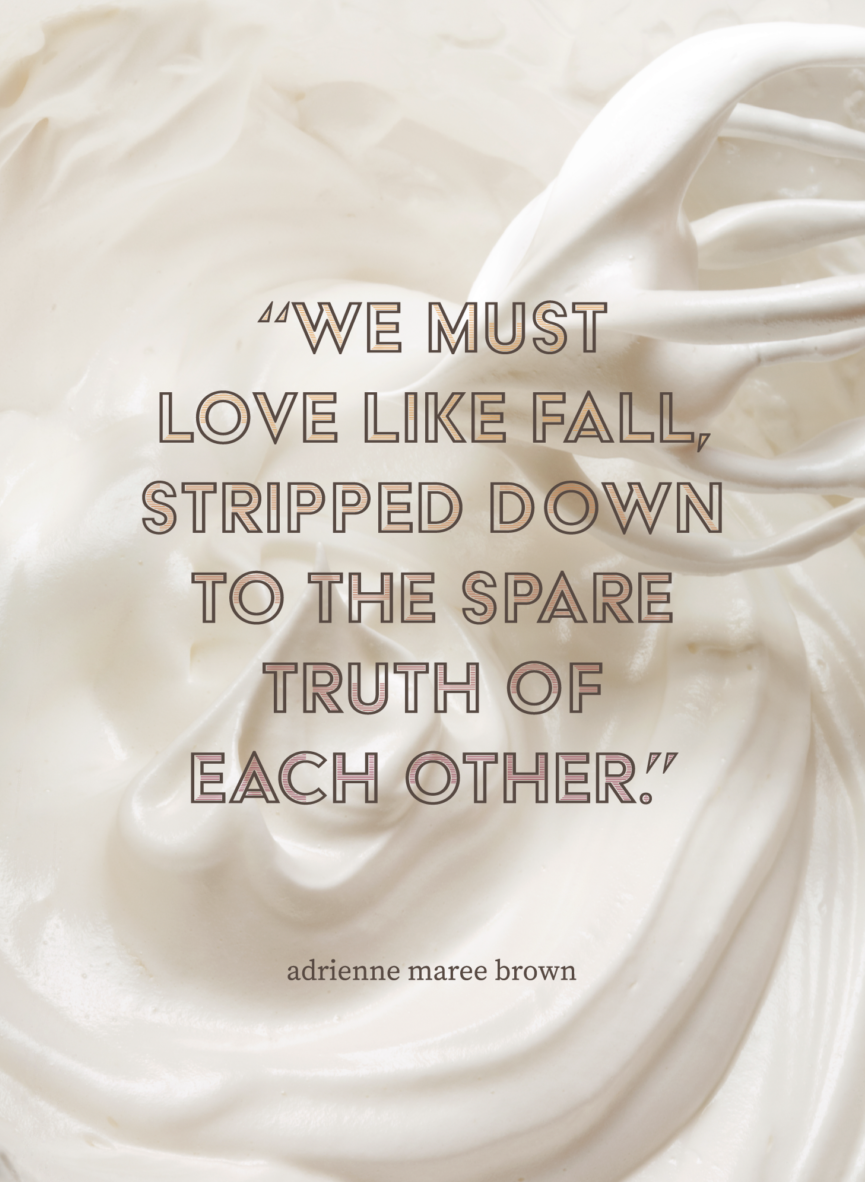
It feels like the season to be still for instance. The season to tap into the wisdom of my predecessors. “We must love ourselves like spring,” author, doula, and Black feminist adrienne maree brown, reminds us. “We must love like fall, stripped down to the spare truth of each other.” It is the season, for me at least, to “feel the great circle of us holding each other.” Channeling the wisdom of Black women’s care work in the kitchen through my own family—in the hopes that I might extend it into an uncertain future—is another, albeit more personal, way of baking against racism.
Curious about my shift of seasonal perspective, I asked other Black women about their own modes of resistance and flourishing—and how these get refracted through their kitchen work. What, I asked, do they bake when they need to feel grounded, resilient, or renewed?
Sylvia Aslaskan, owner of Miss Ella’s Cake Bar, an appointment-only custom bakery, practices her kitchen work as a means of accessing her higher self and building the village she didn’t always have growing up. The joy that baking birthday cakes brings her is evident in each exuberant design. “It’s not about a specific flavor necessarily, it’s about seeing a kid light up,” she says. “When you are never celebrated, you can grow up thinking no one cares. Circumstances shouldn’t define whether we get celebrated or not.” With each and every birthday cake, Aslaskan says, “toxic cycles that were created before you get to be routed in a new direction.”
Baking is sensory and tactile for Carrie Seward, founder of Lush Life Vegan Bakery. When she enters the kitchen, the “click” of the mixer switch flipping on drops her into another state. Her hands, which she considers her energy center, get busy—kneading dough for cinnamon rolls or stirring cake batter. It is through her hands that she is able to “channel unconditional love” into each item she bakes. Seward’s bi-racial background informs her perspective on the way assumptions, perceptions, and ignorance can hinder authentic connection, but she sees cake as common ground: “Everybody loves cake! It’s the great leveler!” she says. “It’s not my job to educate people, but I try to make my cakes for everybody. I have many different kinds of customers from many different backgrounds. They all show up because of the love I put in.”
We don’t have to do this work professionally to understand baking as a space of active resistance and personal renewal. As an educator, writer, health advocate and founding CEO and President of The Foundation for Black Women’s Wellness, Lisa Peyton Caire doesn’t have as much time as she’d like for baking. Still, she notes, “Cooking has been the first love for many of the women in my family,” and the kitchen the heart center of every home. In addition to baked chicken and rice, greens and mac and cheese, Caire remembers sweet potato pie, cherry pie, and her mom’s peach cobbler among her family’s food traditions. When she does take the time to bake her organic, low-sugar version of her mom’s cobbler, Caire, “spirit-surrounded,” is able to re-center and reset. When baking “you are breathing in a different way, you are moving at a slower, more intentional pace, your mind is clear,” she says “And you’ve created something that allows you to transfer healing to your family and acknowledge your roots.”
For me, at least right now, that acknowledgement is taking the form of lemon meringue pie. Apart from maybe the local eggs and butter, this classic has little direct connection to the Wisconsin terroir, but an ice cold slice is the perfect thing to eat on a warm summer evening while social distancing. It’s also a dessert I remember my mother making with joy and natural ease. Young me marveled at how she proceeded with no written recipe, how her slender fingers so deftly worked butter into flour for luxurious flakes, and how her piled-high meringue sometimes toppled (!) but never wept. Now, I marvel at how a woman continually navigating complicated and often inhospitable terrain worked to make a way for us. She leveraged her kitchen work to carve out spaces of care and delight—sometimes even in the midst of difficulty and upheaval. When I re-enter something that feels like a regular timeline and am again baking in sync with what is perfectly ripe, this ability is what I’ll want to bring with me. My mom and the Black women in my community remind me that what you bake against always, essentially, comes down to who you're baking for.
More Stories by This Author

Edible in your mailbox
