

Grazing into the Future
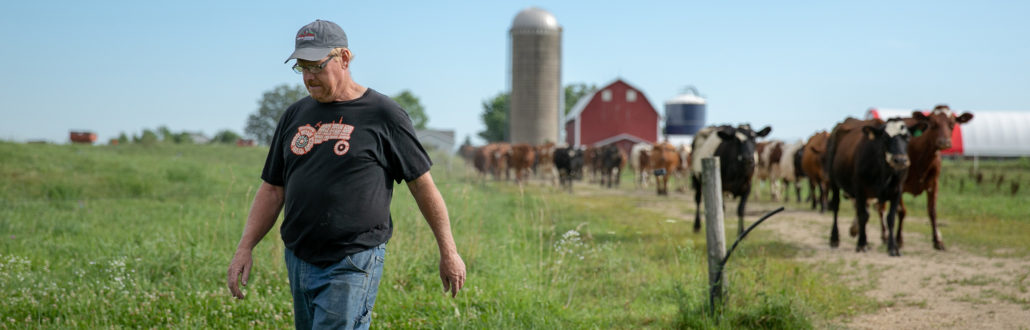
At Paris Family Farm, the cows are three hours into grazing—the sound is soothing as you hear the smack of lips and the crush of fresh grass being evenly munched.
The move from conventional farming to a grazing-based operation happened in 1993—the same year Bert Paris attended a grazing conference in Wisconsin Dells. His wife Trish said he returned to their Belleville farm with “eyes lit on fire” at the prospect of a farming technique that was less time-intensive and more environmentally conscious.
“As a kid, I don’t remember us conventional farming at all,” says daughter Meagan Farrell. “I was four when we started grazing. Growing up I thought, ‘What does my dad even do? Schedule a nap, eat lunch, then take a nap?’ He never missed one of my sporting events.”
If you’ve ever worked on a dairy farm, you know it’s manual labor involving moving grain/hay to feed troughs and around-the-clock milkings. In these set-ups, waste is concentrated—contributing to air and water pollution.
Farrell ran a nonprofit for seven years, but four years into the professional world she felt something was missing. She came back to the farm to reconnect with the land and co-manage the 300-plus acre farm with her dad.
Paris Family Farm is certified organic and working on implementing regenerative agricultural practices. This starts with increasing diversity in pastures. Healthier soil allows plants to grow stronger so there’s less need for weed management and fertilizers. It also allows the plants to absorb more carbon and be more resilient to the effects of climate change like drought and excess moisture. Because soils can store three times more carbon than living plants and animals, the way we manage land is critical in the global carbon cycle. (See author's note.)
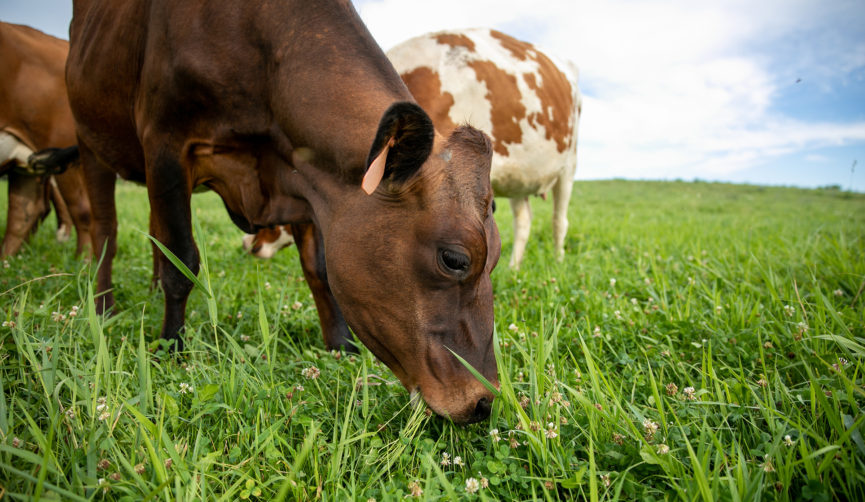
USDA Organic standards require that organic dairy cows spend a minimum of 120 days on pasture and receive at least 30% of their diet from fresh pasture grasses. The Paris’ 75 cows can typically graze from March through December and sometimes even into January. The cows return to the barn twice each day for milking and water. When they’re out in the field, they’re chewing, digesting and then fertilizing the soil. This process sequesters carbon, reducing greenhouse gas emissions typically associated with cattle farming. It also means synthetic fertilizers and herbicides do not need to be added.
“This isn’t your grandpa’s grazing,” says Paris. “They [past farmers] didn’t have fencing so they would do one pasture per year, which would just get beat up over the course of a few months.”
The land is split into 22 paddocks of three acres, then split into one acre sections using flexible poly wire (with an electric charge). Cows eat one paddock for three or four days, deposit manure and then the land rests for 30 days. This is so the animals don’t eat the new plant growth that comes back around day three.
When do cows need a new plot of land to chew? “It’s kind of a gut feeling—it depends on the weather, rain and shade,” says Paris. “That’s what I love about grazing—how much it challenges me professionally. There’s something different to try every day.”
Two major issues facing the dairy industry are overproduction of milk, which suppresses its price, and a loss of infrastructure like suppliers, buyers and repair people. The good news is the grassfed dairy market is growing. Grassland 2.0 is an initiative by the University of Wisconsin–Madison to invest in rural places like Paris Family Farm. The idea is that creating healthy, thriving farms results in better rural communities by decreasing run-off into drinking water and risk of flooding, while improving biodiversity and the local economy. Basically, when these farms succeed, rural communities succeed.
Putting profits over yields is key to the sustainable farming journey. For example, the Paris family was able to get rid of heavy machinery like tractors–drastically decreasing on-farm CO2 emissions but also decreasing fuel, maintenance and equipment costs.
“It’s not about milk production, it’s about profits,” says Paris. “My herd in 1992, each cow produced 20,000 pounds of milk per year. Now the cows make 10,000 pounds of milk per year. Back then, we got 50 cents to a dollar per hundred. Now we get $5 to 10 per hundred.” The farm is producing half the amount of milk, but profits are five to ten times greater when adjusted for inflation due to less machinery costs, lower vet bills, low to no feed cost, among other reasons.
A major barrier for farmers adopting environmentally-friendly practices is a misconception about the amount of time it will take or an unwillingness to change. But if that farming technique actually results in fewer inputs, less labor and lower equipment costs, along with increased consumer demand, it’s more likely to be adopted.
“It [grazing] helps you connect the animals to the land to consuming a product,” says Farrell. And isn’t that what we all want? A more relaxed farming lifestyle that’s more in tune with nature, and that benefits the land and people who surround it.
Author's Note: Livestock is responsible for 14.5 percent of human-caused emissions globally, according to the United Nation’s Food and Agriculture Organization (FAO).
Carbon sequestration is complicated. While grazing sequesters, or pulls carbon from the environment, it requires up to 2.5 times more land than conventional farming.
More Stories by This Author

Edible in your mailbox
