

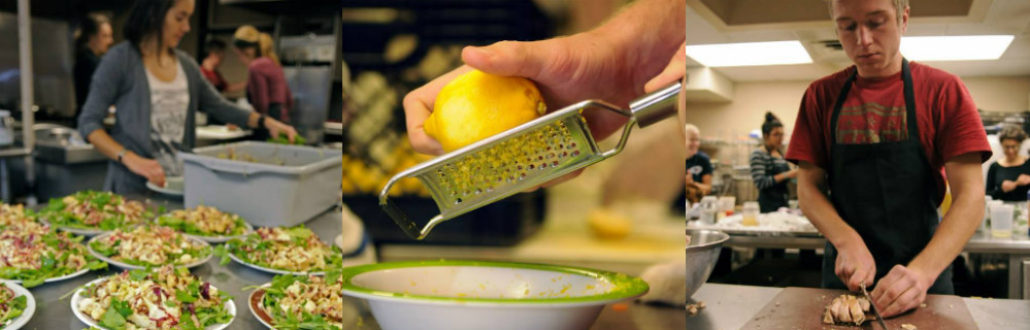
One of the most active university chapters in the country, Slow Food UW is bringing fresh, high-quality food to UW-Madison and more.
The dining room is minimalist hip, a dozen or so large communal tables set with mismatched china plates, coffee mugs and oversized mason jars of water. The food is creative and delicious, locally sourced, and artfully presented. Tonight’s dinner includes citrus ash roasted vegetables planted in dark rye and quinoa (the root vegetables look like they are growing up through the “dirt”), smoked eggplant soup and a brownie topped with homemade honey nut butter and crushed macaron. The three-course dinner, different every week, costs $5, is held every Monday night in Madison, and regularly sells out its 120 seats.
There are a few clues that this is not an average restaurant. There is no alcohol, no napkins, and exactly one hour after dinner begins, people—as if on cue—stand, stack their plates in the center of their table, fold their chairs against the wall, and likely go to study.
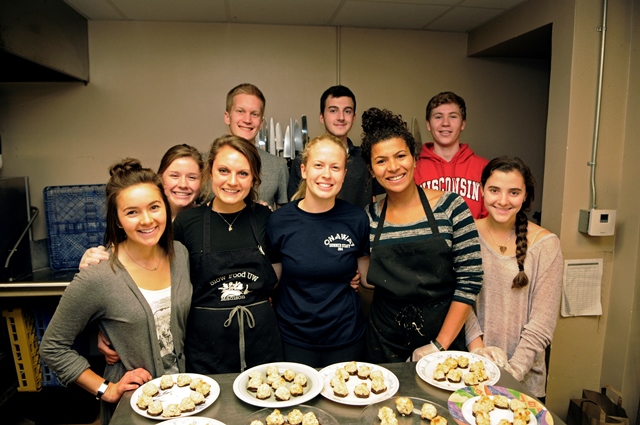
Yes, these are students, cooking, serving and clearing. Whereas many of us remember college food at its best as pizza on a paper plate, these kids are obsessed with gardening, baking, tasting and relishing food, and introducing it all, with great enthusiasm, to others.
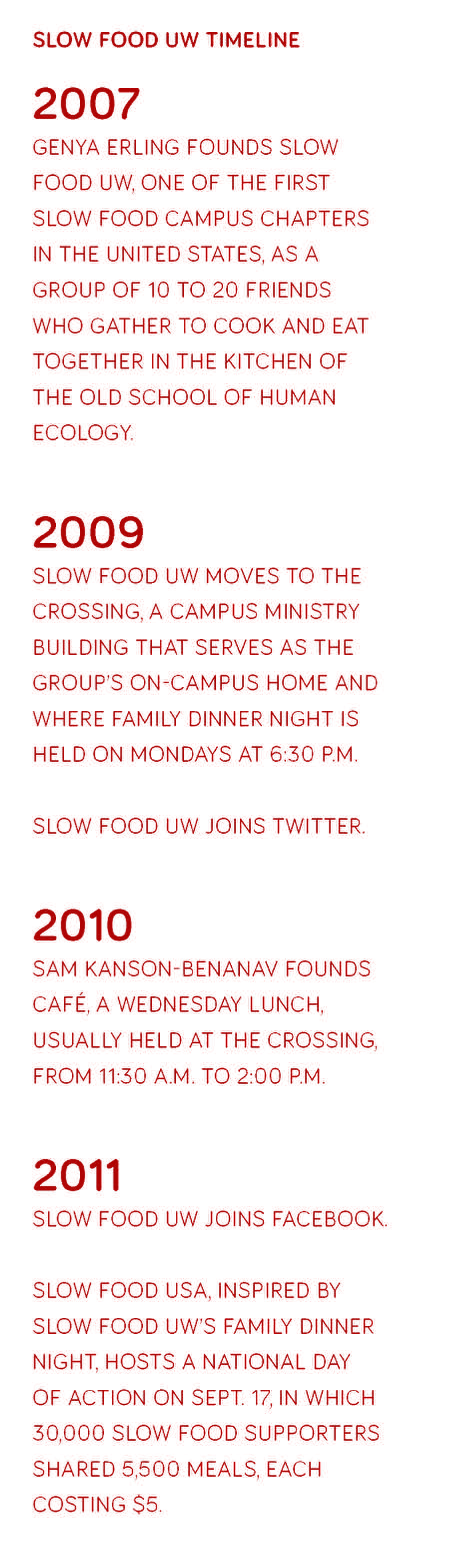
Slow Food UW, founded in 2007 at University of Wisconsin-Madison (UW-Madison) as one of the first campus chapters of the larger Slow Food movement, has fundamentally and vibrantly contributed to Madison’s growth as a food community. The interns, who usually number about 45, inspire their generation to think differently—or even at all—about food. In turn, when they graduate, the Slow Food UW alums take their passion and get-the-job-done mentality to culinary careers in the city and around the country.

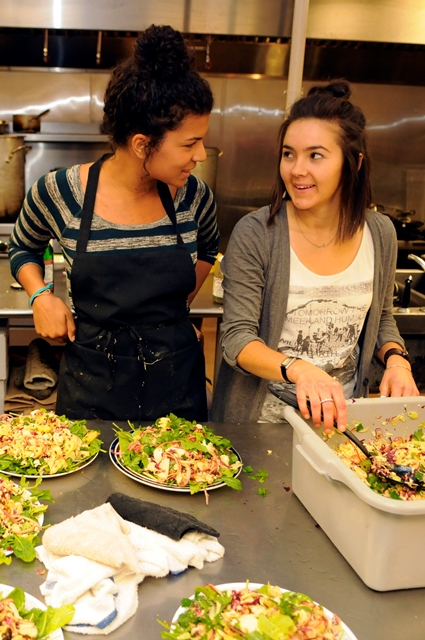
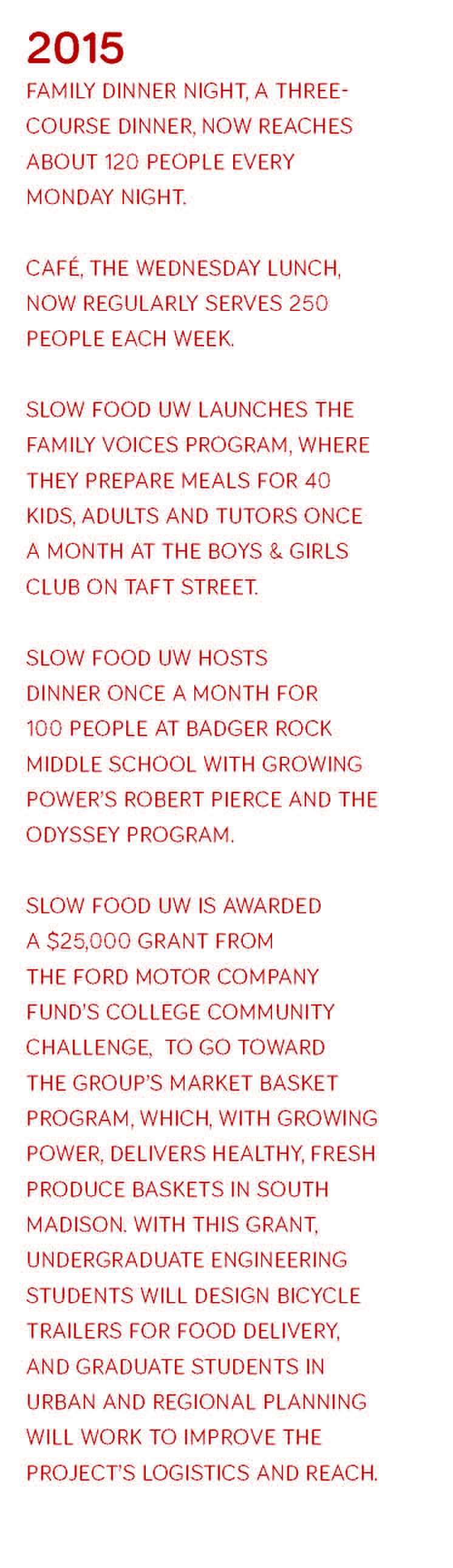
Family Dinner Night, or FDN, the weekly dinner, is prepared in the kitchen of and held in the basement of The Crossing, a campus ministry center. FDN has become Slow Food UW’s signature event, regularly bringing people together over good food and conversation. The crowd is mostly college students, with some faculty and families. It has, to many students, become a Monday ritual, a way to start the school week with friends and food.
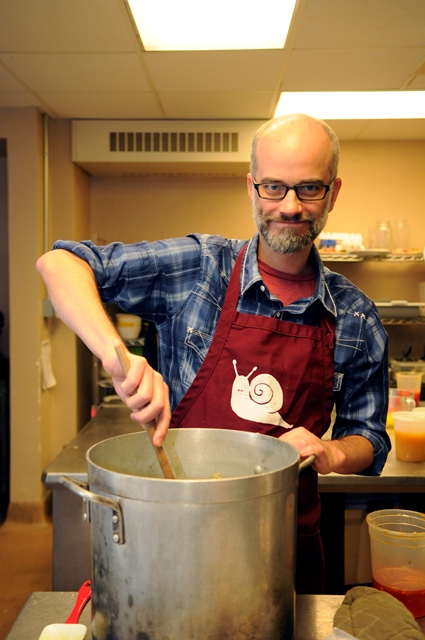
The Monday FDN often features a guest chef, who, in past, has hailed from L’Etoile, Heritage Tavern, A Pig in a Fur Coat and Brasserie V, among other local restaurants. The creator of tonight’s dinner is Andy Jack, who has come full circle from being a Slow Food UW intern, to cooking at restaurants in Madison, to working on his own food product.
One might think, with graduations and semester-based school calendars, that a campus group would be constantly repeating the same highs and lows without moving ahead. But Slow Food UW’s network expands and becomes stronger every time someone leaves the nest. Some interns come back as guest chefs, others join the Slow Food UW board of directors, and others just drop by for dinner, bringing some continuity to the transitional nature of the group. The group’s website was created by Slow Food UW alums who now live in Brazil. The organizational structure and dedication ensures the group will not only continue on but also grow outward after its current leaders move on.
“I think this is the most impressive Slow Food chapter in the country,” says Jonny Hunter, who runs the Underground Food Collective and Forequarter restaurant in Madison, and who, as a UW-Madison student, held pop-up lunches on campus at the Catacombs, very much like what Slow Food UW is doing. He is proud of their autonomy and creativity and says while he may be brought in to be the “expert,” he learns at least as much from the students. “It feels like what anarchists want to happen,” he says of the interns’ natural, revolutionary style. Hunter says he tries to hire a few of them each year to stay connected to the group and its self-motivated students, and he guest-chefs at least once a year.
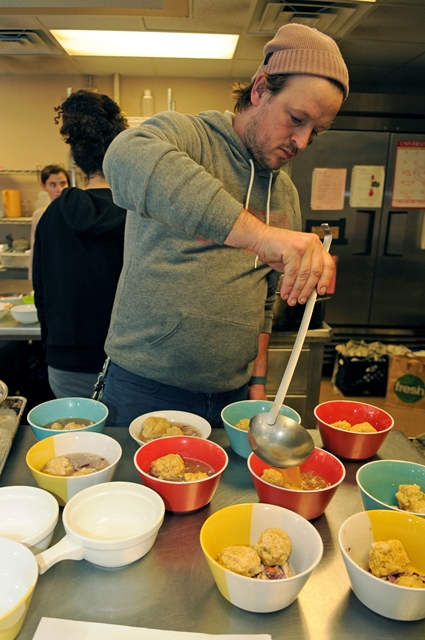
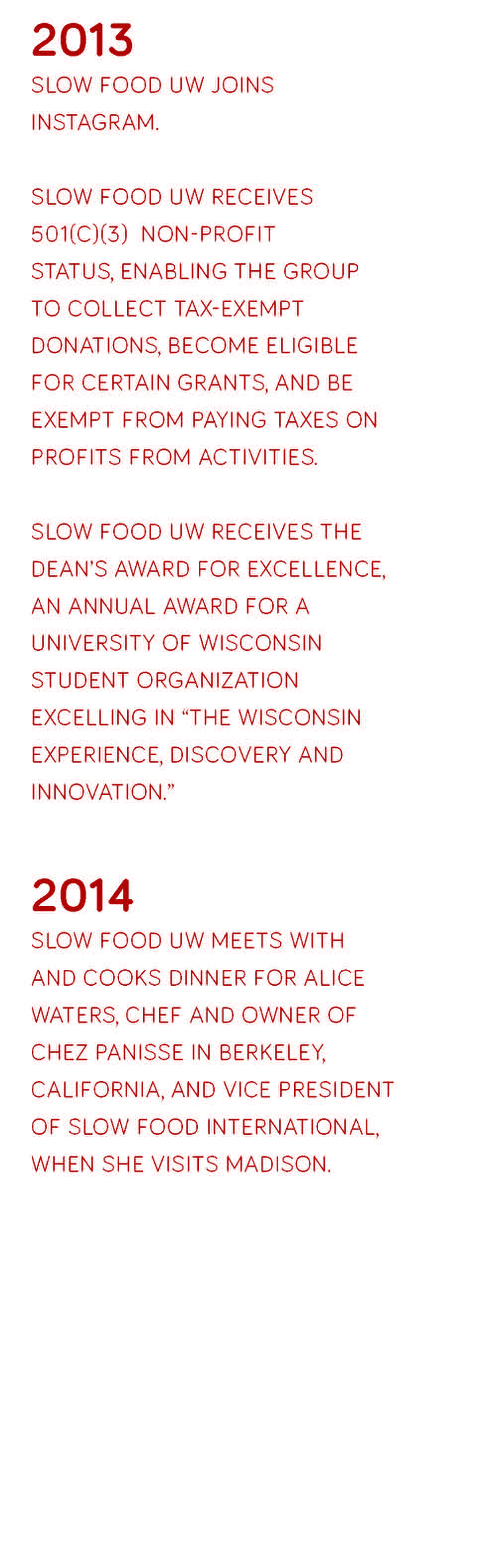
Two years ago, Hunter was at a dinner that the Slow Food UW group cooked for Alice Waters, the legendary chef and owner of Chez Panisse in Berkeley, California, and vice president of Slow Food International. He said Waters transformed from being exhausted from travel and the heavy food people were serving her to inspired by the students. The dinner for about 30 included house-made goat cheese ravioli with a brown butter, mushroom and spinach sauce and a shaved carrot salad with micro-greens, feta, butternuts and ginger-lemon dressing. “It was a pretty magical meal,” Hunter says. “I think she wanted to take some of the kids home with her.”
The Slow Food UW group is one of many regional chapters around the country and around the world, stemming from the 1989 launch of Slow Food International in Italy by Carlo Petrini as an antidote to the growing “fast food” culture. There are currently more than 100,000 members of Slow Food in 150 countries around the world. While Slow Food supports many distinctive projects, such as development of school gardens and the Ark of Taste food catalog, it is still, at heart, a grassroots movement where local chapters develop their own personalities and goals. The Slow Food philosophy is at once simple and enormously ambitious: “The food we eat should taste good; it should be produced in a clean way that does not harm the environment, animal welfare or human health; and its producers should receive fair compensation for their work.”
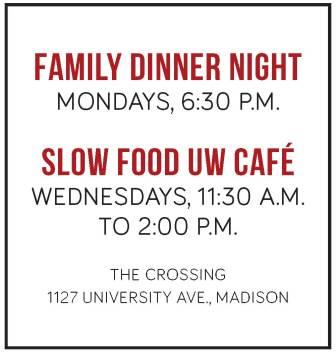
At what could feel like a large and difficult-tonavigate university, the Slow Food UW interns feel like they have found “their people” in the group. Annaleigh Wetzel, a journalism and mass communications major, said she saw a sign for the Slow Food UW Café lunch (held every Wednesday), came to try it by herself and volunteered immediately. The Café lunches are usually also held at The Crossing, although a recent lunch serving 250 people in one hour was held at the Allen Centennial Gardens, where the meal featured food grown in that garden and each dish only cost between $5 and $8. “We pride ourselves on making it affordable,” says Wetzel, now the Slow Food UW communications director.
Bradley Meilinger, who specializes in bread, says he really doesn’t cook much for himself on his own, but he loves to cook and bake for others. Meilinger is in charge of the Slow Food UW Café lunch. He plans the menu on Monday and Tuesday and then buys his ingredients from local farmers markets, cheese and meat producers, and the Willy St. Co-op. On school breaks, he has interned for Tartine Bakery in San Francisco. From Slow Food UW, he says, he has learned how to get things done. “This internship changes people,” says Meilinger, who is majoring in environmental science with a focus on horticulture.
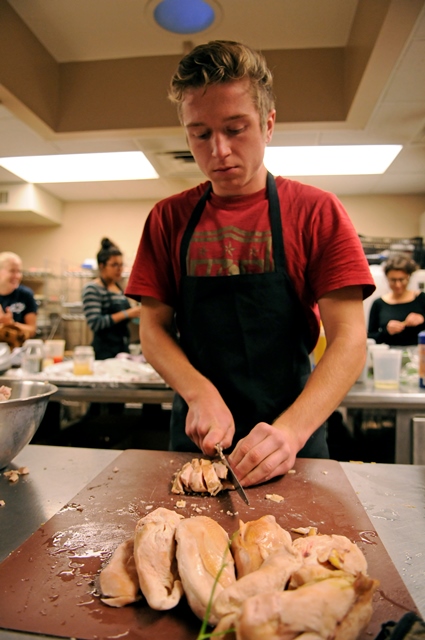
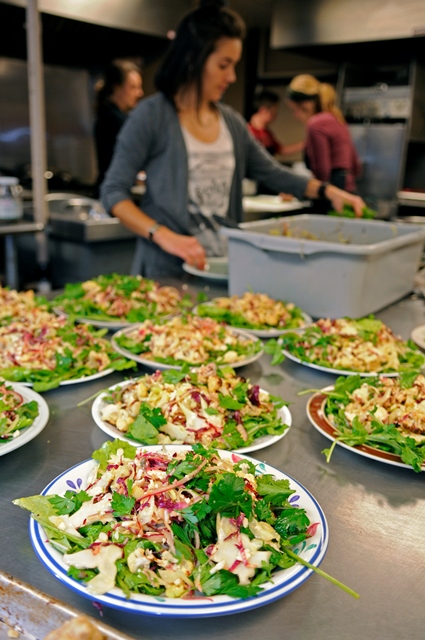
Most of the Slow Food UW interns make food a part of their post-graduation careers, says Mariana Debernardini, the current co-executive director of Slow Food UW. While at Slow Food UW, they quickly become close friends while cooking and working together. “There is a sense of training each other, looking toward our future,” says Debernardini, a horticulture and environmental studies major. The other co-executive director, Maia Persche, is majoring in wildlife ecology.
On campus, the group is best known for the community-building Family Dinner Nights on Mondays and the Slow Food UW Café lunches on Wednesdays. There is also “The Dormant Chef,” where interns teach other students how to cook real food in a dorm room—quite a challenge which involves much microwaving.
Where Slow Food UW is growing most now is its ongoing outreach projects that tackle issues of food inequality and social justice. In one project, Slow Food UW has identified areas in South Madison that are food “deserts,” where access to high-quality, fresh food is difficult. Slow Food UW, in conjunction with urban agriculture group Growing Power, created the Market Basket program for this area, in which weekly fresh, healthy baskets of fruits and vegetables are delivered to residents.
Family Voices is a program where Slow Food UW interns prepare a meal once a month with 40 kids, adults and tutors at the Boys & Girls Club and then sit down to eat together. While the interns are teaching life skills like chopping and how to use an oven, they are also giving lessons on the importance of slowing down to gather and enjoy a meal together.
There is another, completely separate, Slow Food Madison chapter, founded in 1999 by Leah Caplan and Tami Lax. The two chapters are supportive of each other but don’t often work together. Matt Feifarek, executive director of Slow Food Madison and a 1994 alum of UW-Madison, says he’s a bit sad the two aren’t more connected, but he also appreciates how they don’t want him, “a middle-aged white man,” coming in to tell them how to do what they are already doing so well. “They have their thing,” Feiferek says. “They’re student-powered.”
Richard McCarthy, executive director of Slow Food USA, based in New York City, says the characteristics of campus and other Slow Food chapters are completely different from each other. “It’s Instagram versus the Rotary Club,” he says. “There’s a huge chasm.” Like Feiferek, he’d like to see more bridges built between the two, but in the meantime, he says it’s ok to embrace the two kinds of “slow-foodiness.” McCarthy’s own daughter recently started school at UW-Madison, and although he says he doesn’t want to be the parent pushing his work on her life, she has already naturally found the Slow Food UW group and the Monday dinners. This type of same-time, same-place event that Slow Food UW has created, McCarthy says, is key to maintaining the community even as students graduate and move away. “[Slow Food UW] is one of the success stories out there,” McCarthy says. “Their dinners are simple, logical and doable.”
Slow Food USA is doing research to find out more about how campus chapters work and understand them better. There are now about 30 known campus chapters, according to Ann Cromley at Slow Food USA. She says Slow Food UW is definitely one of the most active student chapters, along with the San Francisco Bay area chapters, Clemson in South Carolina, University of Vermont, University of New Hampshire, and the New Orleans area chapters. All campus chapters are part of the international Slow Food Youth Network. Tracking these chapters and figuring out their history and leadership is challenging because of the constantly changing nature.
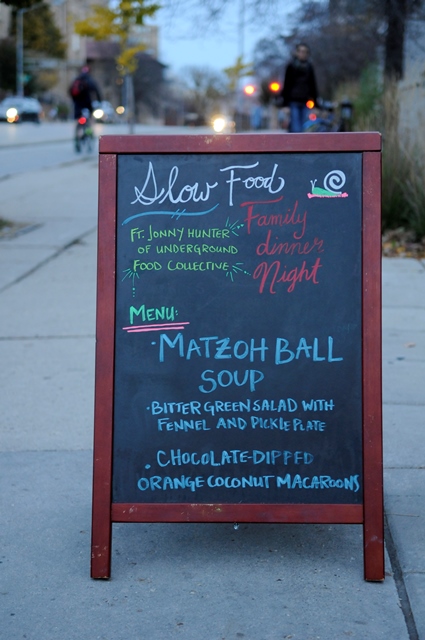
Back at the Monday Family Dinner Night, the tables are washed, the leftovers are packaged for Porchlight, the nearby organization helping the homeless, and the colorful menu board with the signature Slow Food snail logo is whisked away. The professional chefs and the interns have inspired each other in their own ways. For the students, this moment was a welcome slowing down of their regular chaotic college life, a chance to connect with friends and, of course, eat good food.
More Stories by This Author

Edible in your mailbox
