

What is a protein? What is fructose? How do you hold a chef’s knife? What is RoundUp? Where does hamburger come from? What is a beet? Why not eat at McDonald’s? What do farmers do? What is food?
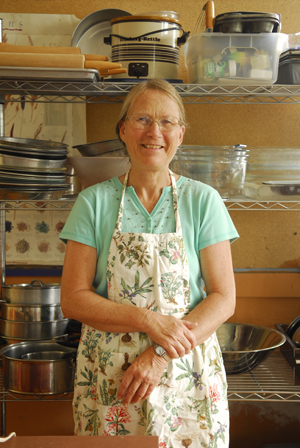
For someone who cares about food, where it comes from and how it affects us, to be a thinking adult is to know the answers to questions like these. Students of Jane Siemon learn the answers to these and thousands of other questions as they learn to cook.
Jane’s class has always been a student favorite, with its irresistible combination of big ideas, practical skills and delicious food almost every day. Now this unique combination of cooking and nutrition is available to high schools, homeschoolers and other groups who want an education in food. Jane and the staff at the Youth Initiative High School in Viroqua (YIHS) have created a food-focused curriculum called The Whole Plate: A Return to Real Food. The four-unit curriculum (plus two bonus mini-units called “Second Helpings”) of practical advice and scientific facts offers other schools this unique and powerful opportunity to educate students in how to cook—and eat— for the rest of their lives.
For most of urban America, food comes in a package that you buy at the store, but it has no obvious relationship to a particular farm or method of farming. Farming, in fact, is an abstract notion for the majority of Americans under 40, who live in the city and are at least one generation removed from the farm.
A class subtitled “A Return to Real Food” must, by definition, offer a critique of the mainstream food system and the dislocation of a people from their means of sustenance. In teaching students what real food is, the teacher must try to present what is lacking in the modern alternative— industrial creations that keep for months and can be eaten while driving. It is in the word “return” that the hopefulness and humble genius in this curriculum is revealed. For millennia, humans knew how to feed themselves; or, more precisely, each family knew how to feed itself with simple and basic ingredients. Jane’s lessons and recipes are an attempt to bring us back to self-sufficiency.
Recently, I spent a day with Jane’s summer teacher training class of college students and fellow teachers. Watching Jane cook with her class is a model of how to lead by example. Without raising her voice, she demonstrates to the whole group how to brown chicken, then gets a few volunteers to take over the job as she quietly moves to the next station and shows the rest how to roll out pizza dough. Quickly the room is humming with activity as Jane gets ingredients together to start on raspberry tarts.
Jane has been an important contributor to the organic farming movement for most of her adult life. The Siemons were one of the founding families of Organic Valley, now one of the largest marketers of organic food in the United States. In addition, she is one of the founding parents of YIHS in Viroqua, where she has taught nutrition since the school’s beginning 14 years ago.
The Whole Plate is one piece of Jane’s life’s work, and it is wonderful: from her motherly yet scientific descriptions of which foods are good for you, to her delicious and simple recipes. If you’ve been to one of Jane’s classes, you see students cooking almost every day. All the research says that people learn most by doing, and in Jane’s class they really do. Following The Whole Plate, a class hears, cooks and eats; the idea and the act and the flavor becoming a full and memorable experience.
The Whole Plate was designed for high school students, but any adult who reads through it will be challenged and enlightened as well. The curriculum covers a wide range of topics from why the processed foods we like so much weaken us—even though they taste good enough and are easy to prepare—to dozens of recipes that are healthy, delicious and affordable like egg rolls, crepes, pot roast and salads.
Beyond the recipes, science and careful insight, the pure optimism exuding from Jane and her work is a wonderful lesson to students everywhere. On every page there is the assumption that we can improve matters for ourselves, today, simply by paying attention to what we eat.
What does the future hold? Will seed companies continue to patent and sell seed for plants that require poison to thrive? Yes. Will major food companies still design food products around shelf life and addictive quality rather than nutrition and taste? Most likely. But if our children (or even us as adults) learn about “the whole plate” in high school, as future farmers and consumers and cooks and eaters they might decide that they want the real thing: food that takes time to prepare and is so good that you try your best to eat it slowly.
Education, agriculture and cooking are such a natural fit for each other. Often, school can be drudgery, an exercise in showing up and acting busy; but when presented on a small scale and with thoughtfulness, education can be beautiful, inspiring and fun, full of love and revelation.
Likewise, farming can be an industrial atrocity or the harmonious union of human, animal and earth. Jane Siemon, her classes and her farm are all visions of something small and beautiful and true.
The Whole Plate: A Return to Real Food curriculum is available for purchase as a full set for $400 or as individual units for $125 each at www.thewholeplate.yihs.net.

Edible in your mailbox
