

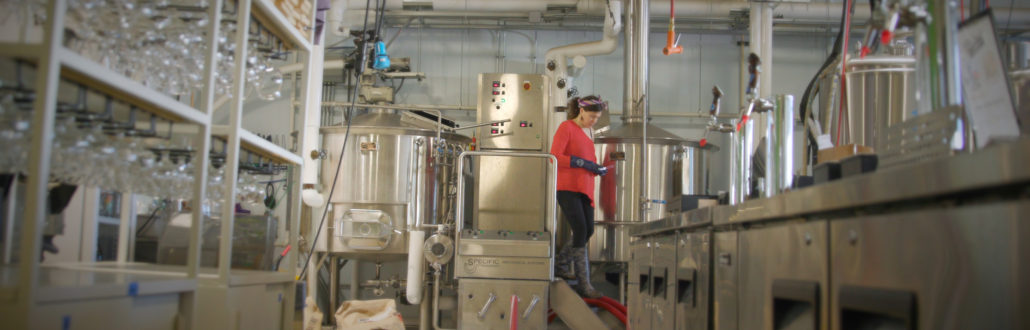
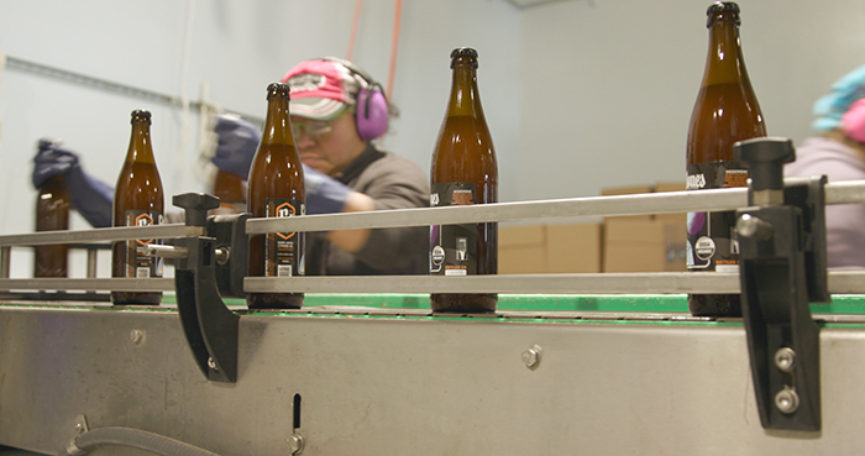
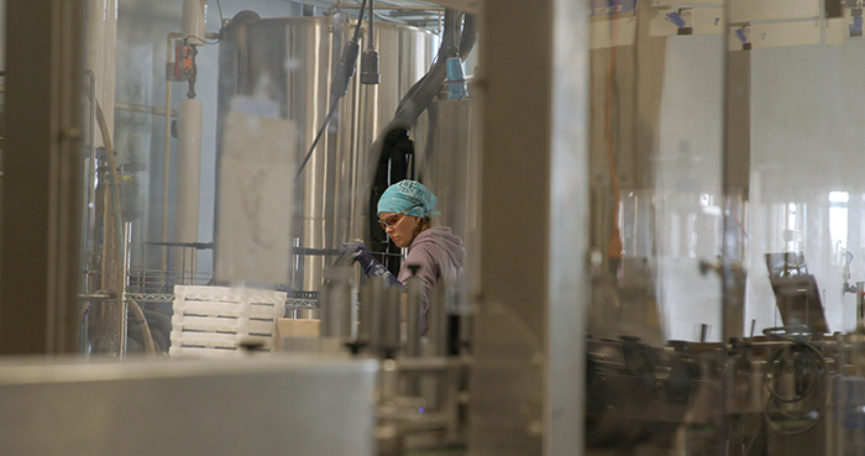
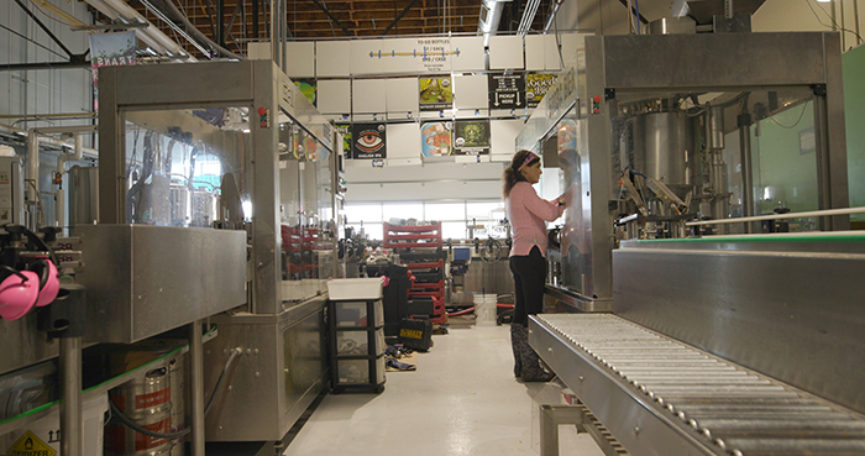
“Beer has no intrinsic value on its own—the last step is to drink it,” says Jessica Jones, brewer and co-owner of Giant Jones Brewing Company. As she walks me through a sampling of their current tap list—pointing out that their Double IPA is built around the same starting recipe as their Tripel—CEO and co-owner Erika Jones inspects returned and washed bottles, and Giant Jones’ Social Butterfly Mari Zoran prepares to open their tasting room. The interview has run long, and their first customers are about to arrive. It should be noted, however, that the first few people who make it through the door are greeted by name.
One of those customers is Wes Gardner, the Mill Manager for Meadowlark Farm & Mill, who helps supply Giant Jones with different grains for brewing, as well as Giant Jones’ neighbor, Origin Breads, with flour. It’s easy to see that Giant Jones is a community effort. During one of their pizza nights with Origin Breads, you might share a table with John and Halee Wepking, the owners of Meadowlark, eating pizza and drinking beer made from their grains and flour. “And the guy who raised the pigs who became the pork for the pepperoni is probably picking up our spent grain for feed,” Jessica says. And while you get the sense that the community would have developed around Giant Jones’ wonderful beers anyway, Jessica and Erika will tell you that what you’re experiencing is also very intentional.
Giant Jones opened their space in Madison on June 15, 2018—a date Jessica rattles off without hesitation. For ten years, Jessica and Erika had been planning on opening a certified organic brewery, making their launch date a truly memorable moment. Their time in California in community-supported agriculture (Erika was also the director of FairShare CSA Coalition) inspired them to commit to organic brewing after seeing small, certified organic farms be able to feed 200 households and still have produce available for the market. “We thought, ‘Oh. We can do that,” says Erika.
Now, Giant Jones is one of only 15 certified organic breweries in the United States, and they’ve spent the last few years reshaping their supply chain to have as many direct relationships with farmers and producers as possible. As of December 2025, Giant Jones sources 65% of their ingredients directly from small farms and malt producers, with the other 35% coming from commodity supply chains.

For Giant Jones, that helps represent a varietal approach to brewing, similar to what you’d see in wine and even in specialty coffee these days. Their beers are inspired by the ingredients they have access to, including reviving some 17th-century historical Belgian styles that use raw grains. For Jessica and Erika, it represented an opportunity to buy more locally produced grains, even though the process now includes three to four extra steps during the brewing process to process the raw grain into something that can be brewed with. But tailoring their beer styles to their ingredient access is nothing new for Giant Jones.
After deciding that their brewery would be certified organic, Jessica and Erika needed to sort out how they would make the financial side of that commitment work. With higher ingredient costs, they figured it would be challenging to market a more expensive six-pack next to other breweries on the shelf. Instead, they decided to focus on stronger beers, typically between 8-11% alcohol by volume, packaged in reusable single bottles. “We get to have an outsized impact as a small brewery on the organic supply chain because we’re using a larger quantity of grain to make stronger beers,” says Erika. They also picked grain-forward beer styles, like barley wine, golden ale, red ale, and Belgian styles, to highlight the organic grains they were sourcing. Now that they work with a hop farmer, as well, they’ve added a West Coast IPA to highlight his work. “We started brewing that one so we could use more of [farmer] Pat’s hops,” says Erika.
Though Giant Jones’ beers are all high ABV, they don’t drink like it. Jessica explained that she wants their beers to be as dry as possible, avoiding the residual sugars that can give stronger beers more body but also make them syrupy and hard to drink. Instead, Jessica focuses on technique to give the beers the mouthful she’s looking for—her extremely technical explanation about suspended proteins and the chemical properties of rye washed over me somewhat, but who could blame me? I was sipping away at some truly delectable beer.
“What I’m going for is maximum nuance,” Jessica explained as I tasted the Double IPA next to their Tripel. As stated earlier, those two beers start with the same basic approach. The difference in the recipe, however, comes down to subtle process tweaks to highlight each style’s flavor profile: the Double IPA is dry-hopped, while the Tripel uses Belgian yeast. The result is a strong, floral, lightly bitter backbone to the Double IPA, while the Tripel tastes fruity and assertive, with a gentle pear quality. Neither beer tastes like it’s almost 10% ABV, and as I sample through their American Barleywine (Jessica’s favorite), the Barrel-Aged Ryewine, the Canadian-Style Spruce Beer, and their Grand Porter, I understand what Jessica means when she says “maximum nuance.” Each beer is distinct, but at the same time, they’re all identifiable as a Giant Jones beer.
Giant Jones is undeniably a passion project, and while Jessica and Erika’s commitment to certified organic brewing is at the forefront of their business, tasting and flavor expression are at its heart. After all, the pair once threw an around-the-world New Year’s party that featured 32 different courses with 28 beverage pairings, representing each time zone as it crossed into the new year. It was the incredible flavor potential of beer that initially drew them into the beer world—after avoiding the standard college trap of cheap 30-racks, Jessica had a transformational American Pale Ale as her first beer at the age of 21. “And so I called my dad and said, ‘Hey, I'm gonna come home. We're gonna make beer,’” she adds, noting that the third beer she ever drank was one she brewed herself with her father, a longtime home brewer himself.
While the community vibes, excellent beers and wonderful hospitality are great reasons to visit Giant Jones’ tasting room, the brewery offers a unique opportunity for anyone picking up their beers at various outlets around Madison and beyond. It’s rare these days that beer gives people a chance to experience terroir, but their supply chain and brewing techniques are explicitly designed to do so. All you have to do is crack the bottle and take a sip. After all, as Jessica pointed out, the last step in making a beer is to drink it.
More Stories by This Author

Edible in your mailbox
