


Fictional Fare
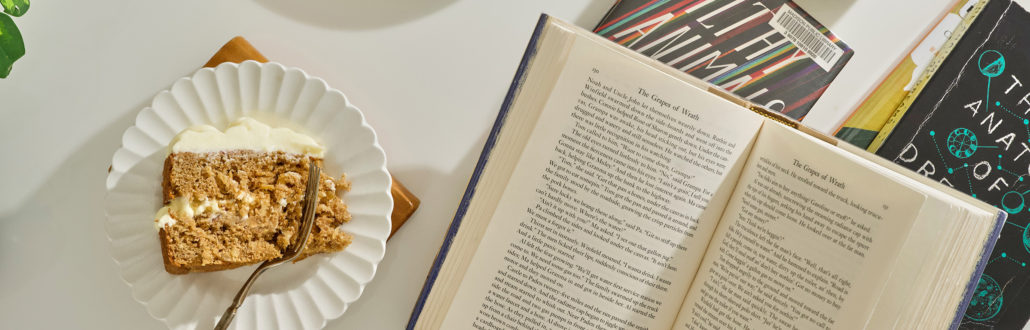
Paging through Madison's food history through fiction
Madison’s food story is often told through the city’s connections to the farmland surrounding it. When L’Etoile opened in 1976, it was one of only a handful of restaurants in the country that celebrated local ingredients as part of the early farm-to-table movement. When Top Chef stopped by in 2023, the show centered the episode on the Dane County Farmers’ Market, celebrating the fact that it’s the largest producers-only farmers' market in the United States. But Madison isn’t just a paradise of local produce. It’s a city of students and retired professionals, brown-bagged lunches and home-baked casseroles, classic Midwest traditions and first-time cooks. But you won’t often see this side of Madison represented in features. Instead, it’s best found in fiction.
It might seem strange to talk about a city’s food history through fiction, but regardless of whether the characters are real, the food traditions represented often are. Fiction—at least the type set in a specific city—is often one of the best snapshots of people’s everyday eating habits from a specific time and place. Food articles in newspapers and magazines are typically focused on something newsworthy, but there’s nothing newsworthy about two women sharing a cup of tea and cinnamon toast in a basement apartment in 1937. But that’s how we meet Charity Lang, one of the main characters in Wallace Stegner’s Crossing To Safety, published in 1987.
A semi-autobiographical novel, Crossing To Safety’s narrator, Larry Morgan, moves to Madison with his wife, Sally, to teach creative writing at the University of Wisconsin. The novel is mostly concerned with the relationship Larry and Sally build with fellow instructor Sid Lang and his wife Charity over a period of 40 years but anchored in the first half are depictions of life in Madison during the Great Depression—including bits and bobs about what people ate. The Langs come from family money and when they host a party it’s resplendent with “Chicken Kiev, saltimbocca, escallope de veau,” which is far afield from the baked potato that Morgan references as their usual fare. When he describes the cost of groceries against his adjunct salary, he mentions the exorbitant cost of milk, eggs and hamburger—familiar to everyone who lived through rising grocery prices in the last two years. Compared to perhaps our most famous Great Depression novel, The Grapes of Wrath, Larry and Sally get by just fine on his meager teaching salary until he sells a short story to The Atlantic, in which he immediately runs out to buy his favorite party food—“rye bread, mouse cheese, potato chips, and salted peanuts.” When they hire a nanny to help out with their newborn, she makes them “some sort of goulash” and “hot tea with jam in it, Russian style.”

The food we see in Crossing To Safety isn’t really tied to Wisconsin outside of “somebody’s idea of a salad (something embalmed in Jell-O)” that’s brought to a celebratory potluck, but it does show how the early days of industrialized food dominated the country’s diet in a period where most everyone was strapped for cash. Morgan picks up an individually packaged can of coffee while he’s out buying booze for a party—something that was only around 10 years old at the time—but there’s scant mention of a single vegetable in the whole book.
The Anatomy of Dreams, by Chloe Benjamin, follows a similar storyline. After becoming research assistants for their teacher’s lucid dreaming therapy at a boarding school, Sylvie and Gabe follow Dr. Keller to Madison to work for him full-time. While the focus of the novel is a meditation on the ethics of intervention and control in people’s lives, the story, told from Sylvie’s perspective, also documents what it’s like to be young and striking out on your own for the first time. Set in 2004, The Anatomy of Dreams captures the feeling of learning how to cook in the era just before the Internet and cooking shows helped elevate people’s understanding of food. When Sylvie and Gabe invite neighbors Thom and Janna over for dinner, Sylvie has a desire to play hostess but lacks the acumen of an accomplished home cook. She finds a recipe for skewered chicken but lets it dry out too long in the oven when trying to keep it warm, serving a lackluster meal to their guests. Even though Janna praised the dish, “she hadn’t eaten much of it. Now she picked the chunks off the skewer with her fingers and grouped them on the side of the plate.”
Serving your neighbors a poorly cooked meal isn’t unique to Madison, but it represents a demographic often overlooked when the city is portrayed in media. Outside of being a haven for professors and a playground for students, Madison is also a city where young couples get their first start. The food in The Anatomy of Dreams isn’t flashy—Thom makes Sylvie a chicken salad sandwich, Sylvie and Gabe bring bagged lunch to work—and it’s remarkable how similar food in Madison was portrayed in 1937 as it was in 2004. In both Crossing to Safety and The Anatomy of Dreams, food represents a transition to adulthood—making do with what you can on a budget and shifting into your perceived roles as a grown-up. Or as Sylvie puts it, “As we crossed the lawn to Thomas and Janna’s house—a bottle of wine in Gabe’s hand, the sweet potato dish in mine—we could have been any young couple.”
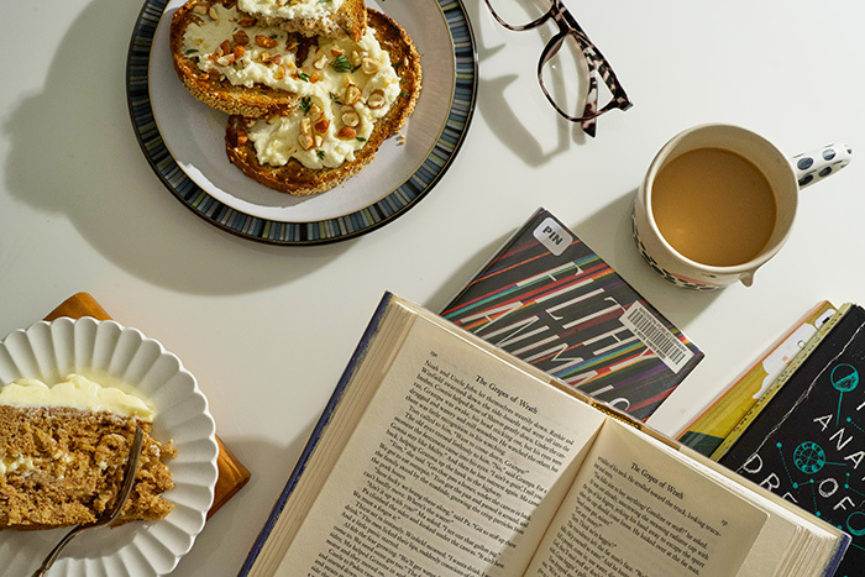
Brandon Taylor’s Filthy Animals takes a different approach to showcasing Madison food. Published in 2021 and set in contemporary times, Filthy Animals collects stories of students and young adults in Madison grappling with turning points in their lives. The world of Filthy Animals skews younger than the other two books mentioned in this piece, but its characters also deal with a harsher, post-2008 financial collapse reality. Instead of dinner parties between two young couples, the book opens with Lionel, a graduate student who
recently recovered from a suicide attempt, attending a potluck. But there’s another shift: Taylor’s characters, struggling as they may be, eat a broader variety of foods prepared more confidently. At the potluck, Lionel stacks his plate with “baked asparagus, brown rice, kale salad” and picks at oxidizing chunks of avocado—all buzzy foods that enjoyed a popularity boost in health-conscious cities like Madison in the mid-2010s.
In another story, Sylvia, a young woman who splits her time as a nanny for one family and a cook for another, makes fries from scratch for the kids she’s watching. As she struggles to keep the kids clean and safe, she daydreams about making a soup for the other couple: “Lots of shredded chicken breast, a stock from the bones and marrow, a thick cream base, some herbs.” And then there’s Marta and Sigrid, a new couple who make latkes and borscht and had “grown vegetables in a little plot behind the house and pickled them.” On their first date at a high-end Italian restaurant, they eat “twenty-dollar orecchiette” and “a fifteen-dollar Bolognese,” even though both women live on meager salaries.
This shift towards a more food-conscious life, even on a strapped budget, showcases the overall priority shift for younger generations in Madison. While the leads in Crossing to Safety and Anatomy of Dreams are primarily concerned with succeeding in their field and living on a tight budget, the characters of Filthy Animals are looking for whatever affordable pleasures they can find—with food being a key small luxury. There is one common theme throughout all three books, however. In nearly 100 years of fictional portrayals of Madison, the city is defined by transplants starting anew, bringing whatever culinary traditions they have with them and adapting as best they can to their new surroundings. It may not be the version of Madison we see in food media, but even in fiction, it’s easy to see the truth in those similarities.
More Stories by This Author

Edible in your mailbox
