
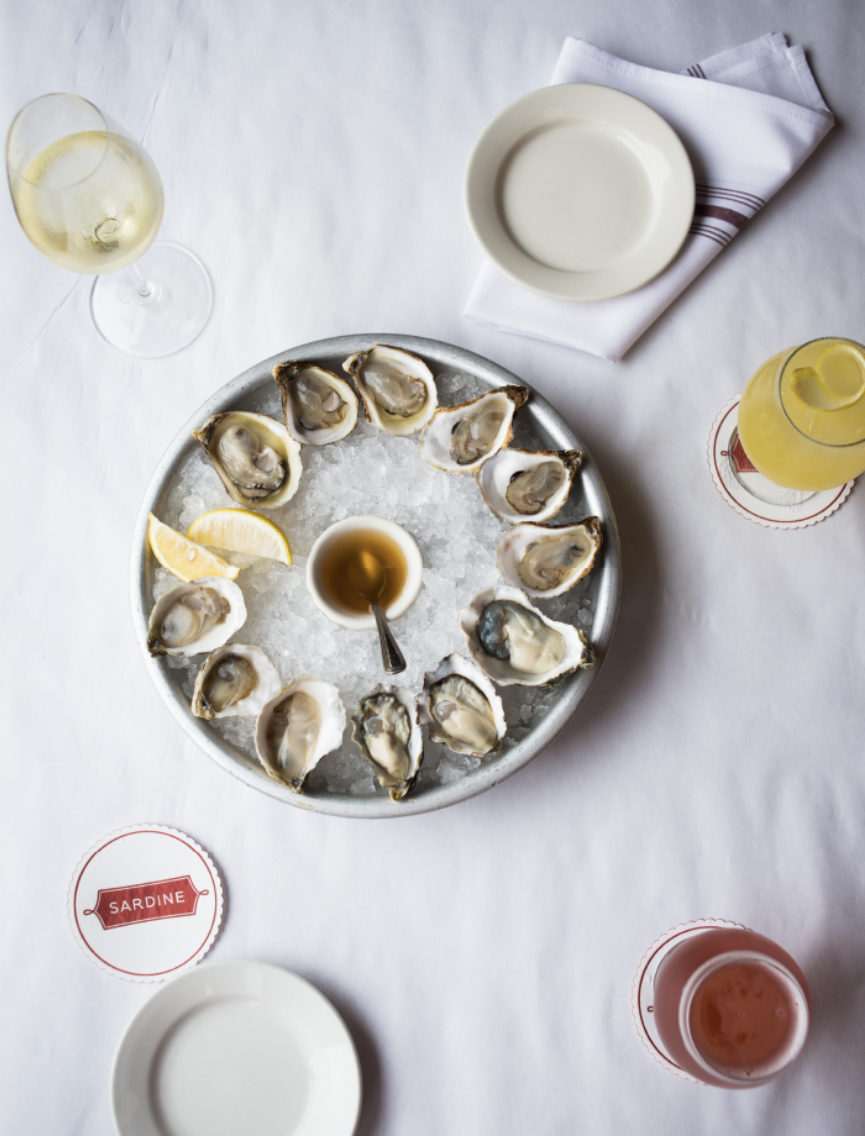
Fast forward a few years and I’m at a client dinner in Philadelphia when someone ordered a dozen for the table. I demurred and said I would pass. But then the server placed a circular platter filled with ice and these alien creatures from the sea in the middle of the table and proceeded to explain each with the grace and knowledge of a sommelier. Wait, oysters aren’t just slimy boogers? My curiosity was piqued; I had to try them.
This experience is what Phillip Hurley and John Gadau, co-owners of Sardine in Madison, were shooting for when they opened the French-inspired bistro in 2006. They saw an oyster-sized gap in the Madison restaurant scene and decided they needed to fill it with their knowledge and love of this diverse shellfish. Now, Hurley says they go through hundreds of oysters a day, placing orders every day except Sunday to rotate through two varieties of East Coast oysters and two varieties from the West Coast.
But Hurley understands the trepidation for a beginner (or someone who is scarred by bad choices in Lansing bars).
“For first-timers, oysters are unfamiliar, the texture [can] be daunting, I get it. But it’s a celebration. It’s a process. There’s something beautiful about sitting down and starting a meal off with something that has a story.”
He explains that just like wine regions, the ocean has a terroir, called a merroir, that defines an oyster: what they feed on, the landscape where they are cultivated, the temperature, minerality and salinity of the water. All of these influence the flavor, size, texture, even the shells. Knowing these differences can be a portal to accepting oysters into your life.
Gateway Oysters
Hurley suggests starting with an oyster that has smaller meat, or belly, to get used to the texture and flavor. Generally, East Coast oysters from Chesapeake Bay all the way north to Nova Scotia and New Brunswick will be firmer with a briny flavor. Names like Wellfleet, Malpecque and Raspberry Point are popular at restaurants like Sardine.
“Pink Moons from Prince Edward Island are smaller in size and have a nice salinity, so they’re sort of briny. They’re a great starter oyster,” says Hurley.
On the West Coast, in regions like Puget Sound, British Columbia and the Bay Area of California, the oysters are smaller with fluted shells. While an East Coast oyster, espeically those from the North, can take up to four years to mature due to the colder water in the northern Atlantic, most Pacific oysters grow to maturity in under three years. That means less time for the salty flavor to embed in the meat, leaving the West Coast oysters more delicate and creamier with notes of melon and cucumber. The small meat and deep cup also make them easier for newbies to slurp.
“The most popular West Coast oyster is a Kumamoto, which has a deeper shell than other West Coast with smaller meat inside, but texturally is very creamy,” says Hurley. “So if you’re newer to oysters or hesitant on the texture, Kumamotos might be a little creamier than you’re ready to jump in to.”
Other common West Coast oysters include Miyagi, Kusshi and Baynes Sound, all characterized with a creamy texture, and melony, yet salty bite.
Taking the Leap
So do you chew them? Kind of, says Hurley. At Sardine, the presentation is classically French. The plate of oysters is served with a mignonette (pronounced min-yun-net), which is simply champagne vinegar, finely minced shallots and a twist of black pepper.
“The idea is that the mixture of the mignonette and the liquor [the liquid inside the shell] creates a simple addition so the flavor of the oyster shines,” says Hurley. “Just slurp it all into your mouth, push it around, and agitate it a bit to release all of those flavors. I don’t necessarily chew them, but I gently crush the meat with my teeth before swallowing.”
Prefer to just take it down the hatch? Go for it, says Hurley, but suggests that keeping the oyster in your mouth longer allows you to experience more of the flavor notes, similar to tasting wine.
The Boisterous Oyster
Not all oyster presentations are so refined, but that doesn’t mean the oyster lover is less refined. When it comes to accompaniments for the oysters, the mignonette is the standard prep at Sardine, but the staff is often asked for other common toppings like cocktail sauce or horseradish. These will all add different flavors but might cover up the complexity of the oyster itself.
Warm water oysters from the Gulf of Mexico, Florida and the Carolinas tend to be larger and less delicate. You can find these at Hurley and Gadau’s other Madison establishment, Gates & Brovi. Hurley says spicy horseradish or tangy cocktail sauce stand up to the richer, meatier flavor of these Southern versions.
“It’s just a different experience. Sit at a big table with friends and slurp down some oysters. It makes you feel like you’re sitting on a beach somewhere down South,” he says.
Oysters at Home
Finding an oyster with a strong shell is step one for those new to prepping them at home, suggests Jim Berke, owner of Berke & Benham Seafood in Madison.
“I recommend Chesapeake Bay varieties because they have stout shells, easy for shucking, but the meat can get large so they might not be great for eating raw for a beginner,” he says. “West Coast shells tend to be more brittle and harder to shuck, and they don’t tend to have the longevity as the East Coast.”
Scared to shuck? Ask your fishmonger for a quick demonstration, or Berke suggests streaming one of the hundreds of YouTube videos available online while you shuck the first time.
He also notes that longevity is key when buying oysters to eat at home. His rule is only buy them if you plan to eat them in the next two days, and store them low and in the back of the refrigerator to protect them from temperature changes as the fridge door opens and closes. If your oysters are on day three in the fridge, Rob Kitto, owner of Lake Edge Seafood in Madison, says there are a few telltale signs for knowing if an oyster is still edible.
“If the shells have started to open, it could mean the oyster isn’t viable anymore. When you open it, there should also be plenty of liquid inside and the meat should look nice and juicy. If it’s dried out, definitely avoid it,” he says. “And the smell. If it has a pungent odor that doesn’t smell like salt water, toss it.”
Both shops typically stock one or two varieties of East and West Coast oysters. Berke says he also carries a frozen Gulf oyster on the half shell, which he says is perfect for thawing and throwing a big pad of butter on before grilling.
Whether you’re experimenting with raw or grilled oysters at home, or going for the full celebration experience at a local establishment, Hurley says to embrace your beginner status.
“At a place like Sardine that specializes in oysters, the staff is knowledgeable from the bartenders to the wait staff. It’s not a problem to say, I’m a beginner. That’s totally fun for us,” he says. “Maybe try one, try three. Then figure out what tastes best to you.”
So grab some friends, ask questions and experiment with this weird, delicate and diverse shellfish. Learn their stories and find a few experts. Chances are you’ll be coming back for more.
With a food as delicate and complex as oysters, pairing the right beverage can make the flavors sing. We asked our oyster experts for their recommendations.
Champagne
Bubbles and oysters are a festive match, Hurley says. The fizziness of Champagne contrasts with the soft texture of the meat, and the acidity of the drink brightens the creaminess of some oysters. Hurley recommends sticking to a dry Champagne to keep the flavor of the oyster as the star.
Muscadet
Susan Schueller, general manager and wine director at Sardine, says Muscadet is the classic oyster/beverage pairing. “It comes from the Loire region right on the Atlantic Ocean, so you get that saline and a little bit of lemon-lime. It all just elevates the oysters.”
Cider
“A crisp, tart cider actually goes perfectly with the brinier East Coast oysters,” says Berke, explaining that the tartness contrasts with the acidity and salinity of the sea. He recently discovered a black currant cider from Brix Cider in Mount Horeb that provides a bubbly, dry tartness, perfect for chasing an oyster.
Stout Beer
While a stout beer seems like the direct opposite of Champagne, Hurley says the bitter taste pairs well with briny oysters and likely dates back hundreds of years. He suggests Guiness if you go the stout route for its sharp bite and creamy finish.