

Bees + Humans: A New Era of Interdependence
For our tenth anniversary, we've created a special issue that is both a retrospective and future-focused view of our regional food system. We've selected ten of our favorite and most pertinent past issues. For each, we revisit the issue's theme or feature article, examine how it has evolved since then, and share insights for the future. We hope you enjoy taking a walk down memory lane with us...
Original article: Bees + Humans: A New Era of Interdependence by Wendy Allen, Summer 2011
Then
In 2011, we set out to explore the state of colony collapse disorder (CCD) in our state, but we were hard-pressed to find a beekeeper who had definitely seen a case of CCD or who was worried about it. The scientists we spoke with were concerned, but even their assessments of the causes and severity conflicted somewhat. As we dug deeper and talked to more people, we simply weren’t finding the high numbers of CCD-attributed hive losses that we thought we’d find.
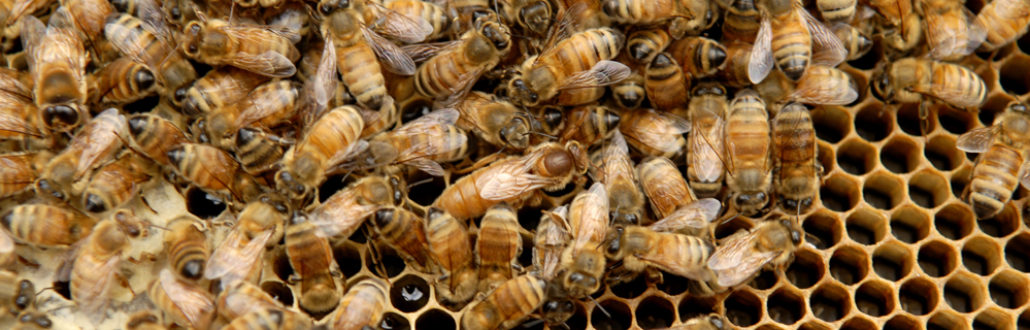
Instead, the story morphed into an examination of the interdependence of humans and pollinators. We depend on each other—bees pollinate our crops, and humans provide habitat and keep the bees safe. “We’ve entered a new era of interdependence,” author Wendy Allen wrote, “as we realize just how much depends on some of the smallest creatures on our planet.”
Now
According to the United Nations Food and Agriculture Organization, “Pollinators affect 35 percent of global agricultural land, supporting the production of 87 of the leading food crops worldwide.” The common honeybee is only one pollinator at risk—the majority of pollinators are wild, including wasps, butterflies, other bugs, and more than 20,000 species of bees. Scott Hoffman Black of the Xerces Society for Invertebrate Conservation says, “Unfortunately, the situation is still dire. Beekeepers are still losing up to 40 percent of their honeybee hives each year, and many native bees are on the brink of extinction.”
The problem goes beyond the single issue that sparked public interest in pollinators a decade ago. Pesticides, climate change, parasites, and habitat loss are each notable on their own, and combined, they can be devastating. Thankfully, interest and action to protect our tiny partners in the global food system remains strong to this day.
Hobby and professional beekeeping are up across our region, especially in urban areas. Bees actually thrive in cities, where flowers bloom early and more consistently throughout the season. Nathan Clarke of Mad Urban Bees writes on madurbanbees.com, “There are a lot of urban beekeepers in Madison, and we are a very pro-bee town. Madison has a very strong local food movement, and the bees help that local food system by providing pollination and great-tasting honey.”
Future
Black says some things give him hope: “The rusty patched bumble bee was the first bumble bee to be protected under the Endangered Species Act. Interestingly, Wisconsin is a stronghold for populations of the rusty patched bumble bee, which provides more options for conservation.”
Public awareness of what individuals can do to support pollinators is high, but we can’t let our guard down. “We need to continue to be vigilant in keeping our honeybee colonies healthy and strong,” says Eugene Woller of Mt. Horeb-based Gentle Breeze Honey.
In fact, Madison is a Bee City, an initiative of the Xerces Society, which means the city creates pollinator habitat on public lands and incorporates pollinator-conscious practices into city plans and policies. This work will continue to support these important creatures long into the future.
“Planting pollinator habitats and eliminating or limiting pesticide use are the two best things you can do for pollinators,” says Black. “In addition, we need people who will advocate to protect and restore parks and natural areas and advocate for their neighborhood association, city or campus to become pollinator-friendly.”
“There is tremendous interdependence between humans and pollinators,” Black continues. “One in three bites of food we eat comes from a pollinator, but on the flip side, if we do not ensure pollinators have high quality habitat that is protected from pesticides, they will not be here to help.”
“It’s art and science combined,” says Woller. “We need to focus on the common value that unites beekeepers. There is a fascination with these marvelous, communal creatures whose pollination services benefit our food supply and, in turn, provide us with a wonderful byproduct of their industriousness: honey!”


More Stories by This Author

Edible in your mailbox
