


One look at the array of American originals handcrafted by Chris Roelli makes it hard to believe that less than 20 years ago, his family’s cheese factory was shuttered and dormant.
One look at the stunning array of cellarcured American Originals handcrafted by fourth generation cheesemaker Chris Roelli makes it hard to believe that less than 20 years ago, his family’s cheese factory was shuttered and dormant.
Located on the corner of State Highways 23 and 11 between Shullsburg and Darlington (fondly known to locals as Hicks Corner), Roelli Cheese Haus has long been known as one of southwest Wisconsin's best retail cheese stores, offering almost every cheese produced in Green County and beyond.
Today, however, the store not only offers quality cheeses from around the area, it once again stocks the coolers with its own creations. Cheeses such as Roelli’s colorful, exterior molded Red Rock—which earned a gold medal at the 2013 U.S. Championship Cheese Contest—sit alongside an Alpine beauty named Little Mountain, a Cheshire-inspired cheese called Gravity Hill, and a bandaged-wrapped cheddar christened Kingsley.

And then there’s the brand new flashing highway road sign proclaiming Roelli Cheese Haus to be the “Home of Dunbarton Blue”—Roelli’s first and perhaps best-known American Original—an open-air, cellar-cured, earthy, cheddared-blue.
Add them all up and what emerges is one of the most successful, celebrated lines of inspired American Original cheeses made in the nation. And it’s coming out of the equivalent of a one room schoolhouse, a small artisan cheese plant and newly constructed state-of-the-art cheese cellar.
“All I ever wanted to be was a cheesemaker, and when I came home from college to find the family factory closed, I felt like I never got my chance,” says Chris. “Well, now I’m getting my chance, and I’m hoping to make it count.”
Retailing for $15 to $25 per pound, the new Roelli American Originals are a far cry from the commodity cheeses Chris and his dad, Dave, made together when he was a kid. Dave, a thirdgeneration and award-winning cheesemaker in his own right, had a successful decades-long run making 40-pound cheddar cheese blocks but got out of the industry in the ‘90s just weeks before Chris graduated from college. At that time, the cheddar block market was no longer profitable, and Dave didn’t want to saddle his son with what he knew would be a future failing business.
"I got tired of working seven days a week only to make pennies on block cheddar," Dave said. "But this artisan cheese, this is fun—working with your hands in the vat, making cheese and even making a little money. This was the right way to go.”
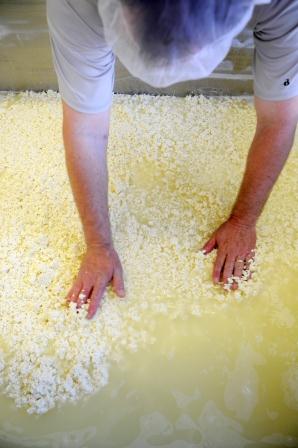
Of course it’s easy to say that now, when Roelli cheese graces some of the most prestigious restaurant tables and cheese shop counters in the nation. Back when the father-son team began renovating the family's mothballed cheese factory in 2007, they started with what they knew best: cheddar. They made fresh cheddar curd four days a week and promptly sold out each day as soon as they made it. That small amount of cash flow allowed Chris to work on his own secret American Original cheeses at night. The result was Dunbarton Blue, one of the first cheddar-blues made in the United States. He crafted it for nearly a year, aging prototypes in a cheesemaker friend’s cave, before showing his veteran cheesemaker father.

“That was my first foray into artisan cheese,” Chris says. “I wasn’t sure what he’d think. But he gave it the thumbs up, and pretty soon I was showing it to a few more cheese industry friends. And then it went viral—was featured in magazines and next thing I knew, cheese shops were calling me. It was wild.”
Roelli hasn’t looked back. With the arrival of more original Roelli creations, including Marigold (a bright-orange, natural-rinded, nutty cheese) and Ziege Zacke Blue (a mixed milk cheese made in partnership with goat dairy LaClare Farms), Roelli soon found himself short on cheese aging space. So after years of planning, he entered the modern age of what the French call “affinage”— or aging cheese—last fall with a state-of the art cheese curing facility.
Built into bedrock with 10-foot concrete walls, Roelli’s aging cellars are 60 feet by 45 feet and 90 percent below grade. The cellar is made up of three distinct curing rooms, each designed for different types of cheese. The temperature naturally hovers around the ideal temperature of 50 degrees, with help from modern radiator pipes. Adding water on the floor controls humidity. A maintenance room contains state-of-the art equipment for controlling the environment, even sending Chris an email three times a day with each aging room's temperature. When the temperature fluctuates too much, it sends him an alarm.
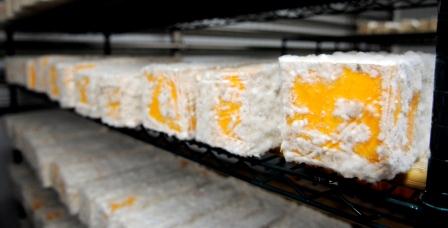
"More than 500 loads of dirt and rock later, we've got ourselves a nice little aging facility," Chris says. The new cellar allows Roelli to make two vats of cheese five days a week, easily doubling his former production. In essence, all the cheese he makes in a year now fits into his new curing rooms.
What was once a standard rural cheese factory making standard cheddar is today one of the nation’s best-known artisan cheese houses. And Chris is just getting started. He’s got more artisan cheeses in mind, and at age 43, he’s young enough to make them all happen.
“We’re going to keep having fun making and aging cheese,” Chris said. “This time, Roelli Cheese is here to stay.”
Featured Recipes


More Stories by This Author

Edible in your mailbox
