

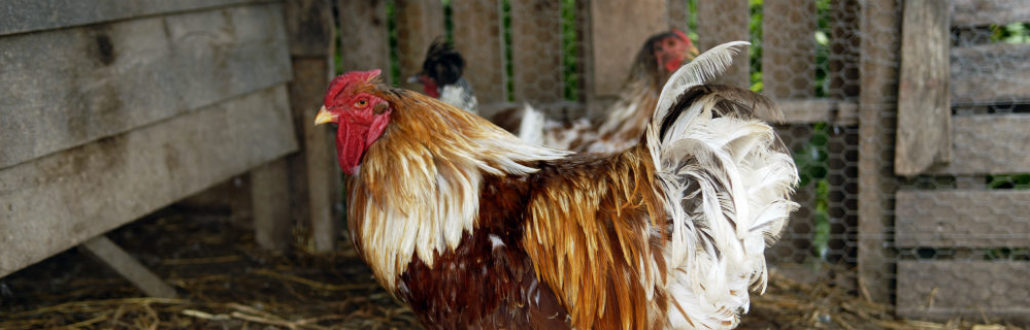
When we fast-forward from bucolic chicken coops to the massive hen houses of today’s egg industry, uncomfortable questions start to pop up.
In answer to the cocktail-hour question that haunts humankind, I go with the chicken. Of course she came first, but mostly because of her egg.
Solid scientific evidence tells us that humans around the world have been eating hen eggs since at least the time of the Druids. Which means Stonehenge soufflé was already on our menu within shouting distance of our Neanderthal days, and chances are, they are the ones who handed down this jackpot of our dietary lottery. It is likely hunter-gatherers of the Fertile Crescent first ate the jungle fowl they could catch while vacationing in Africa, then wrangled the birds for their meat back home. Over time, as farming took hold and the coop technology was perfected, Utog, or Zolfrina, or some other member of the clan started horsing around with the clutches of eggs, which led to eating the eggs, which led to cooking the eggs. Before long, they realized that a chicken, at very low maintenance cost, could produce much more food over time in the form of eggs than could the bird as the main course itself. And because a worthy hen lays an egg every 28 hours, and, poached, it tastes so awfully good with a nice slice of sourdough toast, the rest is history.
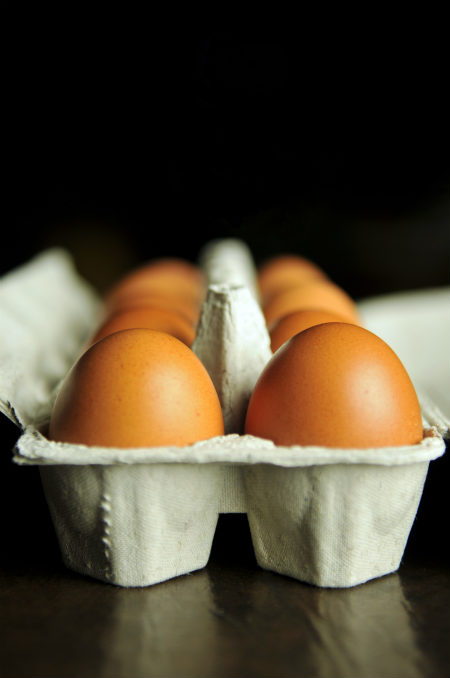
Unlike so many things in life that taste great but are terrible for you, the egg’s great taste is only rivaled by its Olympic-size nutrition. Packed inside every shell, at the bargain-basement price of 75 calories, await seven grams of top-shelf protein, five grams of recently USDA-exonerated fat (1.6 of them oh-so saturated) for noticeably more VROOM! in your daily doings. There’s iron in there, meaningful percentages of potassium, magnesium, calcium, vitamins A, D and B6—all the vital agents of nutrition that make humans the leading mathematicians amongst all mammals. Of course, I could get into the egg’s ample stores of lutein, meso- zeaxanthin and zeaxanthin, which keep your eyes from becoming degenerates, but that would just be embarrassing for all the free radicals that cannot hide from the ridiculously multifarious antioxidant properties of these carotenoids.
You might worry about the egg’s 186 milligrams of cholesterol—about half of the total that government docs say you should reasonably have every day. How much is a milligram anyway? When it comes to blanket statements claiming eggs are “good” or “bad,” I suspect European-style obfuscation that I take with a pinch of salt (which is in there too, by the way). If cholesterol is your egg-show-stopper, you can always separate the white from the yolk, where all that cholesterol resides. But it is much more difficult to separate the chicken from the egg.
Not that we don’t do our best to keep them estranged in our imagination. When we fast-forward from those bucolic, post-Neanderthal chicken coops to the massive hen houses of today’s egg industry, uncomfortable questions start to pop up. Like how much is a dozen eggs really worth? And am I a bad person for eating eggs?

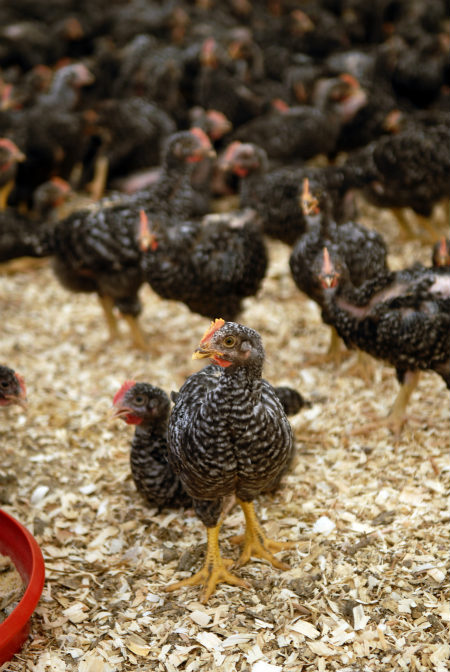
I’ll answer the second question first. No, you are not a bad person because you like to eat eggs. Eggs are awesome (see everything above). But it is so much easier to select from that huge grocery cooler of perfectly packaged eggs if we ignore the circumstances that make them so cheap. If there’s one thing we Americans like a lot, it’s cheap food, so a certain amount of agricultural ignorance is essential to our emotional wellbeing. I will spare you the statistics but ask you only to briefly imagine a big-box store interior filled wall-to-wall with rows of three-high, clucker-packed cages (or, if your imagination prefers cage-free, the entire floor covered with a writhing sea of beaks, feathers, and questioning eyes), and you get the picture of one modern hen house. You can Google the awe-inspiring statistics which allow you, and each of your 328 million American neighbors, to buy eggs at $2.70 per dozen. In our quietest moments, we all know there are losers in this price demand.
What we don’t all know is that a hen requires 3.5 pounds of quality feed for every dozen eggs she lays. If a farmer purchases layer rations at the price available to me, $14 per 40 pounds, it costs $1.23 per dozen to feed the birds. Add to that the cost of housing, electricity, water, chore time and predator ediblemadison.com 27 control, and breaking even at $2.70 is a rare victory for a hobby farmer like me. For professional chicken farmers working on this equation from within the constraints of production agriculture, including markups by one or more middlemen, one pinched penny per bird can make the difference between success or failure.
The thing we do our best to ignore about the big equation is that we have all played a role in converting our nation’s style of making food from agrarian-thinking to factory-thinking because we believe to our core that cheap food is our right as clever, industrious people. Maybe it is.
Even so, chickens are clever themselves. Curious, too. Cat fatalities attributed to that trait are overblown compared with chickens. I’ve kept about three dozen laying hens for almost 20 years— in waves, of course, since hens in my operation live and produce eggs until they age-out at about three or four. Every spring, winter and autumn morning I open their pen’s door and watch them high-step it in cliques to their favorite morning areas. They race for the day’s first dewy bugs. They dig holes in their favorite delousing soil. They do a lot of things we do: squabble, nap, play, run in circles, over-eat, limp, flee the odd threat (stray bad dog or nursing fox, usually) and not always successfully. And did I say that they are, in my experience, far more curious than your average house cat? A chicken, once she comes to trust me, will always approach whenever I’m working on something nearby. She wants to know more, jerking her gaze to see from every angle, asking, mostly, “Is that food, or does it have food on it?” Exploratory pecks follow.
Before long working this hobby, I realized how connected humans are to our hens and how much of that connection we lost when we moved to the cities. Look at all of our axioms and folksy sayings that derive from chickens: when the chickens come home to roost (which they absolutely do every single evening); don’t count your chickens before they hatch; the pecking order; that’s not chicken feed; a hen party; strutting like a rooster; rule the roost; no spring chicken; why did the chicken cross the road?—on and on, all the way to the ubiquitous which came first, the chicken or the egg? Again, just Google it for a geeky-fun afternoon break.
Maybe the most disturbing connection we’ve lost is our relationship to quality. If you have never eaten a fresh egg from a cackling, goofy-sprinting, free-ranging, over-fed hen, you have never really eaten an egg. This is the reason I’ve been fraternizing with chickens for two decades. Such an egg is not found in your local supermarket (although organic eggs come close). The yolk is strikingly orange (abundant carotenoids) and dense with flavor. The white is tender and light as a July cirrus cloud. Poached, scrambled, or fried, this egg is a melt-in-your-mouth delicacy, a culinary headliner, not a pale, gelatinous extra. Maybe I’m biased because I like my throwback hen house scenario, but I suspect most of us don’t realize how much sensuous quality we’ve sacrificed to industrial efficiency.
In our country today, there is one laying hen for every person. They lay 90 billion eggs for us every year, or 275 per citizen, by weight rivaling oxygen as our leading life- giving consumable. Quick, think of the last time you saw an actual live chicken with your own eyes.
Weird, isn’t it, how over time we cut big, fleshy chunks out of our own lives and tuck them away in boxes? Makes it nearly impossible to crack open good questions about what should come first.
More Stories by This Author

Edible in your mailbox
