

Wisconsin’s new governor, Tony Evers, shares his vision for the future of agriculture and food in the Badger State.
In our meme-crazy, proto-digital, modern political world, one meme has clearly won the internet: Democracy Dies in Darkness. Due credit to The Washington Post for getting this slogan rolling, but we’ve noticed some appropriation across the memetic board. No matter if you are right, middle or left, as you scroll your fingers to their social bones, you will sooner or later encounter this line written in support of, or used to scorn, your particular leaning. Seems we all see ourselves awash in heavenly light, blithely striding past villains twisting their mustaches in the shadows.
Aside from the obvious illogic this phenomenon pins to all our backs like so many “kick me” signs, it creates an atmosphere of impossible communication with those outside our bubble, as well as grossly uninformed messaging between bubble-mates. But as any giggly three-year-old will demonstrate, bubbles are meant to be popped out in the sunshine.
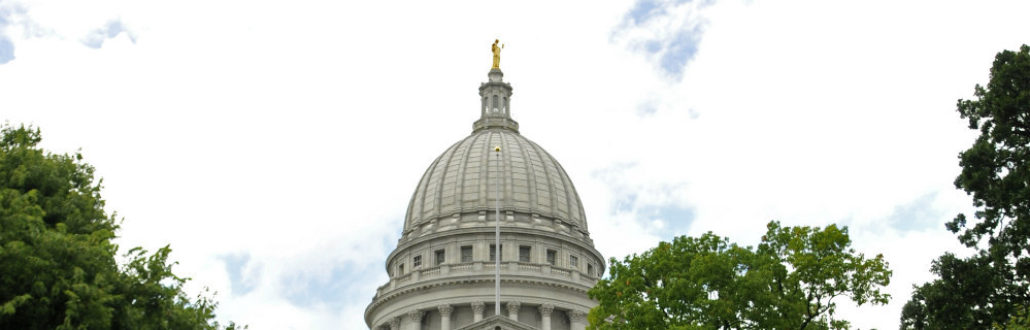
We pondered such as we strolled up State Street on a lovely August afternoon, on our way to chat in the capitol building with Wisconsin’s new governor, Tony Evers, to tease out his vision for the future of agriculture and food in the Badger State.
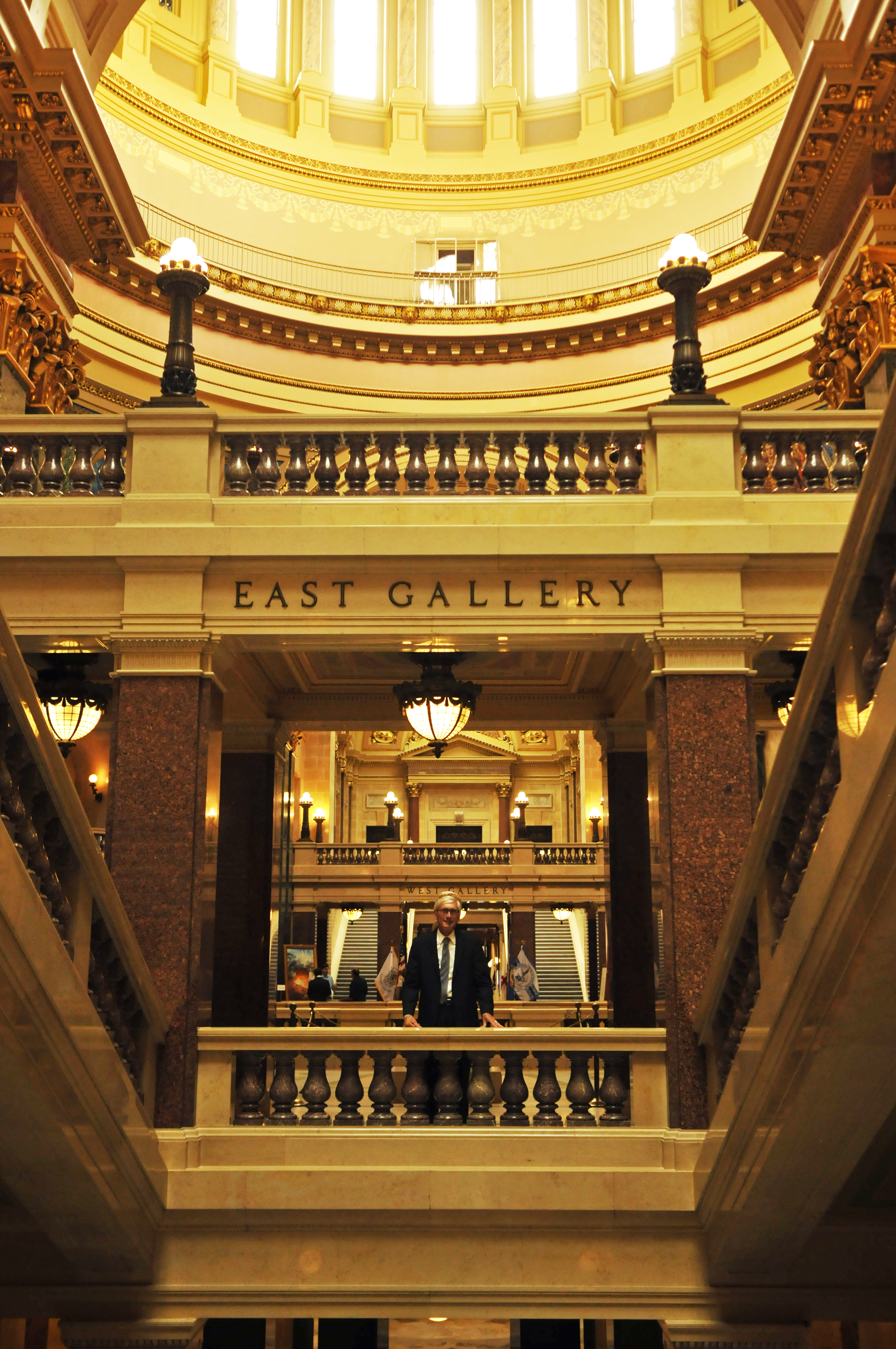
Once inside this awe-inspiring structure, irony slashed down like bats. It’s so dark. Literally. Although the central floors under the rotunda are somewhat lit, from indeterminate sources, venture far into one or another of the four wings, as we did to reach the Governor’s conference room, and you’re going to need a flashlight and reflective floor tape. But oddly enough, given the setting, we witnessed no demise of democracy. Its pulse was strong.
In fact, our time with Mr. Evers was delightful. He was generous with his time and gracious with strange journalists. Very thoughtful. What we found was a man of the people, prompted by the people’s voices, working in good faith for the people’s future.
Here’s what he had to say in answer to our queries about food and farming here in our home state.
Edible Madison: Let’s start with the tough questions, Governor. Cheese curd, or cream puff?
Tony Evers: I have to say...I love both. Ah [still obviously new to this executive decision stuff, but intrepid nonetheless], cream puff, and the reason why is I found out just through happenstance this year that cream puffs actually freeze well, and so you can eat them a couple weeks later, and they taste just about as good. I wouldn’t say the same thing about cheese curds.
EM: So, it’s a longevity thing.
TE: It is. I eat a lot of both, but the fact is that longevity is a little better for the cream puff.
EM: Perch or walleye?
TE: [Quicker to the executive decision, and refreshingly sincere] Walleye. No question. It’s much better. It’s obviously a much larger fillet, but it also tastes much better.
EM: Do you consider yourself a foodie? Foodist is another word for that, to be clear.
TE: I don’t obsess about eating, and I’m probably not the best quality control person in the world as it relates to food, but I do enjoy good food. I like fresh, I like local food. I can’t say that, if you ask me, are the legumes from this farm or this farm better. That might be a stretch for me.
EM: Yeah, that would be a stretch for anybody. What’s your favorite restaurant? Do you go out much in Madison?
TE: Last night was our anniversary, our 47th. We went to Quivey’s Grove. We don’t go out to eat much anymore. The spontaneity of the executive residence doesn’t always fit with, “Let’s go to a restaurant tomorrow.”
EM: Congratulations on the budget passing, by the way.
TE: Thank you. It wasn’t, you know, a complete win, but it was a good stepping stone.
EM: Yeah, you’re never going to get a complete win, but—
TE: Even with a Democratic legislature, I wouldn’t. But I felt good about the results, and we’re in a good place moving forward.
EM: Agriculture’s been in a slump for five years, going on six now. It’s been very tough for farmers, especially Wisconsin’s dairy farmers. Do you see any indications that it may improve, or is there anything in your administration’s policies that is targeted specifically to help the dairy farmers, or help the small farmers?
TE: Yes. I think our efforts to expand exports are a possibility. We have done that in the past. I don’t want to say, however, that just expanding exports is going to make dairy farmers whole. Dairy farmers have done everything we’ve asked them to do. We asked them to produce more—and more, and more—and they have done that. More and more and more. They’ve embraced technology. They’ve embraced all sorts of things. So I think increasing exports is critically important. I think we have to find better ways to make sure the market is fair to them. I think we probably need some more subsidies from the federal government to make them whole. But in turn, I think there are things that we can encourage the dairy farming community to engage in, and many already are. The issue of locally sourced products is going to be a help, and it is a help for them. We see dairy farmers who take their milk and create all sorts of products on-site, and that has been huge—but not everybody can do that. There can only be so many Sassy Cows in the state. And they’ve obviously done a great job on that. I think the Farm to School effort is good, but at the end of the day, it’s not going to save dairy farming. [Farmers] have done everything we’ve asked them to do, so we need to support them the best way possible, and to some extent that will be finding ways to diversify what they do.
EM: That is exactly our next question. What has your administration looked at in terms of helping farmers to diversify? Because, when you look at the tariffs, we were such an easy target because, you know, we’re the cheesehead state. They just whack cheese and it hurts the whole state from the farmer to the processor to the consumer.
TE: Right! And we have lots of cheese hanging out in the state in storage, and so, as I said, farmers have done everything we’ve asked them to do [referring to producing more]. Diversification can take a lot of different [forms], and we’re hoping to incentivize that. Obviously, the issue of hemp (as you see right in front of me here [recent Edible Madison edition with a picture of a hemp plant on the cover]) is one. We need to help people diversify in a way that’s helpful. I don’t think there is a magic bullet out there. I’d be shocked if there was. We’re always looking for ways, but even when we say, “Okay, we can rely on this...” [it still may not be enough]. For example, some of the recent stuff I’ve seen is that vegetables and fruit are still commodities that can bring a profit. That might be an option for folks, but grain tariffs—soybeans are absolutely falling—the market is falling on them because of Trump’s tweeting, so, helping [farmers] diversify is one. Making sure that we have good research and development [is another]. We're investing in the University of Wisconsin system—the whole system. So I think that will help, but it’s going to be a long haul. Unlike Canadian dairy farmers, who are able to control supply—that’s not the case here in the United States. Here it’s the market, and the marketplace is overrun with product.
EM: Is your administration looking at controlling supply, or is that too much of a hot potato?
TE: That’s an interesting question. I think some co-ops over time have attempted to do that, but that’s a long-term discussion rather than a short-term discussion. I think finding ways to diversify the nature of farming practices is probably as good as we can get right now.
EM: What role would the local food movement play in such diversification? Are you thinking about offering programs to assist farmers to translate or transform their operation into more of a local operation working with local markets?
TE: Yes. I think there’s flexibility in some of our funding at the state level and, I think, at the federal level to do that. It’s going to be more of an “all-hands-on-deck” issue, too [referring to requiring both state and federal involvement]. For example, if we could relieve some of the pressure that they face as it relates to some of their expenditures, such as healthcare. Medicaid expansion would be something that would be helpful to all farmers in the state, frankly, because if it’s two spouses, one has to work off the farm in order to get health insurance. Well, that takes half of the work force away from the farm.
EM: What is your administration’s vision for the future of agriculture in Wisconsin?
TE: Well, we are the dairy state and we will continue to be the dairy state. I was raised in a small town in the country [between Plymouth and Elkhart Lake] surrounded by farms, and I understand the extraordinarily important collateral value that family farms have for us. I don’t want to see that going away under my watch because it is something that people of Wisconsin value. And non-farmers ought to see that a family is working together and say, “Jeez, I wish I could do that in my household.” I am a huge supporter of the FFA—the kids who come from the agriculture community and how they interact with adults, and how they are extraordinarily successful kids. I don’t want to see that go away under my watch. So what I want to do is make sure that our farmers, no matter what part of agriculture they’re hoping to prosper in, do prosper! We’ve found ways to incentivize advanced manufacturing in the state, and hopefully we can, with the federal government, find ways to incentivize agriculture. We’re still helping to feed the world and we need to continue in that role.
EM: So you must have some sleepless nights when you look at the numbers over the last couple years, that about 700 dairy farms went under last year.
TE: Yes, two a day. Absolutely [sleepless nights].
EM: It’s happening again this year. When you think back to the crisis of the ’80s, it seems like not much has changed from then to now.
TE: Right, it’s gotten worse, I believe. There was a point in time when farmers, especially in the dairy industry, decided to go organic, and they [went] through their three-years of transition to being an organic farm, and as a result of that effort, they were getting bigger paychecks. Now they’re struggling just like everybody else. The whole idea of succession of farms, especially dairy farms, is so complex now, even if a farmer wanted to [ensure] the transition to some other young person to purchase that farm, it’s almost impossible. The cost is extraordinary. I think we are about to get some good news in that respect. I’m working with some folks that are interested in helping young prospective farmers, to actually help [older farmers] transition on the farm and get young people into it.
EM: Almost like an apprenticeship, or work-to-own?
TE: Yes, exactly.
EM: That’s exciting. Brad Pfaff, the secretary of DATCP [Department of Agriculture, Trade and Consumer Protection], is a very optimistic guy. Do you share his optimism for the future?
TE: Oh, absolutely. We have to. It’s one thing to say things are bad and they’re going to continue to be bad—it’s gong to be a struggle, there’s no question about it. But whoever would underestimate the will of the farming community in the state, they’d be wrong. It’s a strong group of people. I was just at the state fair and I talked to a lot of people, a lot of farmers, and they’re still positive for the future, and so am I. But in order for us to get to a point to where people are going to continue to be successful, we have all sorts of things to put in place, whether it’s R&D at the University of Wisconsin, diversifying products, exports, or helping farmers out with some expenditures that they struggle with, such as healthcare. All those things aren’t possible immediately, but we have to get moving on it, and we believe our budget was a step in the right direction, and I think there are major steps that we did get. This is taking care of a future expenditure—the whole issue of clean groundwater impacts not just the large farms, but the small farms also, and instead of assuming that already-debt-ridden farmers are going to be able to solve this problem on their own—that would be a mistake—the state has to step in. Obviously, we all share the water that exists under the ground, and we have to help farmers transition to different practices, but also help them with the technology to make sure that our water is clean, and saving them that expenditure is critical, too. That’s some of the money we had in the budget that frankly didn’t get through.
EM: But some of it did, and that was great news. [Editor’s note: Governor Evers’s proposed funding to help alleviate Wisconsin’s ag- related groundwater contamination was not cut entirely, but greatly reduced in process.] The consumer, it seems, has changed quite a bit recently, especially the consumer of dairy products. There are a lot of dairy alternatives out there in the supermarket, and it seems to be part of the equation here that hurts the farms—it softens the market a lot. Is there anything the state has in the budget to address that, like MilkPEP or other unified marketing organizations that push dairy—like the “Got Milk?” campaign? Is there anything like that going on to talk to consumers about the benefits of dairy products?
TE: Well, I know that there are a lot of different interest groups in the state that already do that. I’m not quite sure that’s organized at the state level. But I do believe there’s an issue with what defines “milk.” Is “soy milk” milk? Is “almond milk” milk? Is almond ice cream a “dairy” product? We kind of got through it to some extent with what’s organic or not organic, and we should be engaging in that same conversation about dairy products.
EM: Yeah, it’s a long conversation.
TE: Oh, yes.
EM: The local food movement pays a lot of attention to urban and rural food deserts. Is there anything in your budget that’s focused on Wisconsin’s food deserts?
TE: Not really, mainly because it tends to be a local ordinance issue. Right here on Park Street it’s played out. Dean Clinic was going to take down some part of Park Street and they got push-back because there is no grocery store in the plans. To my knowledge, I don’t think there is any particular state plan that deals with that issue. It seems to be playing out more in local issues. Now, Milwaukee, certainly there are food deserts there, but they—in a very urbanized arena—have done a really good job of growing and having lots of fresh food in places that don’t have a large grocery store. I view that, at this point in time, as a local effort that they’re taking on in a good way. The public market down on East Washington [in Madison] is another good example. It’s comparable to the issue of renewable energy, in that the state can do some things to encourage it, but at the end of the day, if consumers want it, suddenly it happens. That’s exactly what’s happened with renewable energy. Certainly the price has been driven down over time, but MG&E customers, Alliant customers, Xcel—all the utility companies—all the people who pay their bills say, “Nah, we don’t want coal. We want renewable.” So the market has probably changed things quicker than the government programs.
EM: Yeah, It’s the same with ag: the markets drive so much of agriculture’s ultimate direction, but consumers’ wishes are sometimes forgotten. Everyone is trying to control from the top, and it’s like, boom, invite the market—
TE: When people want it, by God, it happens.
More Stories by This Author

Edible in your mailbox
