

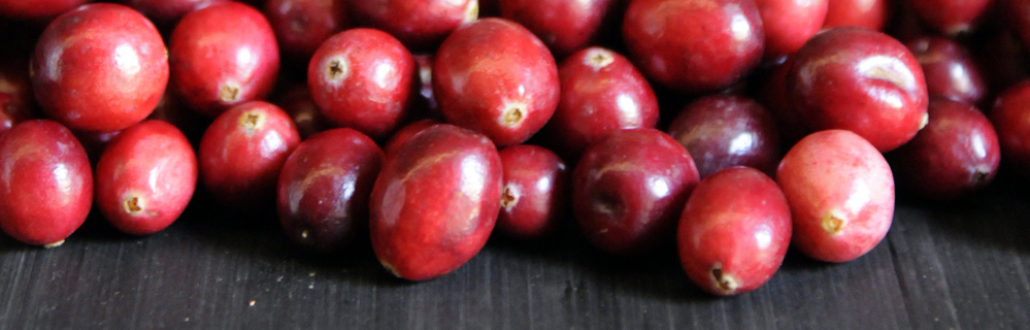
Cranberries: people either love ‘em or hate ‘em. Cranberries have a more sinister reputation than you might think, but one man is on a quest to do right by Wisconsin’s official fruit.
Cranberries—those peculiar and oft-overlooked, sweet yet palate-puckering, purplish-pink fall fruits either induce a dry-mouth gagging sensation or an enthusiastic jump for gastronomic joy. People either love ’em or hate ’em. I gravitate toward the loving ’em crowd, with the exceptions of the off-brand, ribbed-can-molded, “what is that, really?” substance and the over-hyped, sugary-syrup-infused, cranberry-skin-by-product branded as Craisins—a product that ignited an all-out war between raisin and cranberry lovers.
Admittedly, while the revered or reviled cranberry has always held a prominent place at our holiday dinner table, I have known little to nothing about this seemingly ordinary fruit. And other than simply enjoying the texture and sweetness the dried version brings to my chocolate cardamom cookie recipe or when added fresh to our fall apple cranberry chutney preserves, I’ve had nothing to offer on the subject until now.
So do you want the good news first, or the bad? Cranberries have a more sinister reputation than one might think or know. Let’s slather you with sweetness first.
Facts & Folklore
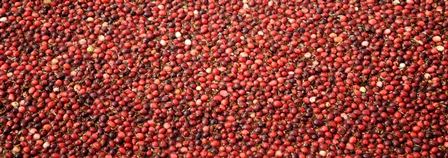
Only three fruits can rightly claim native North American origins—the blueberry, Concord grape and cranberry (Vaccinimum macrocarpon). Native Americans used cranberry skins for making textile dyes and medicines—the whole fruit was ground into a poultice and used to draw poison from arrow wounds and to treat cancers. A superfood, called “pemmican,” made of dried venison or bison, cranberries and animal fat, was an excellent long-keeping, protein-rich food originally prepared by northern native peoples and adopted by colonists and explorers.
Furthermore, cranberries are believed to have been served at the first Thanksgiving feast in 1620 with native turkey and corn; and later, cranberries were carried by American clipper ships and whaling boats to prevent scurvy. The high vitamin C content and naturally waxy skins, which postponed rot, made the cranberry an excellent voyage-worthy food.
The wild fruit that grew in low marshy areas of the Northeast and Upper Midwest was named sassamanash by the Algonquians and referred to as “craneberry” by early Dutch and German settlers, who believed the early spring blooms resembled the head and bill of a crane. The name was later shortened to cranberry. Other less common names include bearberry, mossberry and fenberry because of the fen or marsh environments where cranberries thrive.
Cranberries are a nutritional power-fruit rich in flavonoids and phytonutrients, gifting us little oral explosions of naturally occurring antioxidant and antimicrobial compounds. Especially thankful are our gut and urinary systems, which are aided by cranberry’s powers to ward off bad bacteria. These juicy red spheres also aid in heart health, assist in the battle against type 2 diabetes and contain anti-cancer properties (The Cranberry Institute). An overall health tonic full of vitamins and minerals, this one tiny berry packs in a whole lotta good.
First cultivated for commercial production in Massachusetts around the turn of the 19th century, today cranberries are produced on a commercial scale in Canada, Chile, the Netherlands and the United States, specifically the states of Maine, Massachusetts, Oregon and Wisconsin. Wisconsin has been the nation’s number one producer of cranberries for 20 consecutive years, with nearly 60 percent of the nation’s production and more than half of the world’s production. Cranberries are grown in 20 of Wisconsin’s 72 counties.
In 2003, the Wisconsin legislature designated the cranberry as the official state fruit—the result of a 5th grade class project at Trevor Grade School in Kenosha County. Narrowly, it was decided that the cranberry was a better candidate than the beloved cherry.
According to the U.S. Department of Agriculture, in 2013 Wisconsin cranberry growers harvested a record six million barrels (an increase of 25 percent over 2012) produced on roughly 18,000 acres of sandy marshland in central and northern Wisconsin.
Cranberries have an enormous impact on the local agricultural economy, contributing nearly $300 million annually and supporting around 3,400 jobs. It is estimated that there are enough cranberries grown in Wisconsin to supply every man, woman and child in the world with 26 cranberries (Wisconsin State Cranberry Growers Association). We are as much a berryland as a dairyland.
If there is so much love to be shared for this native superfood, why then is it causing such a stink?
The Dark Side of Berryland
When nothing more than flesh and skin, the wild American Cranberry is a botanical treat awaiting any who wander through northern forests and wetlands when berries are ripe for the picking. But as consumers and producers, we’ve collectively and drastically changed how this native fruit grows.
Commercial fruit production can be a good, honest way to make a living. But when fully exposed, the commercial cranberry industry was built on the notion that growing cranberries without degrading natural wetlands and inputting manufactured fertilizers and chemical pesticides is impossible. Impossible. Thankfully a handful of passionate growers are turning heads with new ideas about how to grow with no guilt and no shame, producing a fruit we can all be proud to eat and claim as our own.
Before I give you the warm and fuzzies, one should know how commercial cranberries are typically grown. It is an industry that has faced more than its fair share of production and price obstacles. Producing commercial cranberries is no easy task, and no one, with the exception of maybe Ocean Spray, is making a windfall.
If you have never stood in or close to a cranberry bog, a field trip to one of the many commercial bogs that dot Wisconsin’s sandy central and northern landscape should be on your to-do list. To my surprise, cranberries do not grow in water but in sandy, acidic soil in locations with plentiful access to fresh water. The plant itself is a low-growing, woody, perennial vine—meaning it comes back every year. In fact, most established cranberry marshes are decades old.
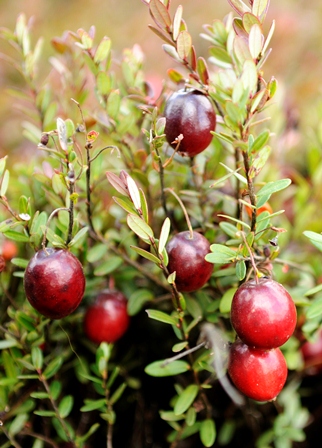
The plant produces horizontal stems, or stolons, that extend up to six feet long, and short vertical branches, or uprights, that can grow up to eight inches in height. Fruiting uprights can produce as many as seven fruits, and pollination largely depends upon honeybees.
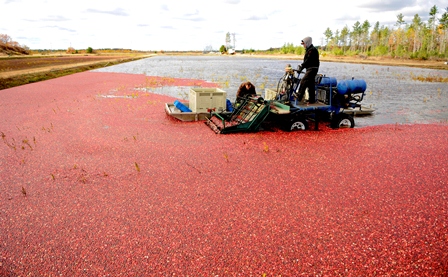
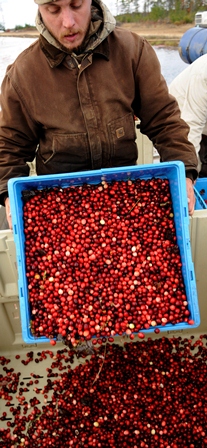
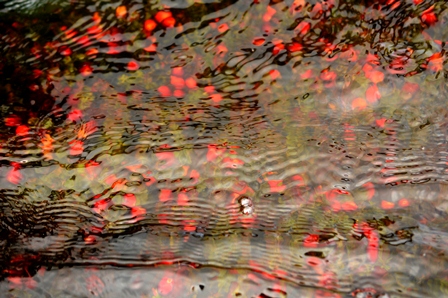
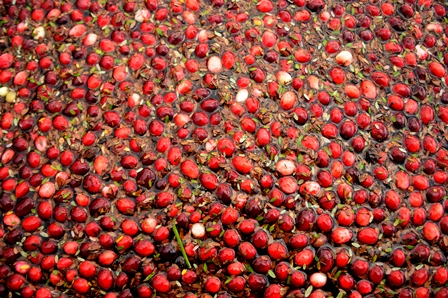
Once mature, each cranberry contains a tiny pocket of air, which aids in harvesting. Machine-made commercial bogs are flooded at peak ripeness, when the fruit easily detaches from the vine or is “beaten” from the vine with specialized equipment. The berries float to the surface where they are corralled and either hand- or machine-harvested. The fruit is then transported by truck to a sorting, packaging and distributing facility to be prepared for fresh sale or processed into frozen berries, juice, sauce, powder, or sweetened and dried.
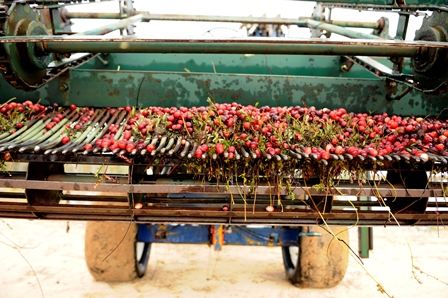
A second, less common harvesting method is a dry harvest, where the fruit is “combed” from the vine using specialized picking equipment, which requires no water.
This all seems perfectly acceptable. Yet problems arise in the marshy conditions where cranberries thrive. The same environment that produces juicy red fruit attracts diverse issues: plant destroying insects like the dreaded black-headed fireworm and fruit worm, fungal diseases, rot, and opportunistic, water loving plants considered noxious weeds by any cranberry producer.
Cranberry producers are not only dependent upon water for harvesting purposes, but efforts to keep pests at bay require forced springtime floods followed by a pre-bloom re-flood, which does a worthy job of drowning unwanted insect populations. Marshes are also flooded in the winter to form a protective ice shell around the plants to prevent winter kill.
Traditionally, cranberry marshes have been developed in wetland ecosystems, and according to the Wisconsin State Cranberry Growers Association, because wetlands are protected by local, state and federal regulations, permits from the U.S. Army Corps of Engineers and the Wisconsin Department of Natural Resources must be acquired first.
Wisconsin’s Cranberry Clean Water Coalition, a now defunct water quality and wetland advocacy group originally consisting of 16 member organizations, maintained that from the beginning of the state’s cranberry production up to the year 2000, approximately 15,000 acres of wetland had been converted to cranberry production and 23,000 acres of reservoirs were constructed (mostly in wetlands) to provide water for Wisconsin cranberry beds. Between 1980 and 2000 alone, approximately 5,200 acres of wetland had been lost for direct conversion to cranberry beds, and additional wetland acreage had been altered for the construction of reservoirs, ditches and dikes to hold and circulate large volumes of water for the cranberry fields.
Growing cranberries requires a lot of water, and subsequently, impacts to water quality and quantity arise. Weed and insect issues plague all cranberry marshes, and as a result, chemical herbicides, fungicides and pesticides as well as manufactured fertilizers have become the norm for commercial cranberry production. According to a Macalester College study, for “maximum productivity, cranberry bogs must be virtually free of any species of flora or fauna that may inhabit a bog. Otherwise, up to eighty percent of productivity could be sacrificed. To avoid this, farmers run a rigid schedule of chemical spraying” (Macalester College).
The study goes on to warn that “even under the watchful eye of the WDNR, the Wisconsin Integrated Pest Management Program, the Wisconsin Department of Agriculture, Trade, and Consumer Protection (DATCP), the EPA, and others, chemical use has raised concerns because Wisconsin studies have repeatedly published frightening results. For instance, one [study] found elevated concentrations of lead, arsenic, cadmium, selenium, and other toxic metals in cranberry bog discharges, and there are approximately 22 pesticides commonly used on cranberries, including napropromide, norflurazon, dichlovenil, 2,4-D, carbaryl, diazinon, chlorpyrifos, and azinphos-methyl." Yikes.
Alone, the chemical pesticide diazinon has been proven by the EPA to cause a “widespread and continuous hazard” to birds, especially waterfowl like geese and ducks. Bird kills have been reported nationwide following diazinon applications. Additionally, diazinon is highly toxic to fish and the cranberry’s primary pollinator—bees. It has been known to contaminate ground water supplies and can take more than six months to degrade to half of its original concentration in fresh water (USDA Cooperative Extension - University of Oregon).
It’s not only humans who are eating these chemical residues; so are birds, amphibians and other living creatures that inhabit or migrate through Wisconsin’s wetlands. Bioaccumulation of these toxins in the soil as well as in the wild game we eat should be a real concern. These chemicals are also discharged into our waterways and cycled into our underground drinking water sources.
With considerable political influence and campaign contributions, Wisconsin’s cranberry industry has received special treatment and exemptions from state environmental laws. For example, the Wisconsin legislature elevated the private rights of cranberry growers over public rights in water related matters as evidenced by Section 94.26 of Wisconsin Statutes. Priority treatment dates back to 1867 with the passage of the “Old Cranberry Law,” which allowed cranberry growers to convert wetlands, alter trout streams and lakes and avoid state dam safety inspections. Former Wisconsin Governor Tommy Thompson (1987-2001) said wetland legislation that would harm cranberry growers’ ability to use and enhance wetlands wouldn’t get the tip of his pen. “You’ve got a friend in the governor’s office who carries a big red pen,” Thompson said on January 15, 1992, at the Wisconsin Cranberry Association’s winter meeting (Wisconsin Stewardship Network).
In recent years, Wisconsin’s cranberry growers have made strides toward creating a more sustainable industry, as evidenced by a 2009 survey conducted by the University of Wisconsin-Madison Horticulture Department (Johnson). The survey included a total of 114 cranberry growers, representing 152 cranberry marshes or 13,274 acres of cranberries. Results document that more than half of growers have created a Natural Resource Conservation Service (NRCS) Nutrient Management Plan to guide the application of fertilizers in hopes of preventing over-applications. Further, 88 percent of growers use alternative practices in addition to pesticides to manage pests, and 98 percent of growers calibrate fertilizer and pesticide application equipment.
Surveys like this show the state’s industry is making strides in the right direction. But is it enough? All Wisconsin farmers are required by the state to have a Nutrient Management Plan in place that meets the NRCS Nutrient Management Conservation Practice Standard. The caveat, according to Sara Walling, chief of nutrient management and water quality for DATCP, is that the nutrient management regulation is only enforceable and regulated when there are cost-sharing funds available to assist with the design and implementation of a plan. DATCP receives roughly $2 million per year to distribute to county Land and Water Conservation Departments which, in turn, work with local farmers. Walling says these funds are competitive and by no means cover all 78,000 farmers in the state. It seems short-sighted to create legislation and regulatory policy that is only enforceable when the Political Will deems the program worthy of adequate funding. Walling did, however, commend the Wisconsin Cranberry Growers Association for taking a proactive approach to promoting the importance of nutrient management.
Chemical inputs are expensive, and by and large, cranberry growers are good stewards of the land, minimizing input overages by hiring professional pest management consultants, or “scouts,” to inspect for insects, plant disease and weeds. According to the survey, 97 percent of cranberry growers use pest thresholds when making decisions about spraying. But pest management plans are not required, and water quality and the overall health of these man-made ecosystems—and the natural ecosystems they impact—remains a real and present concern.
Meet Dan Wandler of Sandhill Cranberry
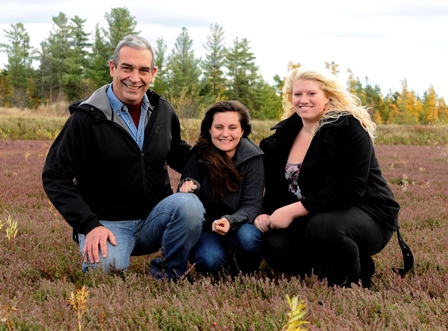
In the heart of Wisconsin’s Central Plain, deep in Wood County, lies the small village of Vesper, population 584. Flat, sandy and marshy, the Central Plain is one of the nation’s most productive cranberry regions. Here lies the home of the Wandler family and Sandhill Cranberry, LLC.
Prior to 2000, Dan Wandler and his father were two of the then nearly 700 member-growers of the global agricultural cooperative Ocean Spray Cranberries, Inc. Formed in 1930 in Massachusetts, Ocean Spray now controls the vast majority of the cranberry market nationwide and about 60 percent of the cranberry acreage in Wisconsin managed by roughly 120 growers.
Weary of contract growing, low prices and conventional agriculture practices, Dan and his father left Ocean Spray and set out on their own as Sandhill Cranberry, LLC. With small children on the home farm, Dan could no longer justify the “heavy use of toxic, chemical sprays.” The simple act of hugging his family at the end of a hard day’s work had to be postponed until his “spacesuit” was removed and he was showered. In addition, Dan began to notice a stillness that fell upon the marshes after spraying. Normally the air was full with the sound of birds chirping, frogs croaking and insects buzzing and whirring, but for about two weeks after spraying, the marches fell eerily silent. “Poisoning my family and farm” were not risks he was willing to take given the limited rewards of conventional contract growing.
In 2000 Dan decided to transition to organic production methods, and after a three-year transition period, his farm became USDA Certified Organic in 2003. Today he has six organic marshes covering 26 acres. Dan has watched health bloom on his marshes, now alive with pollinating insects and Sandhill cranes nesting and raising their young on land surrounding the marshes.
Transitioning to organic production has not been easy. In fact, it was the challenge that partly drew Dan to make the switch. You see, Dan whole-heartedly believes he “can make a good living on 30 acres of organic cranberries,” and this is not a man who gives up easily.
The biggest challenges to organic cranberry production are pests and weeds. Preventing or maintaining a reasonable level of both is managed by hand-pulling weeds, though some growers use a vinegar injection to kill weeds. Specialized weeding equipment can also be used when capital resources allow.
Insect management requires flooding the marshes in late spring and again pre-bloom. The timing of these floods is critical and can mean life or death of a harvest. Flood too late and the blooms are damaged, too soon and you may not reduce insect populations enough to ward off widespread plant damage. Dan admits it has taken him ten years to solve his pest and fertilizer issues, and now he is something of an expert on the subject, often called to advise other organic growers.
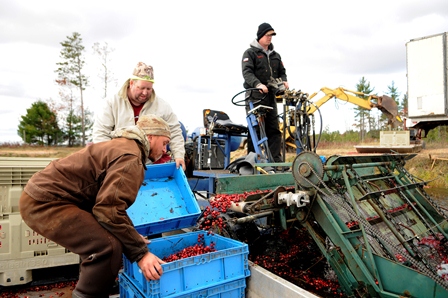
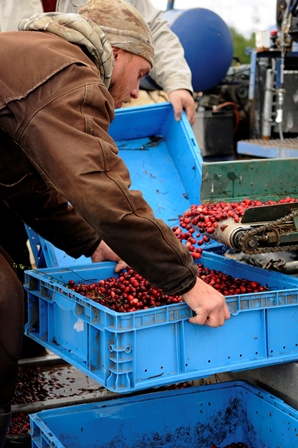
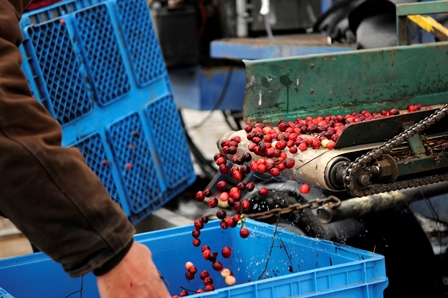
A six-foot-six-plus, broad-shouldered man of middle age with a resonant bass-like voice, Dan is kind in an infectious sort of way, if not overly confident, with a solid thread of serious that unravels frequently in a warm yet sarcastic wit. His M.O. is quite clearly along the “I’m not messing around here; this is not a side-show hobby but serious business that demands no amount of second-guessing or tomfoolery” lines. I immediately liked him. His wheels are always turning—he is more engineer and business man than farmer, although the best farmers typically think like engineers and CEOs. He catches nary two to three hours of shuteye per night during the spring and fall “frost watch” and, like an adrenaline junkie, lives to tackle the next day’s challenges.
When asked what he likes best about his day-to-day, he is quick to mention the land and wildlife that share his outdoor office space, but his whole being brightens when he talks about the commitment to farming organically. He is literally fed by “doing something I know is possible…and really doing it.”
A disciple of Walter Shewhart’s Statistical Process Control (SPC) techniques, Dan follows strict process control standards throughout every aspect of his business. Not only is Sandhill Cranberry the largest producer of organic cranberries in the state, but he is the only producer in the nation who also owns and manages a certified organic on-site processing, packaging and distribution facility. From start to finish, this man knows his berries. Implementing SPC methods has been a saving grace for his operation, saving time and money through reduced waste and increased customer satisfaction. His 2013 harvest resulted in merely three customer-rejected cases, an almost insurmountable achievement in the fresh fruit business.
Growing cranberries organically for commercial sale is tough, really tough. Wisconsin maintains around 100 acres of certified organic cranberries—a number that may be decreasing as farms like Jonjak Family Cranberry Farm of Hayward transition back to conventional after eight years of organic production, a decision based on tough economic times and problems with weed control.
In a good year, Dan can harvest 180 to 200 pounds per acre compared to the conventional average of 200 to 210 pounds per acre. Lower yields won’t hinder his success as the demand for organic cranberries remains high and growing, resulting in a much larger return for his organic berries compared to conventional berries.
If you think about it, a couple more dollars at the cash register translates to direct, real, tangible investments in retailers who provide a local and organic option as well as in certified organic family farms. Those few extra dollars equates to more money in the hands of someone who is taking care of the land, the wildlife, the water, his family and yours. A safe and solid investment for all. Let’s not take people like Dan Wandler or his efforts for granted.
And maybe it would be OK if not every man, woman and child in the world had 26 cranberries to him/herself.
Look for Dan Wandler’s fresh Sandhill Cranberries this fall.
If your local retailer doesn’t carry Sandhill Cranberries, implore them to do so.
Sandhill Cranberry, LLC
Vesper, WI
Website: sandhillcranberry.com
Phone: 715-697-CRAN (2726)
Email: dan@sandhillcranberry.com
Another Wisconsin organic cranberry grower is Ruesch Century Farm of Wisconsin Rapids.
Sources
Johnson, J. C. (2010). "Sustainable Cranberry Production for a Vibrant Future: The Wisconsin Experience.” University of Wisconsin-Madison. Horticulture Department.
Macalester College. (n.d.). "The Effects of Cranberry Bogs on Flora and Fauna.”
Pesticide Action Network. (n.d.). What's On My Food database.
The Cranberry Institute. (n.d.).
USDA Cooperative Extension - University of Oregon. (n.d.). Extension Toxicology Network. Pesticide Information Profiles - Diazinon.
USDA Pesticide Data Program. (n.d.).
Wisconsin State Cranberry Growers Association. (n.d.).
Wisconsin Stewardship Network. (1998, December 18). Natural Resource Accountability Project.
Featured Recipes


More Stories by This Author

Edible in your mailbox
