

The climate is changing; we know this.
Politics and media distractions aside, the science is in, and who’s to argue with some of the world’s smartest data crunchers and model makers? Bizarre and increasingly severe weather patterns yielding widespread human fatalities, mass extinctions, environmental havoc and crumbling economies—is this what we have to look forward to? The future is a big mysterious unknown that’s hard to look directly in the eye, but the status quo, what we already know, is what keeps me up at night.
Even more telling than the data and prediction models, instinctually we feel it, this change. It’s happening at a much faster pace and on a broader scale than any one of us can wrap our heads around. The sooner we accept the science, release the regret and hold ourselves and industry accountable, perhaps then we will have the motivation to move forward on a mission to accelerate ideas and practices resilient to change. We have passed the point of no return and its gettin’ hot out there. Someone pass the perennial peas.
As we ponder a new reality that rings even partly true to the predictions, we will continue to experience a warming global climate—7.1 degrees Fahrenheit (4 degrees Celsius) warmer on average by the turn of the century. This is within the lifetime of my children.
Focus, if you will, on the “on average” part of this reality and consider the following scenario. If we continue on our current course, by the year 2100, Wisconsin’s average mean temperature will increase by 14.4 degrees Fahrenheit (8 degrees Celsius), according to climate change scientists at the U.S. Environmental Protection Agency (EPA) and the Intergovernmental Panel on Climate Change (IPCC), the leading nternational body for the assessment of climate change. In Wisconsin, an increase of 14.4 degrees will result in an average mean temperature of 58.1 degrees Fahrenheit. At that temperature, Wisconsin would mimic the current climate and weather patterns of Mexico, the Philippines and parts of central Africa. Gone are winter parkas and Mukluks. Are you ready for 12 months of equatorial summer?
Given this highly probable scenario, in 100 years will dairy exist in Wisconsin? What about cranberries, maple syrup and soybeans? How will our aquifers meet the demands of a stressed, chemical-dependent, monocrop agriculture as temperatures rise? Will commodity crops even exist in this “new” Wisconsin?
What will feed our economy? Who will feed us? One thing’s for sure: what we will eat as our nation’s food system shifts—not only by region but also by the products produced—is a great unknown.
One man in southwest Wisconsin has been considering this shift for decades. Perhaps that is why he has planted thousands of California walnut trees (to some success) and has plans to experiment with pecans, cocoa and coffee. Yes, cocoa and coffee in Wisconsin.
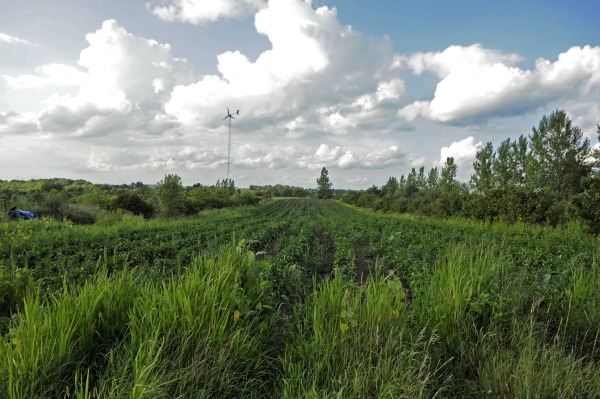
Rooted deep in Wisconsin’s Driftless is a place where resilient change unfolds daily. What once was a hardened, barren landscape has been exchanged for a new land ethic. A place seemingly protected by the promise of a good future despite the tornado of change that rumbles overhead and at its borders. This model of change is New Forest Farm.
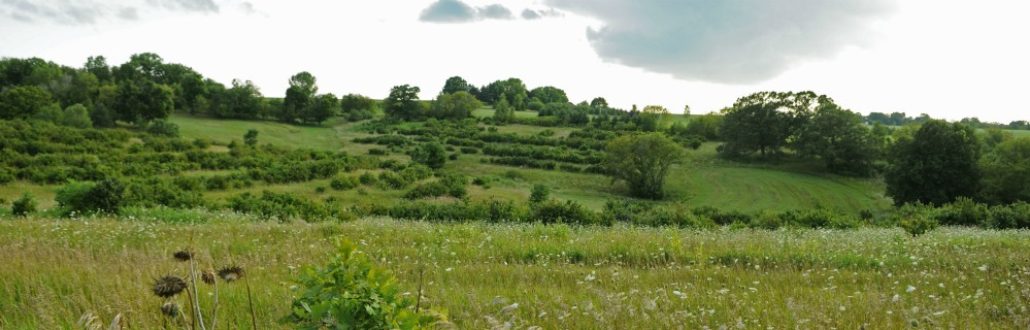
In the heart of the Lower Wisconsin River Basin, east-southeast of Viola near the high-lying, unincorporated community of Ash Ridge, rests Mark and Jen Shepard’s New Forest Farm. Cradled among monoculture contours and dissected hardwood forests are 110 acres of resilient, nature-mimicking, working agriculture—an intensively managed, restorative ecosystem all its own, a mere 21 years in the making.
The type of agriculture the Shepards practice is commonly referred to as “permaculture,” a system of “permanent agriculture” that provides a radically different ethic of practical strategies and techniques to address a great number of social, economic and environmental concerns, including climate change.
Once a diverse oak savannah, the land that is now New Forest Farm was managed as a single-owner, mixed crop dairy farm since the 1930s and was reduced to an abandoned, overgrazed and depleted landscape by the early 1990s. Mark’s vision has transformed this indistinguishable place into a verdant swath of earth that comprises, one could argue, more plant and animal diversity than any piece of native or tamed land in all of the Driftless.
In the winter of 1994, Shepard and two original investors recognized an opportunity to change the status quo of this forgotten corner of the world, and Mark, with the support of his biochemist-turned-massage-therapist wife, Jen, and two sons, Erik and Daniel, persisted in the pursuit.
Farmer, entrepreneur, engineer, teacher and author, Mark has been a man on a mission since the age of 18, striving daily to “bring an agriculture form to humanity that mimics nature,” he says.

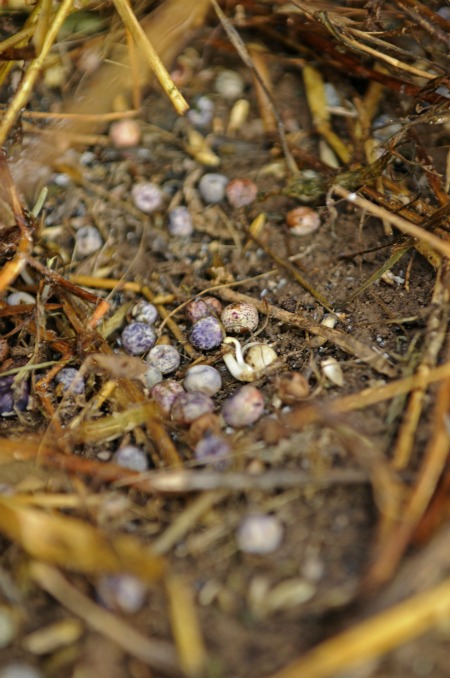
When discussing his passion, he offers the following visualization. “If you can imagine two planet Earths side by side—one wild and one restorative agriculture—the two would look the same. We know what 10,000 years of industrial agriculture looks like: food diets based on annual crops result in collapsing societies, war and inequality. Humanity has yet to try an ecological agriculture to scale.”
As a child in north-central Massachusetts, Mark was inspired by his parents’ 10-acre biodynamic homestead. There, Mark was able to observe plant relationships and how best to manage plant systems with the least amount of work and the highest probability of success. His experiments with trellising grape plants on apple trees turned into a multi-year observation where success was finally met when the grape vines were pruned and kept to only the lower branches of the apple trees, resulting in healthy plants and high fruit volume.
Professor J. Russel Smith’s Tree Crops: A Permanent Agriculture (1929) inspired a young Mark to explore the concepts of agroforestry and forest farming on a farm scale. Mark has since lived a life devoted to this mission of investigating how to adapt and design agricultural ecosystems that imitate natural systems, all with the intention of harvesting yields as food. Years spent observing nature, designing systems that imitate nature and interacting with nature on a daily basis, first in Alaska and later in Maine, prepared Mark for his biggest challenge yet.
Upon visiting, New Forest Farm feels unlike any farm you’ve experienced. It seems chaotic and unplanned without the typical boundaries, fences or division of space. It feels more like nature than a farm.
There is a rhythm to the landscape that isn’t immediately recognizable but feels…familiar, perhaps like an ancestral landscape. The folds and contours of the land are enveloped and accentuated while the natural run and catchment of water as it moves across the landscape is respected and harnessed. Diversity of life bursts out of every corner and crevice as humans, birds, animals and other creatures move without thought through each twist and turn. I am guided by wonder toward each new path, plant community or open space left almost intentionally for one to pause and take it all in.
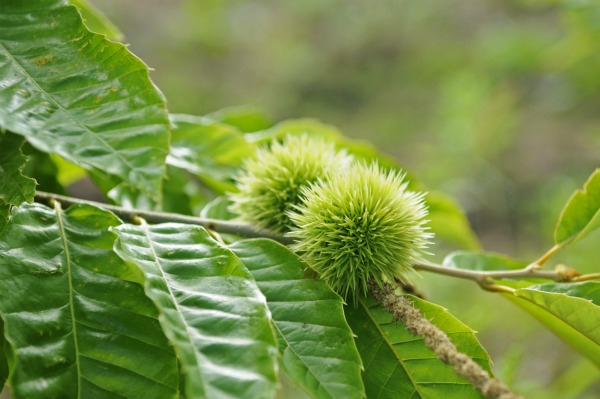
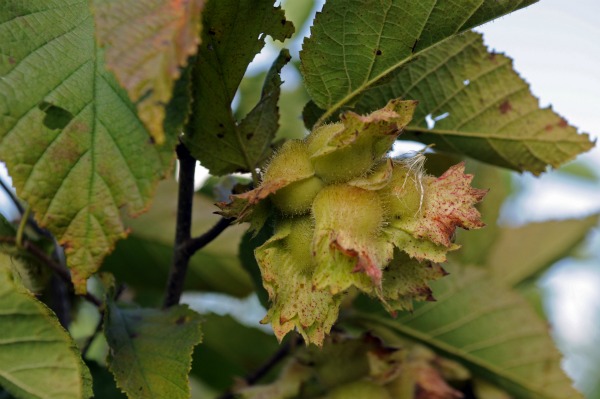
Mark estimates that he’s planted more than 250,000 trees on his 110 acres—trees that yield food, timber and a financial return, not to mention the ability to sequester a great deal of carbon from our atmosphere while providing critical species habitat and improving soil and water health.
Following permaculture’s multi-level design approach, the farm is bursting with oak, chestnut and beech trees, which act as an upper-story canopy. Next, mid-story fruit trees, including a diverse planting of apple varieties, are followed by hazelnut and then understory plantings of cane fruit, currants, gooseberries, grapes and grasses, which are grazed by animals. Plantings are not haphazard but, rather, in rows that follow the lay of the land for ease of maintenance and harvest. This system is intensively managed, especially in the beginning, but as restoration takes hold, the whole system begins to behave more like a wild place—a wild place that is managed like a farm.
Where species diversity was once minimal and fragmented, Mark now counts seven different species of amphibians, a number of ground- and tree-nesting birds, badgers and three types of weasels in addition to the domesticated pigs and sometimeresident cattle, sheep, chickens and guinea fowl.
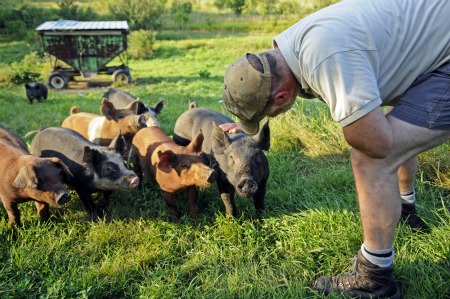
The economics of the farm come in the form of woody plants sold as nursery stock, asparagus (a perennial crop) and eight acres of annual vegetables including acorn squash, as well as rye and wheat, which were introduced as soil building crops. Chestnuts, hazelnuts and apples provide additional income. The opportunities for value-added food production are endless. Mark has invested in hard cider production and is now exploring the pressing and marketing of hazelnut oil.
The ecology of North American oak savannahs, as mimicked at New Forest Farm, includes a number of key species that are prized not only for their timber value but also for staple food production. The human and economic benefit awarded by the sheer volume of food produced in an oak-savannah-type ecosystem should warrant the attention of any society looking to build more resilient communities and food systems.
When combined with the ecosystem benefits—carbon sequestration, control of climate and disease, nutrient cycling, improved soil health, increased pollination, species diversity, and energy and cultural benefits, to name a few—the question becomes, why are we not doing this on a mass scale?
For one thing, restorative agriculture is a radical shift from the industrialized mono-agriculture that is so prevalent in our global food system. Comprehending forests as not only habitat and recreational/spiritual places but also as valuable contributors to carbon sequestration and high-volume food producers will require the passion and dedication of a million change-makers like Mark.
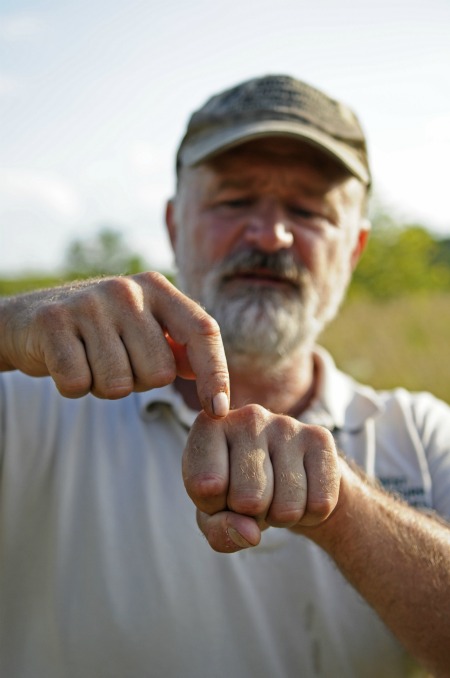
The application of permaculture principles on the landscape is not the hard part; in fact, it’s highly practical and well within the abilities of any individual or society. Shifting societal behavioral patterns, especially in developing countries and in industry’s steel-fisted grip on global profiteering at the expense of human and environmental health, will be the bigger hurdles to overcome.
In practical Wisconsin terms, we could start by applying “ally cropping,” where woody tree species are planted between hay and corn fields. Dairy farmers planting chestnut trees in field lines could remove “millions of tons of carbon from the atmosphere at a profit,” says Mark. Wisconsin dairy farmers could be the largest producers of chestnuts—a highly nutritious, protein-rich, starchy nut. What’s more, ally cropping between pastures would provide beneficial shade and reduce ground temperatures. Cooler soil temperatures allow grasses and crops to grow faster early in the season, which leads to better yields as temperatures get hotter in late-summer months. Wisconsin alone has thousands of acres of crop alleys that could be restored into food yielding and carbon sequestering spaces.
Since the publishing of his book, Restoration Agriculture: Real-World Permaculture for Farmers (2013), Mark has been invited to share his perspectives on permaculture across the globe. Mark recently traveled through Greece and Italy teaching this “new type of old type of farming,” as he likes to call it.
More recently, Mark has been invited to work with the United Nations and the World Bank. “The global community takes seriously the current state of the planet,” says Mark. “Propaganda in the U.S. leads us to believe that the world doesn’t care, when, in fact, there is big money for global restoration projects. Our existing programs designed to take carbon out of the atmosphere are not working. We are operating under old concepts of forestry. We need to feed billions [of people] while also maintaining our forests. We need to grow food trees. We need to redesign the way human beings get food in [accordance] with nature’s image.”
Where the sky’s the limit, I’ll leave you with one last thought. With support from the Union of Concerned Scientists, Mark and others are exploring a large-scale restoration project in a 100-millionsquare- mile area within five degrees of the equator. This land—once a diverse, tropical rainforest with rich perennial plant systems—was turned into a monoculture system, burned and plowed under for commodity agriculture, then later abandoned due to nutrient depletion. This barren, forgotten landscape is now being considered for one of the world’s largest restoration agriculture projects—a project with the profound ability to sequester billions of tons of carbon, mitigating climate threats and producing food on a scale that will bring widespread benefits to our global community. Radical, perhaps, but definitely worth our attention.
Even if the northward climate shift is inevitable, as many climate scientists warn, we are not handcuffed to a hopeless future. We can, today, put in place resilient farming systems with our descendants in mind so that even if we can’t predict what they will eat, we can at least say they will eat.
More Stories by This Author

Edible in your mailbox
