
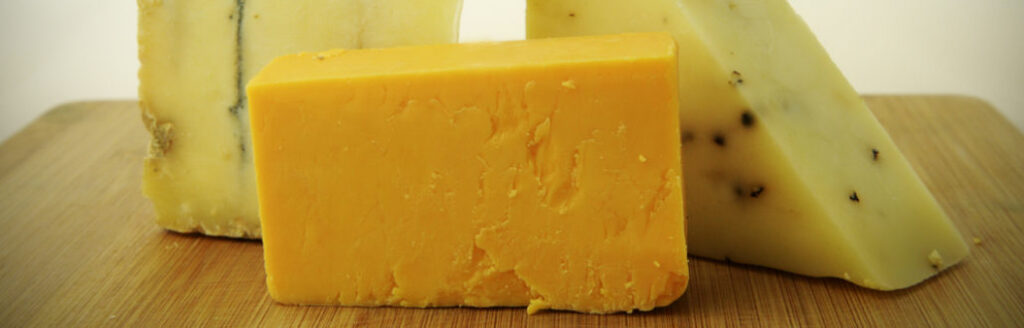
If ever there were two words meant to go together, they would surely be “Wisconsin” and “cheddar.”
Made in blocks, barrels and wheels, and then cut, wrapped and stamped, millions of pounds of construction-orange Wisconsin cheddar are sold every year to American consumers. Most get shipped to customers on the coasts, but thousands of pounds are bought by locals at roadside cheese shops and cheese factories, with many a family still putting the requisite plate of sliced cheddar cheese on the table at dinnertime.
Cheddar cheese may very well be responsible for putting Wisconsin on the map as America’s Dairyland. While cheddar was just about the only cheese produced in the entire United States prior to 1850, by 1880, Wisconsin had taken the lead in producing more cheddar than any state in the nation. Today, Wisconsin cheesemakers continue to lead cheddar production, with more than half of the state’s 129 cheese plants pumping out cheddar in some way, shape or form.
There is no doubt cheddar will continue to be Wisconsin’s ticket to fame; however, the production of commodity cheddar cheese— typically made in giant, 640-pound blocks—is dramatically changing. While overall cheese production in Wisconsin increased during the past 10 years, the amount of cheddar decreased. For example, in 2000, Wisconsin made 2.2 billion pounds of cheese and 33 percent was cheddar. In 2010, Wisconsin made 2.6 billion pounds of cheese and only 24 percent was cheddar.
What’s filling the cheddar gap? Specialty cheeses. Wisconsin’s production of specialty cheeses doubled in the past decade, increasing from 221 million pounds in 2000 to 552 million pounds in 2010. With more consumers demanding bigger and bolder flavors, cheddar makers have had to adapt.
Perhaps no one has changed the cheddar cheese scene more in Wisconsin than Tony and Julie Hook, who together craft award-winning aged cheddars at Hook’s Cheese Company in Mineral Point. College sweethearts who married and started making commodity cheddar and Swiss back in 1976, the Hooks transitioned to specialty cheeses, including a variety of blue cheese and aged cheddars in the 1990s. By then, the commodity cheddar market had crashed (blocks and barrels of cheddar are still sold today on the Chicago Mercantile Exchange), and many Wisconsin cheesemakers were making only between one and five cents per pound on cheddar.
Instead of focusing on quantity, the Hooks began to focus on quality. They reduced the number of days a week they made cheddar and began aging it longer. Today, they age cheddar in a curing room at just the right temperature and humidity for a slow aging process, allowing their cheeses to age to perfection. Every few months, Tony taste-tests each batch to ensure that only the cheeses of the highest quality are saved to age another year.
In 2006, Hook’s 10-Year Cheddar took first place in the aged cheddar category at the American Cheese Society Annual Competition, the first time a cheddar that old had ever won. In 2009, the Hooks made history again by putting their 15-Year Cheddar on the market. Retailing at more than $50 per pound, it promptly sold out, creating waiting lists and general mayhem at specialty cheese stores across the country.
Making a cheddar that ripe, without it turning acidic or bitter, is a rare skill. But the Hooks have perfected it. They’ve also perfected the art of marketing Wisconsin cheddar, making it both in the traditional Wisconsin orange as well as in its more natural white. (The golden hue of colored cheddar comes from the addition of annatto, a tasteless, odorless vegetable dye made from the seed of the annatto plant.)
Another veteran cheesemaker who has taken cheddar making to the next level is Kerry Henning at Henning’s Cheese in Kiel. In addition to being the only cheese factory in the nation to make mammoth cheddar (wheels of up to 12,000 pounds are custom-made for retail shops across the country), Kerry spent 14 years of his life perfecting a specialty Peppercorn Cheddar.
The result? A gold medal at the 2010 World Championship Cheese Contest. Firmer and drier than most cheddar and studded with black cracked peppercorns, the cheese features hints of Parmesan. Kerry says he gets new ideas for specialty cheddars by eating other cheeses and then wondering, “Can I do that with cheddar?” While it may seem simple, Kerry takes no shortcuts; hence, the longresearched process to get the peppercorns to merge into the taste of the aged cheddar and not give off an explosion of heat with every bite. With its consistent flavor—not too peppery and with a nice edge—Henning’s Aged Peppercorn Cheddar keeps racking up awards.
In addition to aging and adding flavors to cheddar, Wisconsin cheesemakers are creating new American Originals based on Wisconsin traditions. One such example is Chris Roelli at Roelli Cheese in Shullsburg. A fourth generation cheesemaker who watched his dad sell the family cheese plant after the cheddar cheese crash of the 1980s, Chris re-opened the plant in 2006 and today makes only small-batch artisan cheese, including a beauty called Dunbarton Blue. Imparting the feel of an English cheddar but spiked with the delicate, subtle flavor of a fine blue, Dunbarton Blue is made by hand and aged in a curing cellar, where it ripens to perfection.
It’s worth noting that, while the Roelli family cheese plant closed 20 years ago because of low-priced commodity cheddar, today the same cheese plant is expanding because of specialty cheddar. The Roellis are nearing completion of a larger aging room to cure more wheels of Dunbarton Blue, as orders from cheese shops across the country continue to increase.
“We’re entering a new era of Wisconsin cheddar,” Roelli says. “It’s built on a foundation our fathers and grandfathers laid, but we’re crafting something we can call our own. The next 100 years of Wisconsin cheese will be even more successful than the last.”
Find the cheeses mentioned here at one of these fine retailers:
Fromagination, Madison
Metcalfe’s Market, Madison
Driftless Market, Platteville
Or order online at the cheesemakers’ websites:
Hook’s Cheese
Henning’s Cheese
Roelli Cheese
We hope you enjoy the Flatbread with Wisconsin Aged Cheddar and Maple Bacon recipe which accompanied this article in the Fall 2011 issue.