

These little “entrepreneur-mobiles” turn an iconic roadside business into a work of art.
“Foodshed” has in recent years become a popular term in local food lingo, and now we find a unique organization taking the concept a step further. Wormfarm Institute co-founders Jay Salinas and Donna Neuwirth have embarked on a journey to grow a local “cultureshed,” a place where food, art and community connect, starting with the Wormfarm itself.
It all began in 1995 with the Wormfarm CSA serving customers from Chicago, Salinas and Neuwirth’s former home. As the pair delved into the connection between urban and rural communities, “It quickly became clear how art and community were so linked to food and can be what reinvigorates a healthy rural culture,” says Donna. So in 2000, they created the nonprofit Wormfarm Institute, from which has emerged a range of projects that have indeed added a new cultural dimension to the Reedsburg area: the Woolen Mill gallery hosting homegrown and national art exhibits, an on-farm artist residency program, community workshops and a twice-monthly speaker series. All this in addition to keeping the worms happy.
Obviously, their time is spread impossibly thin, but they still took a moment to sit on the porch overlooking a well-tended garden, fawn over the farm’s newest addition—an adopted kitten dubbed “Ren”—and chat about their next big project, one for which Donna is visibly excited.
If you’ve driven through farm country this summer, you may have noticed a farm stand or two nestled by a country driveway. A simple structure, shelves for produce stocked daily, a jar for payments on the honor system. Maybe a bird has taken up residence in the eaves and some creepers have claimed one wall so that it’s almost part of the landscape.
The Wormfarm Institute has taken this classic image, added a deeply local, beautifully artistic dimension, attached wheels and sent it into the world as Roadside “Culture” Stands.
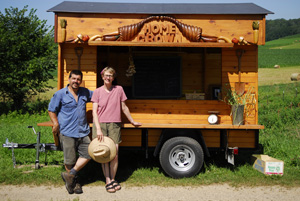
And they truly are works of art, every element incorporating the values of the region to create a stimulating visual connection to our food. A particularly stunning stand designed by artist Homer Daehn features wood carvings done with found materials, consciously chosen and carved with obvious care—apples carved from applewood, potatoes from butternut, squash and corn from white cedar driftwood from Oregon, carrots from reclaimed old growth fir from century-old Wisconsin warehouses.
Not just an artistic outlet, the stands partner with local growers as an opportunity for a small business bringing fresh, local foods to Sauk County, Madison and Milwaukee. “They’re little ‘entrepreneur-mobiles,’” says Donna, “and designed to emphasize and reflect the landscape, part of the ‘eat the view’ concept.”
To find out where they will appear next, visit www.wormfarminstitute.org. The Roadside Culture Stands are an initiative supported by the Wisconsin Arts Board, Wisconsin Farmers Union and the Brico Fund.
When asked how many they plan to build and roll out in the Midwest? “Hundreds,” Donna replies. “Hundreds.”
More Stories by This Author

Edible in your mailbox
