


Rooted: Building Food Resiliency in a Pandemic-Challenged World
As COVID-19 shifted from a distant threat on the news to a reality of everyday life, our nation experienced a shock of looming food insecurity that resulted in unprecedented and resurgent interest in gardening, and rising demand and pressure on food banks. Here in Madison, Community Groundworks and the Center for Resilient Cities have underpinned efforts to increase food resiliency and reconnect residents with gardening. The two organizations merged earlier this year to form Rooted, which has, as they put it, “a new name and a new look, but remain[s] the same organizations you have come to know over the past twenty years in your neighborhood, at your farmers market, in your schools, and where you garden.”
As a small grower with a deep interest in how to put an end to food insecurity, I caught up with Marcia Caton Campbell, Rooted’s Executive Director, to ask how the merger—and a global pandemic—have affected these two well-loved organizations.
Campbell, formerly Executive Director of the Center for Resilient Cities, explained to me that the two organizations had always worked closely together. Center for Resilient Cities was partly an urban land trust that helped to hold the agricultural easements and conservation lands at the Troy Farm site, a staple of Madison urban agriculture and food systems education. Center for Resilient Cities also founded and owned the Badger Rock Neighborhood Center, where CRC contracted Community Groundworks to provide farm staff and training. As Campbell said, the two “worked for many years as essentially sister organizations with dovetailing missions.”
Between 2018 and 2019, the boards of each organization discussed the possibility of merging.The entire staffs of the two organizations were first brought together at a YWCA training on Racial Equity and Inclusion in January 2019. Campbell noted that while they brought together both staffs as a chance to meet each other, they also really wanted the potential new organization “to be grounded in racial equity and inclusion,” including a deep assessment of how their previous organizational structures might enable or inhibit that work. A year later on January 1 2020, the two officially merged to become Rooted. “The work goes on uninterrupted,” Campbell told me. “Everything just kind of slotted together very neatly… Similar missions, commitment to urban ag, racial equity and inclusion, the work that we had done for a long time. It made a tremendous natural fit.” Yet the new organization of Rooted had barely undertaken their initial strategic planning process when the COVID-19 pandemic became a harsh reality. Campbell put it eloquently and succinctly: “We were now one and this was an extraordinary challenge that we needed to rise to.”
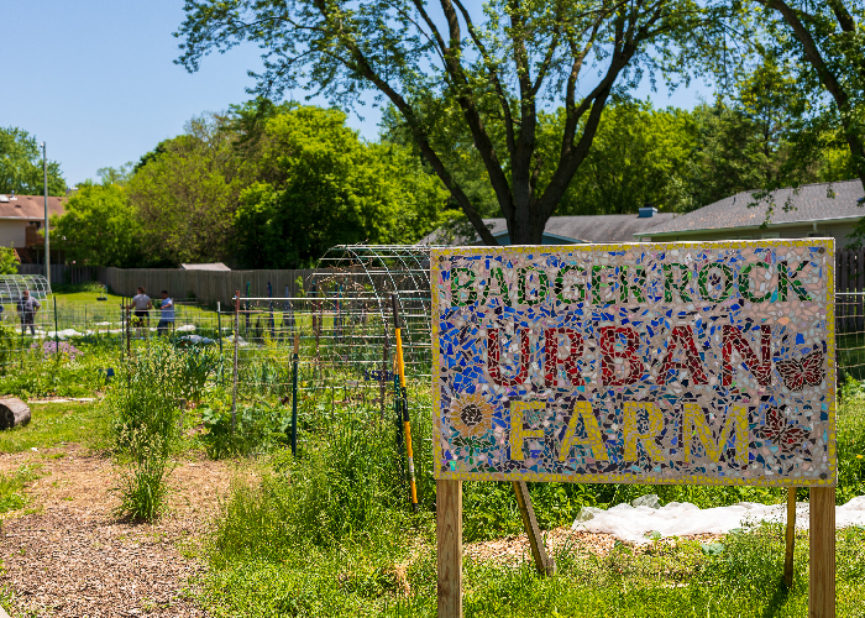
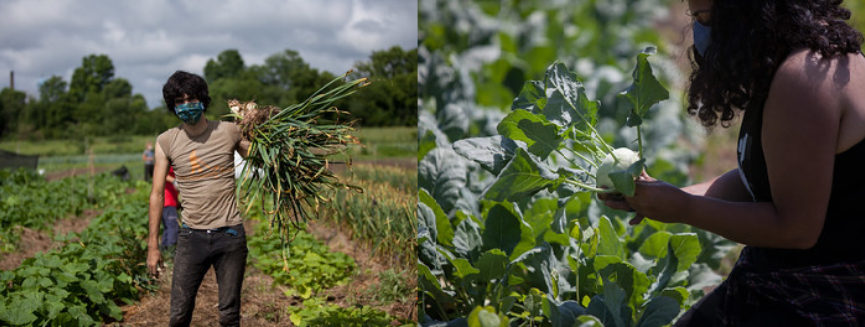
With seeds barely started for their normal season, Rooted decided to double down on vegetable production for community food security, and increased the production area at both Troy Farm and Badger Rock by over 50 percent. They also doubled the number of community garden plots at Badger Rock and took their normal education programming virtual in hopes of reaching more families in their homes. Previously in-person gardening and cooking classes are now offered via Facebook Live, and are banked there for community members to continue to enjoy and learn from. Similar videos are posted to their Youtube channel. While the staff hope to connect with learners in person soon, there has been a very positive response to the virtual classes, and they plan to continue offering them even after the current pandemic has subsided.
Rooted also helps manage a network for “farm to early care and education” programs which include the Wisconsin School Garden Network, a Gardener-in-Residence program that provides unique instruction at Grow Academy (see our September 2015 article about this amazing alternative to juvenile corrections), and The Gardens Network, which connects Madison residents with community garden space and resources. These programs are also supported by partners such as UW-Madison’s Environmental Design Lab and the City of Madison.
Campbell pointed out that the revival of interest in Rooted’s gardening programs after COVID-19 came about “for lots of reasons: because it supplies food but also because it is really good for mental and physical health, and it’s also nice to see other people (masks on of course). Just to know there are people three plots over.” Badger Rock has also become an aggregator of sorts, helping facilitate the transfer of much needed food to hundreds of area families alongside partners such as Community Action Coalition and REAP Food Group. The food produced at Troy Farms includes 85 CSA shares provided free of charge to local families battling food insecurity. Community members can also purchase shares annually, and find produce at their farmstand and the Northside Farmers Market.
I’ve loved all the interviews I’ve done for Edible Madison, but this one brought some tears to my eyes. We all know these are unprecedented times. Campbell and I, alongside so very many others in our community, are in some ways fighting the same battle against COVID-19 and food insecurity from different positions: myself as one very small grower among many struggling to find markets with normal supply chains disrupted, and Campbell spearheading an organization that helps get food and the skills to produce it where they are most needed.
I asked Campbell if the pandemic had brought about any long-term changes for this new organization, and she pointed to an effort alongside Michael Fields Agricultural Institute and UW-Madison’s School of Urban Agriculture to bring programming to Madison High Schools. “We have food system education from preschool through middle school, but then we have this gap because none of the high schools have urban ag programs, or agriculture programs at all,” she said “One of the things we are focusing on is filling that gap… What we really want to do is create this continuum of garden and farm-based education so that someone can follow it on through college or into their own backyards.”
As a young, white, male farmer privileged to follow the continuum of my own family farm, that one hit home. But it was what she said next, when I asked if she had one takeaway for the reader, that really got the tears welling up and prompted me to make a speedy end to the interview: “As an appeal to folks,” she said, “if you’ve got some disposable income, support your local farmers, your local food banks, and figure out where you fit in the food system response to the pandemic to making sure that everyone gets fed. Plug in anywhere. Your time is helpful, even if it’s just doing last-mile food delivery.
“The business of working to relocalize the food system is more important now than ever, and there … are a myriad ways you can plug into this food system to keep it functioning healthily and actually rebuild it. Find the place in the food system that moves you, that you have a passion for, and jump in. Because we need you.”
More Stories by This Author

Edible in your mailbox
