

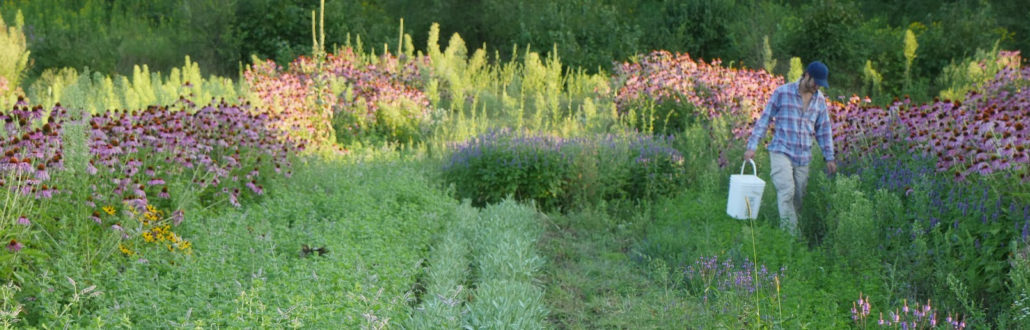
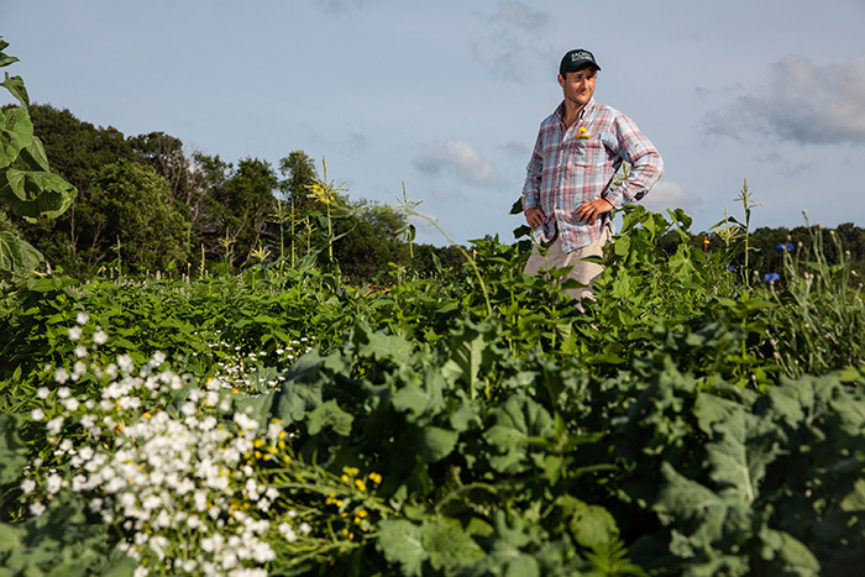
At Sacred Blossom Farm, Tony DiMaggio grows and harvests herbs: fragrant tulsi interplanted with red clovers, wild stinging nettles foraged from surrounding woods, ashwagandha with roots growing deep into the soil. He harvests with the help of his team. That is, a few employees, including neighboring farmers who join during their own slow season, and two very happy dogs.
After harvest, each plant is carefully dried in greenhouses. Later they are packaged as individual herbs or mixed tea blends. One winter afternoon, I brewed a cup of Sacred Blossom Farm’s Tiger tea and watched as the gently dried herbs blossomed like flowers in the just-boiled water. Each herb seemed to hold its original color and textures. This is the quality that DiMaggio strives to offer. “By doing the whole leaf, loose leaf thing, we’re really held accountable that it’s just top quality stuff in there,” he says. “Because if it's not, it's gonna be really obvious.”
Sacred Blossom Farm sits just outside of Mondovi. They lease land from Crazy Rooster Farm and are surrounded by other agriculturalists. Neighboring farmers collaborate often with DiMaggio. One farmer provides a freezer full of beef in exchange for grazing access and occasional cattle moving. DiMaggio has worked that grazing into his herb crop rotation. Other farmers help forage for herbs during their slow seasons. Together, they scrape cherry bark, pinch off raspberry leaves and collect white pine needles, all harvests that require significant time and labor. Many of the full-time or regular Sacred Blossom employees have been around for years. “We really try to create good jobs for people,” DiMaggio says. “What we do, it's very unique and every week is like a totally different set of processes and jobs. So retaining people for the long-term is super helpful.”
The landowners of Crazy Rooster Farm were some of the earliest investors in Sacred Blossom Farm’s mission. They offered the acreage rent-free for the first two years. As the business grew, the rent inched up. Today, having landed on its own two feet, Sacred Blossom Farm pays market rates for leasing the land. Land access is one of the greatest barriers for young and beginning farmers around the country, so land stewardship relationships like the one between Sacred Blossom and Crazy Rooster farms can make or break the success of dedicated, talented young farmers.
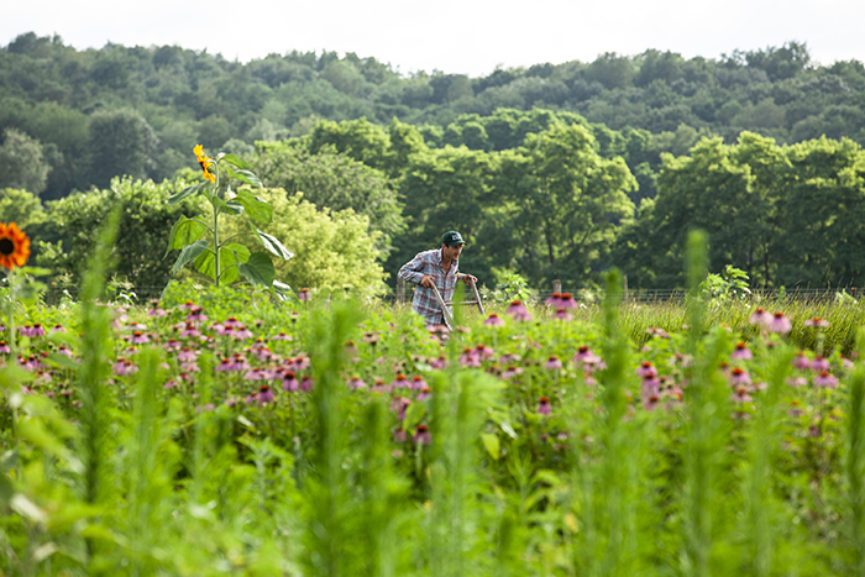
Anyone steeped in regional farm systems knows how hard it is for small farms and beginning farmers to turn a sustainable profit even when they do find affordable land. Those farmers need a lot of grit and a bit of genius. But they also need some strokes of luck, and importantly, a supportive community.
DiMaggio spent nearly a decade trying to crack that small farm code. “What could I do to get in the game and stay in the game?” he asked himself, “As well as follow my goal of farming for health. You know, for my health, for the health of the people that consume my food, and the health of the planet.” After seven years apprenticing and managing an established farm in Minnesota, he travelled for a year visiting specialty crop farms around the country and in South America. The sweet spot, he decided, was low initial overhead and a value-added product. He landed on herbs and herbal tea.
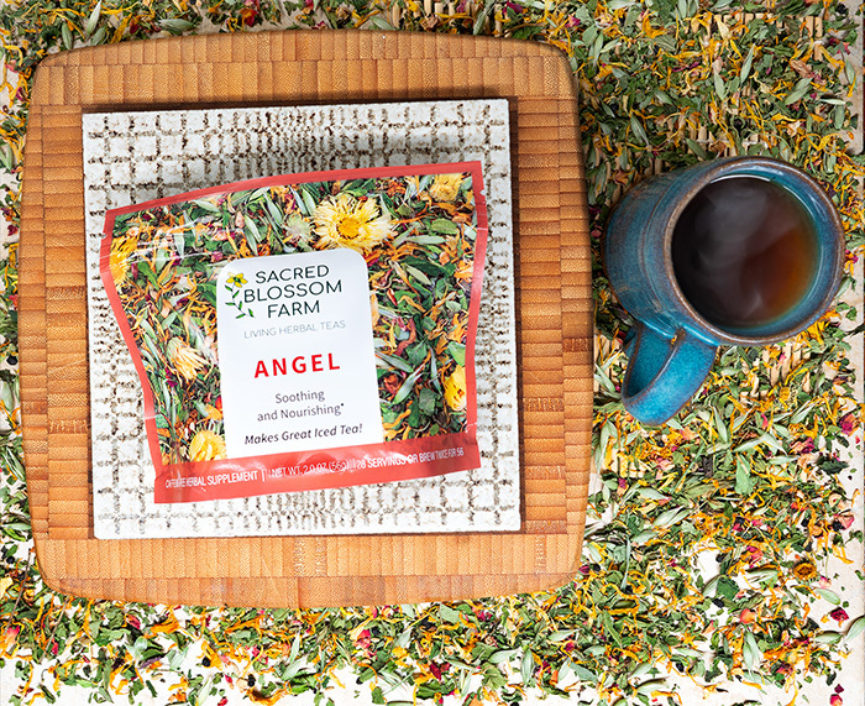
DiMaggio dove into herbs and herbal teas, learning through research and hands-on education. When it comes to creating tea blends, “it has to be functional, and it has to taste great,” DiMaggio says. “I have journals and journals full with tea recipes and iterations on these different flavors.” Angel Herbal Tea, one of Sacred Blossom Farm’s first offerings, took 350 iterations. It is a blend of mint, nettles, lemon balm and other flavorful herbs. It’s also the winner of the Chicago Tea Festival’s 2019 People’s Choice Award.
Despite his dedication to excellent tea blends, the straight tulsi tea is DiMaggio’s favorite Sacred Blossom Farm product. Tulsi is also his very favorite plant to grow. In the summer, he says, “I go sit out there in the evenings and she's like buzzing, buzzing loud with thousands of bees.” Anyone who has taken a deep inhale of tulsi knows the energy it can send throughout your body. To know that we share the joys of tulsi with our bee accomplices is a treat in and of itself.
Sacred Blossom Farm has grown from two large garden beds several years ago to twenty acres of herbs and two greenhouses today. In the first year, herbs were hand-harvested from densely planted polycultures. Now, herbs are planted in triple-row beds, cut carefully with a swather. “Most people who grow herbs come at it from an herbalism background. But I come at it more from a production background,” DiMaggio says, as he shares how the farm has grown each year. “We're not big scale at all, but you know, we're not doing like a few raised beds either. We grow herbs on about 20 acres.”
To maintain ecological diversity as they have scaled up, the Sacred Blossom team has found ways to maintain plant diversity and soil health within a row crop system. California poppies are planted in middle rows of the triple-row beds to draw in pollinators. Other plants distract foliage-eating insects, deterring those insects from the marketed varieties.
“We take fennel, which attracts so many different insects, and we scatter that all around the farm.” To increase winter ground cover, red clover is interseeded with tulsi, and winter oats are planted amongst perennial herbs. That winter ground cover builds soil organic matter and helps insulate perennials throughout the winter.
Just last fall, DiMaggio was offered a 10-year lease on a larger, neighboring plot of land. The soil is a heavier clay, and DiMaggio is excited to plant elderberries and other shrubs that struggle in the sandier soils of Crazy Rooster. In addition to more acreage, Sacred Blossom Farm recently bought a processing building in Mondovi. “A neighbor friend sold me the old meat locker in town—a 115-year-old meatlocker, that most recently was a cheese factory.” The building has made packaging and storage easier, and shipping trucks can move in and out far more smoothly than on a farm. And it was nearly turnkey, ready to use from the day of purchase—but not quite. “Another funny thing is—this building we bought? They left 2,000 pounds of cheese behind in the basement. And it smelled like, really, really bad. We had wheelbarrows full of cheese.” DiMaggio says smiling. From the other room, DiMaggio's partner Nora chimes in with a laugh, “It smells incredible now and there's no indication of cheese—and there is no cross-contamination!”
With the arrival of spring, the farmers and processors at Sacred Blossom Farm are finishing packing hundreds of thousands of loose leaf tea bags. Soon, they will start seeds in the greenhouses. Until then, it is tea time. “ It doesn't really matter what the situation is, you know?” says DiMaggio, “It calls for a cup of tea.”
More Stories by This Author

Edible in your mailbox
