

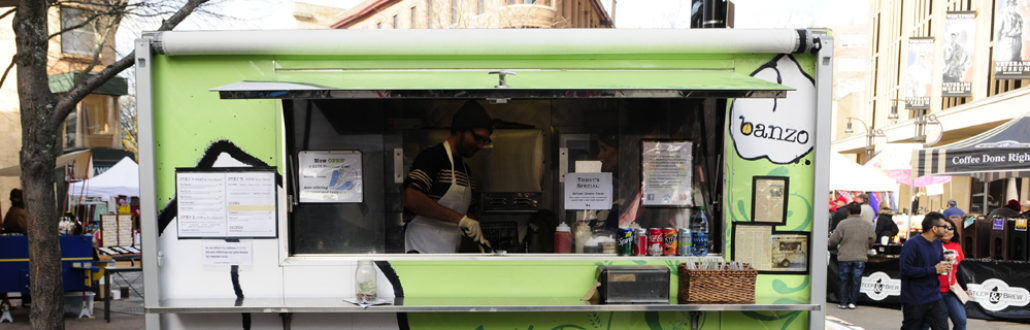
They’re tiny and cute and a lot of work. And totally worth it.
If there’s one thing all food cart operators in Madison want you to know, it’s that running a food cart is harder than it looks.
We hungry folks walk up on a bright and shining day and see the cute little carts decked out in their bright colors with shining faces at the window. What we don’t see is everything that goes on behind the scenes to bring that wonderful food to our mouths. And it’s more than just food prep.
A DAY IN THE LIFE
Madison’s food cart scene is satisfyingly eclectic. A walk around the Capitol Square or through the Library Mall, cutting through the University of Wisconsin-Madison campus, bombards you with Peruvian, Mexican, Venezuelan, Japanese, American, Mediterranean, Indonisian, Thai, Chinese, and for good measure, smoothies and drinks. Some of the carts operate year-round to brighten their loyal, cold-weather patrons’ days with a hot lunch. Once the weather warms up, the atmosphere turns jovial and expectant, with students and downtowners perched on every available surface to enjoy the fresh air, sunshine and good food.
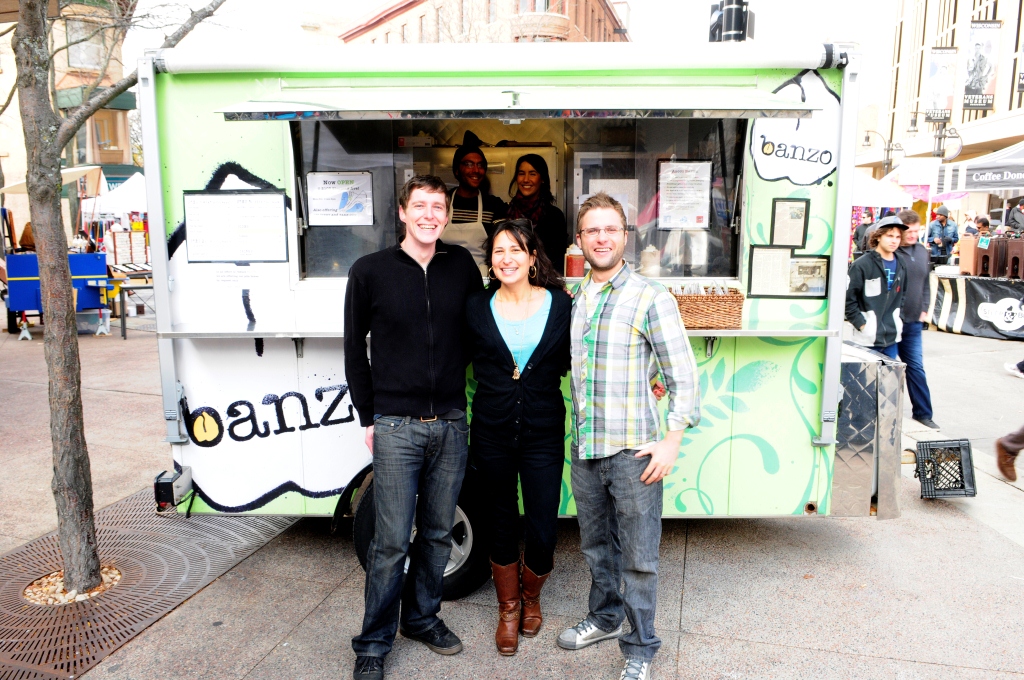
And yes, the food is delicious. “It pretty much has to be,” says Dan Schmitz, chef and kitchen manager for Banzo. “In other cities, the carts are spread out all over town, and if there’s a bad one, it can usually get by. But here we’re put in clusters, which is pretty smart. If there’s a cart with bad food, people don’t have to go to it. And they won’t. And they’ll tell their friends.”
The carts must have their menu approved before they can begin operating to weed out copycats, and they’re ranked each August to determine their location for the next 12 months. Besides ensuring delicious and varied food options, these policies allay the fear of turf wars that plague other cities’ food cart cultures. “You have your spot and that’s your spot; nobody else can take it,” says Dan.
“If you’re going to run a business, you ought to know where you’re going to put it that day. I’m grateful to have a spot,” says Melanie Nelson, owner of Good Food. She calls the vibe between the vendors fraternal. “You drive past with your cart and we both wave, and we trade food. I think that’s pretty special for Madison.”
And with everything to take care of in a day of running a food business, who needs the stress of unfriendly competition?
“It’s definitely more work than just having a regular restaurant,” says Dan. The carts aren’t allowed to do any food prep in the cart or on-site, so they must prep everything the night before, which requires owning or having access to a commercial kitchen somewhere in the city. The carts are loaded up in the morning and pulled to their locations; they sell for three to four hours; then the cart must be removed every afternoon, cleaned and restocked.
All in all, it comes to 12 to 14 hours of work per day for only three to five hours of sales. Many of the carts supplement their business with catering, a restaurant location (which doubles as the prep kitchen) or special events, such as the Isthmus a la Carts food cart festival, Great Taste of the Midwest and neighborhood Meet and Eats.
“The carts are really charming for people who don’t do it, but really, it adds an extra step to running a restaurant,” says Netalee Sheinman, who co-owns Banzo with partner Aaron Collins. “But we enjoy what it’s become.”
SOCIAL MEDIA ON THE SCENE
In other cities, the social media boom has made it easy to track a cart’s location day by day, but in Madison, where assigned locations makes tracking unnecessary, the carts use Facebook and Twitter a little differently. In a business where the staff only have a few seconds of face-time with each customer, social media has become a great way to express their personalities and make connections with loyal customers.
When Melanie at Good Food posted on Facebook that she was bringing back the Strawberry Love wrap, her followers went gaga. “Every post had an exclamation point,” she says. “It feels good to be well-received like that.” (Sidenote: She added candied pecans this year, a fantastic surprise!)
Steven Lawrence, CEO/Janitor of the late-night Fried and Fabulous, says that social media is an extension of his personality. (He also gushed about Strawberry Love for a bit— he’d found out on Facebook, too.) He posts funny pictures and quotes from the midnight to three a.m. scene, and he takes suggestions and comments seriously. “When ‘Dave’ takes time to tell me on Facebook that he’s coming to the cart tonight and can’t wait to have a fried cinnamon bun, I’ll remember to set one aside for him if we’re down to the last one. That’s the kind of personal touch an owner working on the scene brings to a small business.”
From posting about that day’s special menu item to a photo of the tip jar with a cheeky caption, social media brings the people behind these hopping mobile facades into 3D view.
CARTS BUILDING COMMUNITY
They're not just fostering goodwill among their customers or the food cart clique either. These entrepreneurs are building relationships with farms and non-mobile restaurants in and around the region. Many cart operators seek out local foods directly from farms and local suppliers where available, such as R.E. Golden Produce. Melanie is noodling over a distribution network to transport and consolidate local, farm-fresh food, which would save both the farmers and the city’s food businesses gas money and time, while providing more access to quality, local food. “Maybe that’ll be my next business,” she muses.
Steven was late to our interview because he was running up and down State Street talking to David of Madison Sourdough in order to help Katie from Madison Sweets navigate some confusing food cart and farmers market policies. I forgave him instantly, and Katie will pay him back in cupcakes.
“Right there you have three different business owners who are communicating very openly about a similar event at a similar location selling similar foods,” he says. “I have a deep fried cinnamon bun, David has an actual cinnamon bun, and Katie has a cinnamon bun macaroon, and we’re helping each other out anyway.”
Cart culture also helps the community build relationships within itself. “Meet and Eats” kicked off just last year and are already quite popular. Twice each summer month, the events bring food carts to areas of Madison that may not have easy access to fresh food (nearly all of the food carts prepare their food from scratch) or local restaurants beyond the fast food and convenience stores. More important, the events draw people out of their homes and get neighbors meeting neighbors and local police. Folks are more likely to look out for people they know and more likely to contact police after a positive experience. The cost of these events to the City of Madison is minimal, and the relationship building has sustainable, long-lasting benefits that can really change a neighborhood for the better.
THE VIEW OUT THE FOOD CART WINDOW
“It’s stressful, to be honest, definitely stressful,” says Netalee. “You see the people lined up waiting for their food, staring at you, and sometimes you need a quick huddle below the window.”
“It’s the size of a shoebox in there,” says Melanie with a laugh. It’s hard to believe these tiny carts have two to three people inside. “I see a lot of regulars. We know a lot of names; a lot of orders.”
“Since we’re late-night, it’s dark outside and I have a bright, bright light inside, so I’m usually waving at myself in the window,” says Steven. “If I stick my head out, though, I see drunk people, yeah, but I also see people who are at ease at the end of their week and having a lot of fun.”
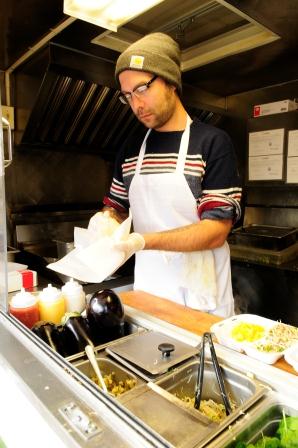
The next day, Saturday, I open an email from Steven sent at 1:28 a.m. It contains a slightly fuzzy photo of the sidewalk and some feet. The caption: “I see lots of legs and shoes.”
The carts present some unique challenges, too, such as when the Banzo team got one of their two carts stuck under their Sherman Avenue restaurant’s eaves. “We were kicking it, letting the air out of the tires, piling people inside to weigh it down, everything!” says Netalee.
But she also says the meaningful experiences balance out the challenges. “A man came up to me one day and said, ‘You know, I looove my meat and potatoes, but sometimes when I eat I don’t feel so good. But when I had your food, I feel good!’ Here’s this meat and potatoes guy who’d maybe never had vegetarian food and whose wife probably dragged him out there, and he really liked it. That touched me.”
They see out their windows neighboring vendors who will fix generators and trade food, or even give food to one another because they all know it’ll come back around in a few days. That friendliness spills over into their dealings with customers; even when I didn’t know what (or how) to order and with people lining up behind me, the servers I encountered always gave me their advice and a smile, which makes me eager to go back.
When a wall of Luis Dompablo’s cart, Caracas Empanadas, began smoldering at the 2011 Taste of Madison festival, the support was immediate. “The festival organizer was so helpful,” he says. “She got the word out right away. Another vendor let me borrow his fryer, and the next day we were back in business. It was weird. It was almost like a movie. Hard to believe it was happening to us.”
After he redesigned his cart, “Luis came around to our cart to tell us what happened,” says Netalee, “and he looked over all of our equipment to make sure the same thing wouldn’t happen to us. That meant a lot.”
When Luis looks out his window, he sees a community. “I really do. It makes you feel alive. It makes you feel part of this city.”
A LA CARTS!
More Stories by This Author

Edible in your mailbox
