

More than you think when it comes to Wisconsin cheese.
Marisa, Dunbarton, Evalon: three names that could be characters in a Shakespeare play, cities in Italy or answers to a Trivial Pursuit question. Instead, they are the names of three Wisconsin cheeses, examples of a growing American trend to name cheese after people and places instead of traditional European varieties.
Naming a cheese is more complicated than one might expect. There are many European cheese names that can’t be used at all in America. In the past, if you made a common European cheese, you could label it as such. But the European Union has halted this practice by protecting well-known varieties with a “designation of origin” label, limiting production to specific locations in Europe.
For example, let’s say you want to make Manchego, a well-known Spanish sheep’s milk cheese. That name is now protected by the European Union. Unless you’re living in the La Mancha region of Spain and making your cheese from the milk of sheep of the Manchega breed, your cheese can’t be called Manchego. The same applies to other greats such as Pecorino Romano, Saint-Nectaire and Danish Blue.
As a result, since about ten years ago, when American cheesemakers create a cheese similar to a European variety, they give the cheese a unique name, often based on their own region or the name of a loved one. Then in accompanying literature and label copy, they state the cheese is based on a specific European style of cheese.
Perhaps the most famous example of this naming procedure is the three-time American Best in Show winner, Pleasant Ridge Reserve. Ask Uplands Cheese co-founder Mike Gingrich what type of cheese he crafts, and he’ll quickly answer “Beaufort.” But Beaufort was certified as a name-protected cheese in France in 1968. That means if you don’t live in the Beaufortain, Tarentaise or Maurienne valleys and make the cheese using certain procedures from the milk of Tarentaise or Abondance cows that graze in the Alps, you can’t label your cheese Beaufort.
“By using only grass-fed, raw milk, our Pleasant Ridge Reserve recipe follows the tradition of the Alpage versions of Beaufort, but we have tailored it to our own, unique milk supply,” Gingrich says. And when it came time to name the cheese, Gingrich looked no further than his back door. That’s because the dairy farm literally sits on Pleasant Ridge in the Driftless region of southwest Wisconsin.
When naming a cheese, cheesemakers must not only be familiar with European Union rules, they must also research U.S. standards. If a cheesemaker wants to use a common variety name that is not nameprotected, such as Asiago, Brick or Cheddar, then Title 21, Part 133 of the U.S. Code of Federal Regulations for standards of identity must first be checked.
For example, let’s say you wake up one day and decide to make “Swiss cheese.” To label the cheese as such in the United States, Section 133.195 of the Code of Federal Regulations dictates the cheese must have holes, or "eyes," developed throughout, with a minimum milk fat content of 43 percent. The code also specifies precise cheesemaking procedures, such as cutting the curd mass into “particles similar in size to wheat kernels,” alternately stirring and allowing them to “settle for 30 minutes,” transferring and pressing the curd in hoops or forms, and then salting “by immersing it in a saturated salt solution for about 3 days.” The cheese must then be held at certain temperatures until the so-called eyes form and transitioned to a lower temperature for further curing.
So while some Wisconsin cheesemakers do make Swiss, Asiago, Brick and Cheddar cheeses following the U.S. standards of identity, others develop their own versions of tried-and-true European cheeses and then use fanciful names to avoid European Union or American naming rules. Often, these cheeses are considered American Originals.
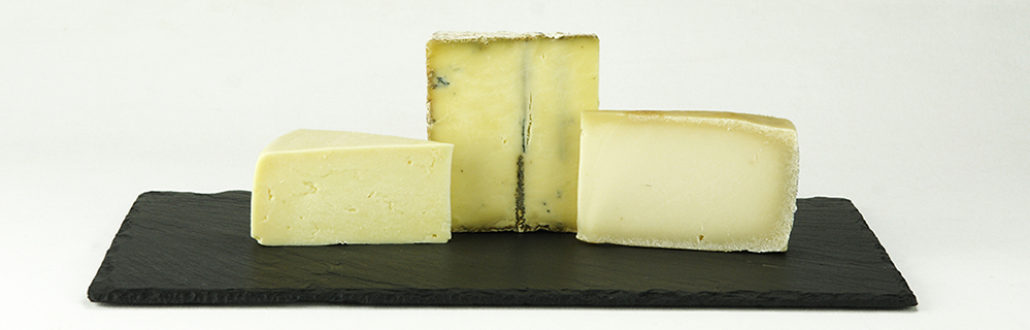
Dunbarton (above middle), made by Chris Roelli at Roelli Cheese in Shullsburg is the perfect example. An earthy, cheddared blue that is open-air cured on wooden boards in Roelli’s custom-made cheese cellars, Dunbarton has the feel of an English Cheddar spiked with the delicate, subtle flavor of a fine blue. Roelli named it after his neighboring Dunbarton Township.
And then there’s Marisa (above left), a seasonal sheep’s milk cheese made by Sid Cook at Carr Valley Cheese. Ask Cook to describe this cheese— named for his daughter—and he’ll describe both the cheese and the girl as sweet and slightly rambunctious. “Both are true originals,” Cook says.
Finally, there is Evalon (above right), the 2011 U.S Champion Cheese crafted by Katie Hedrich at LaClare Farms in Pipe, Wisconsin. The property where the family’s new farmstead operation is located was originally purchased in the 1940s by owner Larry Hedrich’s grandparents, Greg and Evelyn Ecker. As a teenager, Larry grew up helping his grandparents on the farm. So when it came time to name the family’s first signature cheese, the Hedrichs chose Evalon, in honor of Grandma Evelyn.
Peruse any American cheese counter and you’ll quickly realize most cheeses carry unique names: just another growing American tradition.
Featured Recipes


More Stories by This Author

Edible in your mailbox
