

In Wisconsin’s Driftless Area, several thousand miles of trout streams offer both quality fishing and plenty of opportunities to have fresh fish for dinner. Let’s take a little look at the region and its productive streams, how to catch trout and ways to prepare them for your family’s plates.
Southwestern and western Wisconsin were not covered in a mile of ice during the last Ice Age (from about 110,000 to about 12,000 years ago) like the rest of the state. That means the limestone-sandstone bluffs weren’t ground down by the ice shield and pulverized like the bedrock of much of Wisconsin. Elsewhere, you can see boulders and gravel left by the retreating glaciers. It’s known as “glacial drift.” You won’t find it in the 25 counties lying west of Madison in an arc along the Mississippi River up toward River Falls. Early geologists exploring the area thus called it the “Driftless Area.”
The Driftless Area’s bedrock is crucial to the quality of the spring-fed streams flowing out of the bases of the bluffs and wending toward the Mississippi, Wisconsin, Kickapoo and other rivers. Why? It provides calcium minerals that sustain organisms in a rich food chain. The springs flow consistently and cold at about 48 degrees, so they don’t freeze in the winter and stay cool in summer—perfect for native brook trout and introduced brown trout. These streams, when not choked with sediment or pollutants, are the most productive cold waters in the state.
After European settlement in the 19th century, farmers and loggers used these lands hard, not concerned about losing soil to erosion. When the ridges and blufftops were logged and their deep-rooted prairie plants replaced by shallow-rooted wheat, the soil on the high ground began to slide downward into the valleys and rivers. By the 1930s, flooding was widespread, streams were badly degraded and communities couldn’t afford to keep fixing bridges so dairy farmers could get their milk to their creameries. An economic crisis loomed.
In 1934, the brand-new Soil Erosion Service started the nation’s first watershed protection project around Coon Valley, 30 miles southeast of La Crosse. The Civilian Conservation Corps and Works Progress Administration, formed to provide work to the millions of unemployed during the Depression, worked to install check dams on eroding gullies and contour strips on upland fields. That helped the farmers and communities, but the streams were still choked with sediment and prone to flooding. In the late 1950s, the Wisconsin Conservation Department’s fisheries chief wrote off the Driftless streams as trout habitat.
But anglers and local clubs and eventually the Wisconsin Department of Natural Resources worked to bring those streams back to health. By the 1990s, hundreds of miles of habitat had been restored and public access rights secured so anglers could walk along the streams and fish.
Now the area has a nationwide reputation for abundant, high-quality streams. Where habitat work has been done, populations have often increased dramatically—2,000 trout per mile of stream is not unusual.
This means an economic boost to the region of over $1 billion a year brought in by visiting anglers. It’s not unusual to drive along these streams during the season and see cars from Minnesota, Illinois, Missouri, Ohio and plenty of places farther off.
Many people these days—Edible Madison readers among them—try hard to be aware of where their food comes from. If you’ve wondered about trout as a food resource, this is a great region to learn about how to catch, cook and enjoy them.
These trout can be caught by many legal methods: with flies, spinners or bait. Significant numbers of anglers use each method, and there’s a lot of loyalty to one’s own practice. Even though people catch plenty of brown and, to a lesser extent, brook trout, most anglers surveyed by the DNR report they don’t keep many fish. Fisheries managers who keep track of populations uniformly suggest that taking a meal’s worth of an 8- to 12-inch trout won’t hurt, and may actually help, the overall population.
In most of the Driftless Area, these trout reproduce naturally and aren’t stocked. That means a higher quality flesh and good eating. One of the most common food sources for trout in these streams is a freshwater shrimp, or “scud,” which gives the trout an orange, salmon-colored flesh. Stocked fish born in hatcheries or fish that live in streams without many scuds may have whiter flesh.
For several years, the Wisconsin DNR has annually staged a weekend workshop for people who’d like to learn rudiments of fishing and cooking trout. I call it “Fishing for Dinner,” but this year the DNR has cancelled it, possibly due to budgetary tightness. They should consider re-starting it.
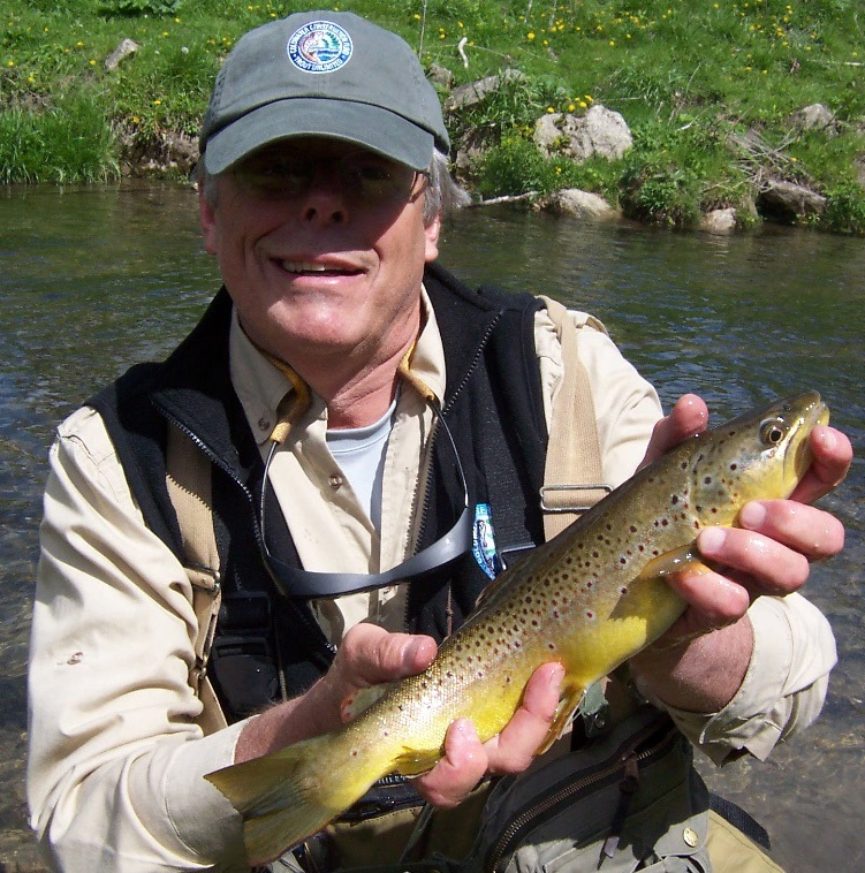
So, let’s cook trout. Ideally, fresh-caught trout should be cleaned when caught and kept cool until you’re in the kitchen (or, for some, until you have a campfire or camp stove ready). When I look to bring home trout for a meal, I bring a creel or a plastic bag with ice (and if I don’t catch trout, I can dump out the ice and fill the bag with morels, ramps or other bounty). I carry a small knife and gut the trout with a single cut, from the base of gills to the anal vent, and scoop out the entrails (which by regulation need to be kept in my ice bag). Two 12-inch trout will feed two people, or three 8-inch trout.
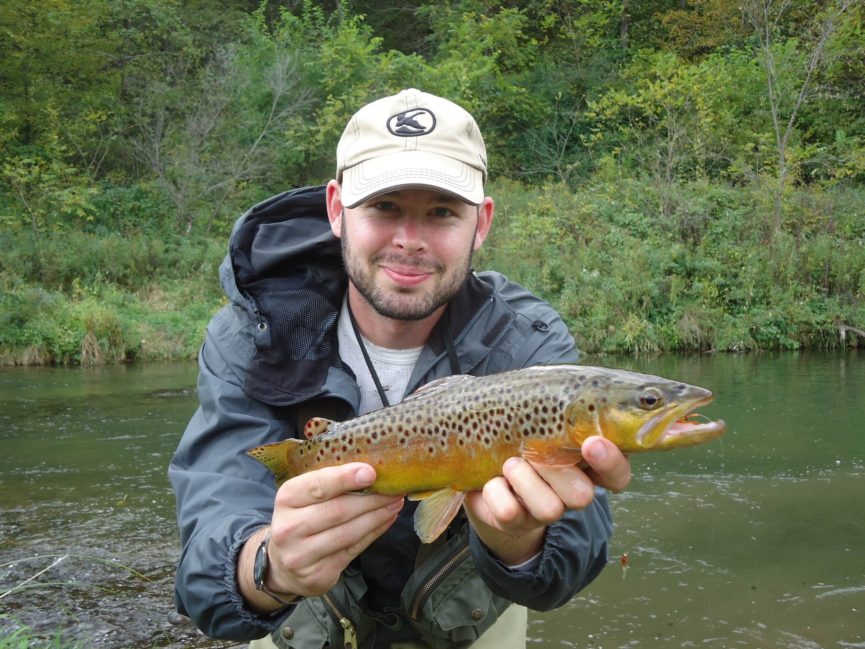
Brown trout, which dominate most of our Driftless streams, were introduced from Europe more than a century ago. They’re a colorful fish, with black-spotted backs and a yellow belly that turns golden when it’s fall and spawning time.
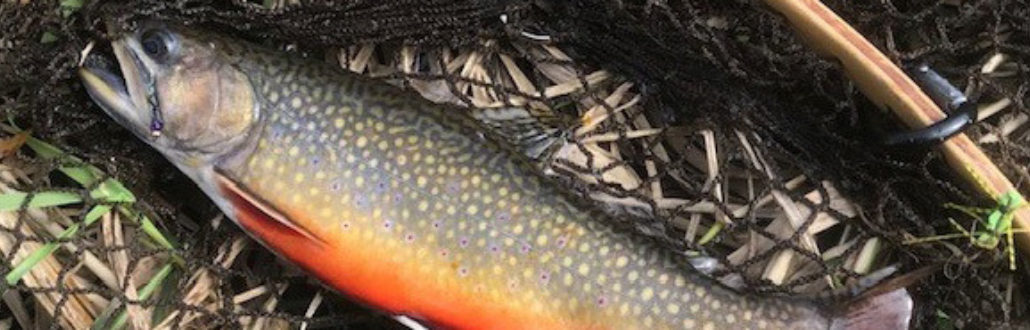
Our only native trout are brook trout, also a colorful fish with pink to orange bellies, spots with red or blue aureoles, and backs with green noodle-like markings. Brookies are struggling with changing climate (warmer summer temperatures, flooding), habitat loss and competition from the brown trout. If you have a yen for brookies, fish in the Rockies where brookies are considered an invasive species and outcompete the western native cutthroat trout. There, eat all the brookies you want and the regulations allow.
Now come the choices. Many simply put those trout on a piece of foil, season with salt and pepper and a squeeze of lemon and snip of parsley, securely fold the foil edges together and bake at 325 degrees F until the flesh flakes easily. If you’re outdoors, put it on the grill or edge of a fire for 10 minutes. Then open the foil and see if the flesh flakes easily, and serve.
You can also pass up the foil, spice the fish and lay it on an oiled grill for 10–15 minutes.
My favorite recipe (and more importantly, my wife’s) calls for fileting the two sides of the fish and cutting the pieces into 11/2 to 2-inch chunks, skin on or off as you choose. Trout have very fine scales and it’s not necessary to scale them. The chunks are dipped in beaten eggs and tossed in a bag or bowl with cracker crumbs, Parmesan cheese and salt and pepper (and onion and/or garlic powder if you wish), sautéed in butter and served with crackers. They’re a great appetizer.
Trout meunière is simpler than its name suggests. Remove (if you wish, but you’d miss the cheek morsels) the head, then dip the rest in egg and then in seasoned flour, and sauté in browned butter. Serve on a platter with meunière sauce, which is simply browned butter, fresh chopped parsley and a teaspoon of fresh lemon juice.
Trout almondine is another popular and easy recipe. Dust the cleaned fish in seasoned flour, sauté in butter, and remove to a platter in a warm oven. Using the same pan, brown ¼ to ½ cup of slivered almonds until golden brown, then add ¼ cup vermouth and parsley and heat. Pour the sauce over the trout and serve.
Lighter wine pairings with these recipes include a New Zealand sauvignon blanc, pinot grigio from almost anywhere, a French chardonnay or a rosé of pinot noir or cabernet. Even Wollersheim’s Prairie Fumé can be a good complement.
Trout is not a strong-flavored fish, so you won’t find many recipes using garlic or other strong flavors. Instead, consider using parsley, dill or chervil for herbs, and always consider using lemon to zing it up a little.
If you aren’t an angler, you probably know one who might bring you some freshly cleaned trout. When I ask a landowner or farmer for permission to fish along their stream, I often ask if I can drop off a pair of fresh trout. Few decline the offer.
This food source is abundant across our area, easy to prepare and tasty–well worth the effort.
More Stories by This Author

Edible in your mailbox
