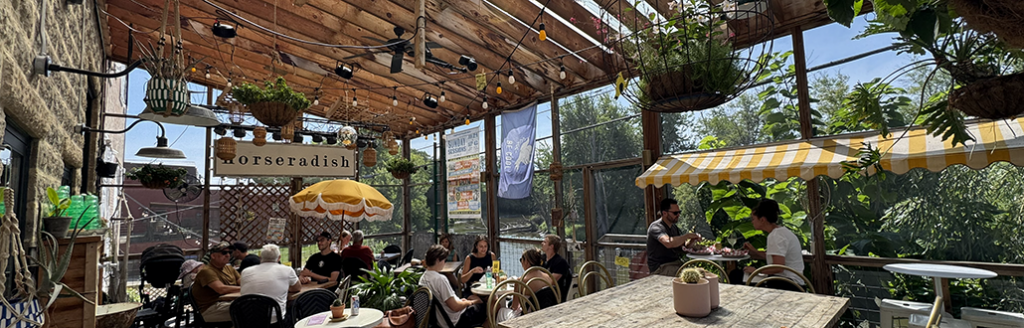
Those who have watched Horseradish Kitchen + Market grow since 2015 might recognize the striped yellow awning hanging in the corner of the eatery’s screened-in patio overlooking the Fox River. It’s the same awning that shaded walk-up guests when Horseradish was a stationary food truck just across the street from its current location (505 W. Water St.) in Princeton.
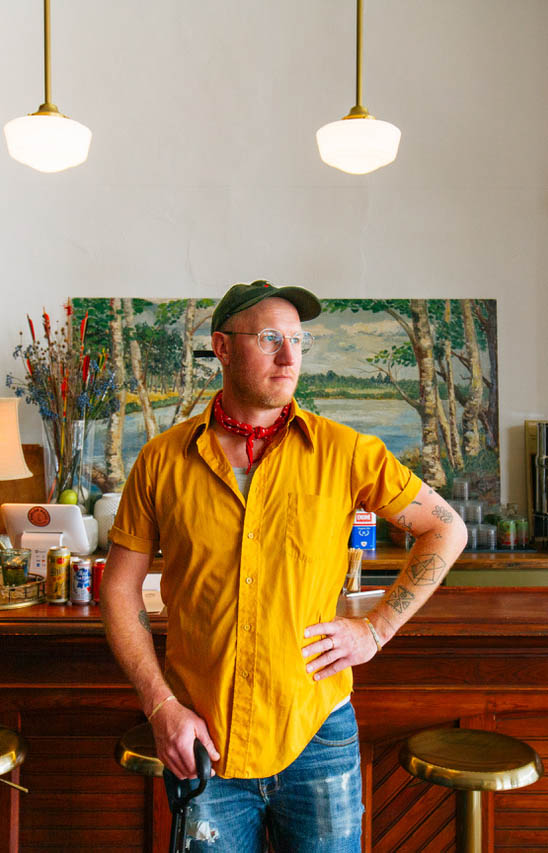
Matt Trotter is a collector of visual reminders like this one that tell a story. The yellow awning tells the story of what happens when you plant a seed and let it grow.
He started out in 2012 with a retail shop called Teak & Soxy at 444 W. Water St. Then in 2015, Trotter parked a white 1984 Check Econoline school bus in the adjacent lot and started a food truck with little food-service knowledge.
“All these people before me when I was coming of age, they sort of gave me the freedom to think of this as a place where you can be creative,” -Matt Trotter
“It does seem risky when you talk about it now, but I didn’t have a lot to lose at that point,” Trotter says. And he started small—the truck only cost around $3,000, he notes.
Then, there was an even bigger risk. Alex and Sarah Pearsall, Horseradish regulars who were impressed with Trotter’s food, bought the historic building across the street and asked Trotter to partner with them to reopen Horseradish with a permanent address. “[Trotter] is this amazing visionary, and he’s got a design sense that I think is unparalleled,” Alex Pearsall says.
They opened the doors (and an Airbnb upstairs) in 2018. The growth has continued since then. A weekly live music event called The Sunday Sessions launched in 2019. Teak & Soxy reopened inside Horseradish in 2021. The next year, a sister operation started welcoming overnight guests down the street at the seven-room Parlor Hotel (544 W. Water St.). And there’s a lot more on the way.
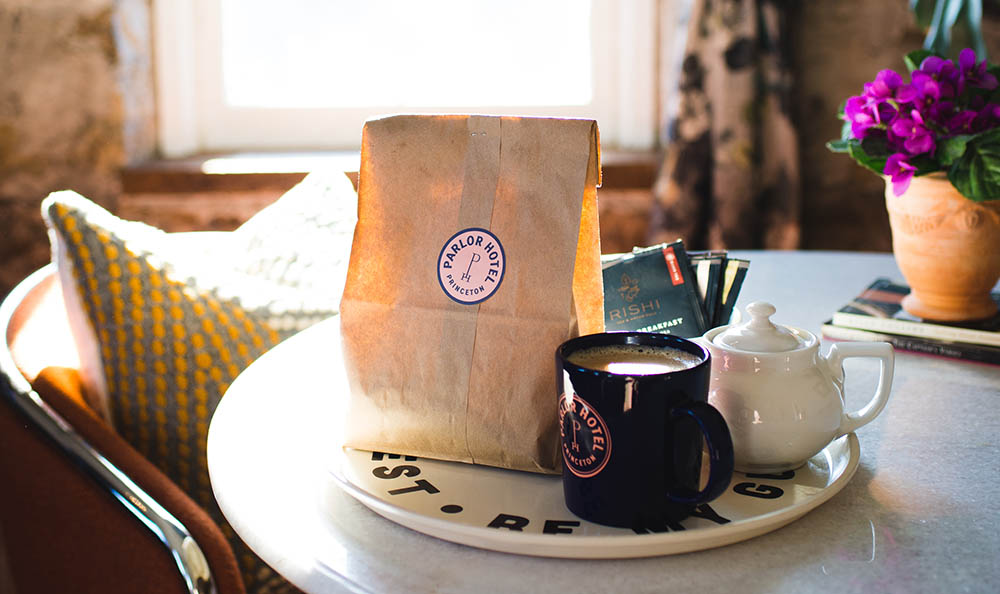
“They’re all these interconnected hospitality businesses,” says Greg Wright, who entered the picture in 2022. A relationship with Trotter meant a relationship with his enterprises, too. Wright now manages Parlor Hotel and does HR work for both operations.
“My favorite joke is that I thought I was on a dating app, but I must have actually been on Indeed,” Wright says.
Today, Wright helping run Horseradish feels exactly, well, right.
“I like the big picture, he likes the micro details of placemaking,” says Wright, who grew up in Stevens Point. “A lot of what we connected on right away was a similar love of these small communities and a desire to see them have new life breathed into them.”
“A lot of what we connected on right away was a similar love of these small communities and a desire to see them have new life breathed into them.” -Greg Wright
For Trotter, his hometown holds a lot of meaning and family history. He’s the fourth generation of his family to operate a business in Princeton. His great-grandparents made and sold hand knit slipper socks in Princeton; they’re credited with popularizing the footwear called Muk Luks. Growing up there in the early 2000s, Trotter says he watched a community of artists, designers and retailers spark a resurgence after an economic slowdown in Princeton.
“All these people before me when I was coming of age, they sort of gave me the freedom to think of this as a place where you can be creative,” Trotter says. “I wouldn’t be back here if there hadn’t been people who had done that in my youth and I watched it happen, and a lot of them were queer people. It was so cutting-edge what those people first did.” He notes that Princeton hasn’t lost that creative standard—the local entrepreneurs around him today are still just as special.
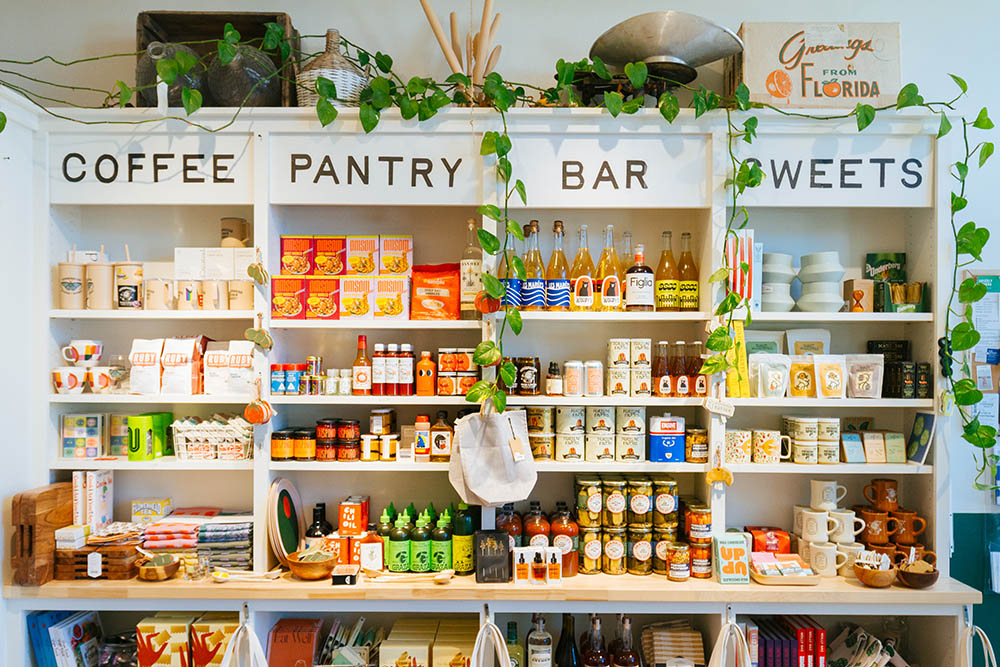
Trotter has joined the business community and infused his distinct sense of style into his work. Horseradish brims with character, color, plants, art, music, playful fonts, intentionally built spaces and vibrant plates of food.
“He can bring something unexpected to the community in a way that still feels very approachable and familiar to people,” Wright says. The businesses have grown both organically and strategically to serve Princeton’s 1,267 residents, plus visitors who now see the town as a destination.
“We’re thinking about: What makes a small community thrive in an era when a lot of small towns are struggling economically? How do you bring back the charm, care and beauty of these communities?” says Wright, who also runs his own consulting business called Spark Towns, which works with communities on public art and entrepreneurship.
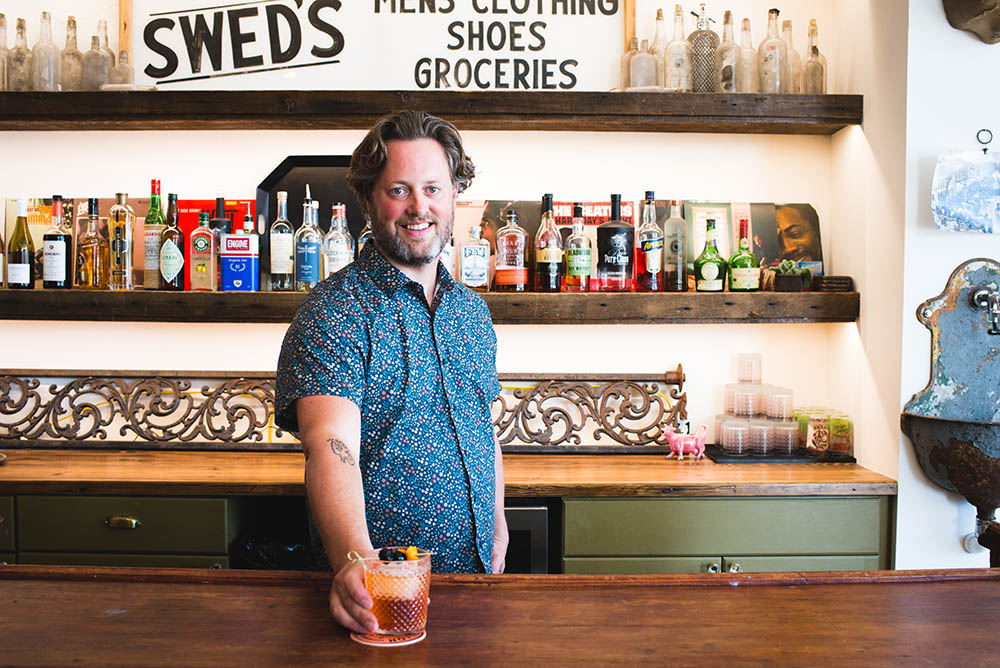
Trotter admits he didn’t start out trying to “make an impact”—for him it was about self-expression and doing things differently than they’d been done before. Alex Pearsall’s passion was in adaptive reuse of historic buildings.
Wright notes that without Pearsall, none of this works. “His ability to bring to life physical spaces is such an essential piece of the puzzle,” Wright says. Pearsall is a real estate developer who lives in Chicago, but he has owned a farm just four miles north of Princeton for about 20 years and loves and frequents the area.
Now the historic spaces they’ve revived are filled to the brim with diners, overnight guests, people listening to live music during The Sunday Sessions, shoppers and employees. Horseradish, Parlor Hotel and the Airbnb have become essential parts of an entrepreneurial ecosystem in Princeton—and they’re still growing. Upcoming expansions are a response to what they heard people wanted.
Soon, storefronts to the left and right of Horseradish will become the future homes of two more sister concepts—a sit-down dinner restaurant called The Carpenter Club on one side and a yet-to-be-named coffee shop on the other. The coffee shop will expand Horseradish’s coffee program, market and retail spaces. They also plan to add an amphitheater on the Fox River side of West Water Street so they can turn the once-a-week Sunday Sessions into a multiday summer music offering. They might even bring back the original food truck as a drink station and an homage to their roots. Two doors down from Parlor Hotel, they’ve purchased another historic building that might become a makerspace with a hostel upstairs. There will be a total of six Airbnbs on the upper floors of all of these spaces.
“There’s a lot going on in Princeton, and it would be a shame to have that disappear,” says Pearsall.
But Trotter, Pearsall and Wright won’t credit a beautiful storefront, a stellar food menu or a local concert as the singular reason for this new chapter in Princeton. It’s the people, they say.
“Our core group of employees that have been with us forever— they’re really kind of amazing,” Pearsall says. “Several of them now live downtown, and that’s bringing a vibrancy back to the area. In general, I think more people are coming downtown and experiencing what it has to offer. New and creative ideas are coming to town.”
Don’t Call Him Chef
Matt Trotter doesn’t want to be introduced as “the chef,” even though that’s one of the big roles he plays at Horseradish Kitchen + Market.
“I think food to him is almost like a vehicle to help people enjoy a vibe more than it is like a passion of his to be a chef,” says his partner, Greg Wright.
Trotter hasn’t changed a lot about the food he’s been serving to Princeton diners since 2015 when Horseradish was still a food truck. His sandwiches and salads stood out by being different—it’s what drew in the person who would become his business partner, Alex Pearsall.
Pearsall remembers the first time he saw the Horseradish menu. “I thought, ‘This has to be a joke. Nobody is eating roasted beet sandwiches in Princeton, Wisconsin,’” he says. “I mean, there was no deep-fried food on the menu. No burger, no brat, no cheese curds, and I was like, I gotta meet this guy
and make sure this is real.”
That beet sandwich is still on the menu today, topped with pistachio goat cheese, basil pesto, beets and mixed greens on ciabatta. Horseradish’s sandwiches and salads and even some of its drinks come covered in edible confetti and flowers that make them look artful. Trotter sources key ingredients from local producers: bread from Renards European Bakeshop, vegetables from Boerson’s Farm, microgreens from Sandy Fox Farm and tomatoes when they’re in season from Graveside Greenhouse. Trotter is proud of these local connections.
But, still, probably best not to call him “chef.”
“The phrase he taught me for him is ‘environmentalist,’ as in he really likes to create and build environments,” Wright says. “He wants people to love being in the environment they’re in. That environment usually includes plants, usually includes music, usually includes art and it usually includes food. Those are kind of the essential ingredients.”
Those ingredients have kept many customers coming back over the last decade and have drawn visitors from all over. “People still come in today from that first year,” Trotter says. “We just did a rehearsal dinner for someone who came to my food truck when she was a young girl.”