

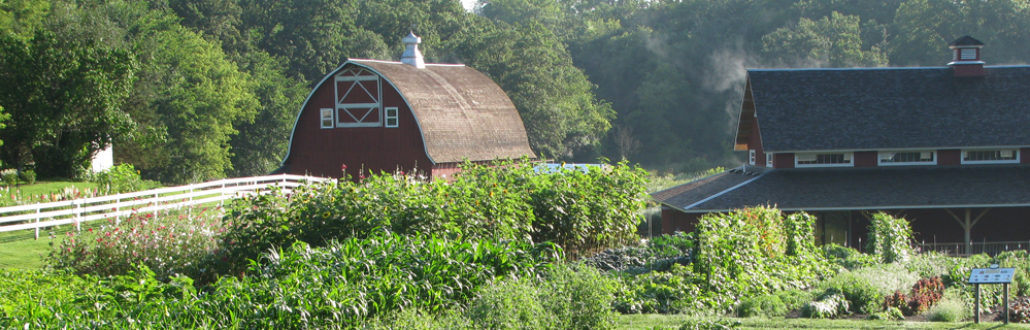
A little hop over a big river lands us in Decorah, Iowa, a town filled with community connection, good food, and a special terroir.
“This is not your ‘off the truck’ restaurant,” noted Mark Smeby, owner of La Rana Bistro in Decorah, Iowa. Simply stated without airs or pretense, these words were like music to my husband and my ears. If you are to know only one thing about us, a pair of self-proclaimed “foodies,” it is that we are not ‘off the truck’ eaters. While we understand that all food is transported by one way or another from farm to table, we are not interested in eating foods prepared largely from overprocessed ingredients shipped thousands of miles by semi-truck, arriving weeks, if not months, post-harvest with nary a nutritional offering and an ecological footprint that would rival a grocery-stocked tomato in the middle of a Wisconsin winter.
No, we long to experience foods of a particular place that are lovingly created, seasonally inspired and sourced locally with sustainably-produced ingredients. It is often through food that a visitor comes to intimately “know” a place. Through food we can taste tradition, soil and growing conditions of a particular locale with which it is intimately associated—this is often referred to as terroir. We are not only food enthusiasts but terroir enthusiasts.
Following years of gentle nudging by our close friend, renowned chef and fellow food enthusiast, Monique Hooker, we embarked on our first Edible Journey from our hometown of Viroqua, Wis., to Decorah. Decorah rests near the western boundary of the Driftless Region nestled in the Oneota (pronounced oh-nee-OH-tah) River Valley of northwest Iowa. Home to approximately 8,000 and the Evangelical Lutheran liberal arts institute, Luther College, Decorah has been coined one of America’s “Great Small Town Getaways” by Midwest Magazine.
To our delight, Monique was correct on all accounts. Decorah is a treasure of a town with a strong sense of place, and what’s more, a community so enthusiastically devoted to local food that you would most certainly leave a convert if you had no prior local food loving tendencies.The local food movement, or rather revolution, has been brewing for years in Decorah, according to La Rana Bistro owners Mark Smeby and Joanie Sheahan.
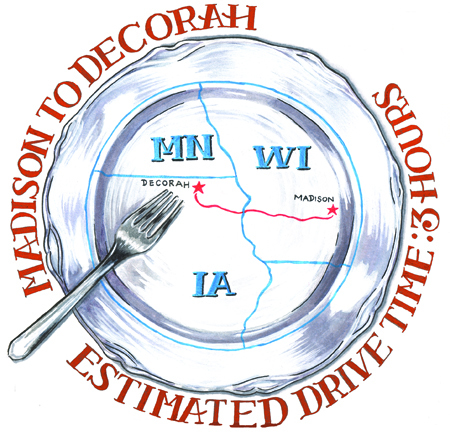
Decorah—Farm to Table
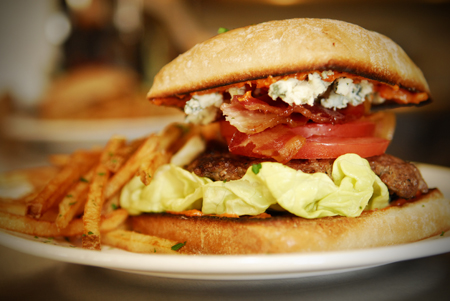
Transplants to Decorah in the early 1980s, Mark and Joanie waited 20 years to open their restaurant in September of 2002. Theirs has been a struggle of sorts waiting for the community to develop a taste for locally- inspired, made-from-scratch fare with a European twist; I recommend the locally-sourced, sustainably-raised beef burgers with hand-cut potato fries. At La Rana, the burgers are always local with meat sourced from Rock Cedar Ranch, a fifth generation cattle ranch located 11 miles north of Decorah. Specialty herbs, eggs and micro-greens are sourced from Canoe Creek Farm located 6.5 miles northeast of Decorah and operated by Barbara Beard Kraus and her family. Produce is provided by Patchwork Green Farm, a small, chemical-free family produce farm located north of Decorah and operated by Eric Sessions and his wife Sara Peterson.
If there is one name that is synonymous with local food in Decorah it is Eric Sessions. From La Rana Bistro, to the ambitious “farm to table” inspired Rubaiyat Restaurant and the Oneota Community Food Coop—which we will visit later—Eric Sessions and his Patchwork Green Farm is clearly a favorite source for nearly year-round, fresh vegetables such as garlic, onions, beets, potatoes, tomatoes, greens and peppers. These are just a few of the almost 200 varieties of annual vegetables grown each season on four acres of fertile ridge-top farmland. Eric is known for having the highest quality produce and the “prettiest” farmer’s market stand.
The Tie That Binds— Oneota Community Food Co-op
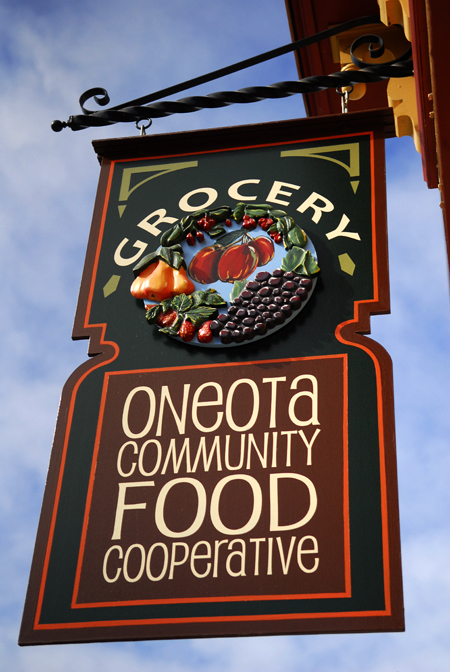
Throughout our food travels we have come to recognize that a vibrant, healthy, local food scene is almost always supported by an equally thriving community food co-op. In most communities, it is the co-op that binds local food relationships. This is very much the case in Decorah. The Oneota Community Food Co-op started in 1972 as a buying club like many early co-ops. Once nicknamed “Oleville” after an admired landlord, Ole Youmans, the co-op started with staple food products like honey, whole grains and organically grown beans. Now in its 5th location, the co-op boasts over 3,000 members and over $3.2 million in annual sales.
One can’t help but be charmed by the contagiously upbeat employees of the Oneota Co-op.We sat down with Front-end Manager Johanna Bergan, General Grocery Manager Michelle Campe and Wine Buyer Barrett Kepfield to learn more about the co-op and its role in supporting local food relationships. It quickly became clear that these folks loved their jobs and, even more, loved the opportunity to talk about their community and the mission of the co-op. The gracious staff, house-made fresh mozzarella from the co-op’s 80% organic and local deli, and the fact that they still host a monthly community potluck on the first Thursday of every month—an ongoing tradition since the early days of operation—sold us, and will you too.
In an effort to build local food relationships, the co-op sources its 90% local and/or organic produce from 13 area farmers. In addition, Iowa wines from local, family-run Winneshiek Wildberry Winery are featured in the wine section. Before heading back to kick up your feet at one of the many bed and breakfasts in town, be sure to pair your local wine purchase with one of many artisan cheeses such as the Amish blue cheese or local goat feta.
The thread of local food runs deep between Decorah and the Edible Madison food region in Wisconsin. We were pleased to see some of our favorites on the co-op shelves, namely Kickapoo Coffee from Viroqua, Harmony Valley Root Vegetable Soup Mix from Viroqua, Westby Cooperative Creamery from Westby and Potter’s Crackers from Madison, to name a few.
Seed Savers—A Culture of Exchange
In addition to Monique’s urging, what first inspired our journey to Decorah was the famed Seed Savers Exchange. Seed Savers Exchange is a non-profit organization of gardeners and plant collectors who save and share heirloom seeds that were brought to North America with the earliest immigrant families. Over 25,000 heirloom seed varieties are grown on the 890-acre Seed Savers farm north of Decorah. As avid home gardeners, we wanted to experience the farm where our fresh garden harvest was sourced from seed. We have been purchasing from Seed Savers since our early gardening days back in Bellingham, Wash. Now living in Viroqua, we find ourselves a mere 80 miles from this “living museum” of garden splendor. Not yet skilled at the art of saving our own seed, we are happy to support such a worthy organization.
Seed Savers was founded by Diane Ott Whealy and Kent Whealy in 1975. Diane’s terminally-ill grandfather gifted her with the seeds of a certain Grandpa Ott’s Morning Glory and German PinkTomato that were brought from Bavaria when he immigrated to Iowa in the late 1800s. Today, Seed Savers has over 11,400 members who assist in the collection, preservation and distribution of heirloom seed varieties. Seed Savers offers an annual seed catalog with over 600 varieties that are grown-out and germination tested every year. Our Seed Savers host, John Torgrimson, noted a 23 year-old Cezanne radish seed with a 100% germination rate.
Keeping with the culture of exchange, Seed Savers boasts the largest ongoing seed swap, which runs annually from February to May. Over 700 members list more than 20,000 seed varieties in an annual yearbook. As a member of Seed Savers, you too can exchange seed varieties and growing recommendations with thousands of other garden enthusiasts, all in an effort to preserve the genetic diversity of our food crops.
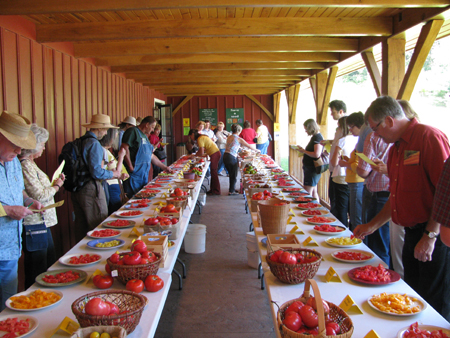
You can visit the Seed Savers Exchange Lillian Goldman Visitors Center to purchase seeds or explore the preservation gardens and historic orchard. They have a number of events throughout the year such as the well-loved Heirloom Tomato Tasting held every September and the October Harvest Festival.
An Edible Journey—All in a Day’s Drive
We are blessed to live in one of the richest and most diverse food baskets or foodsheds in the country—or, for that matter, the world. The food you eat today could have been raised by you, your neighbor or one of the many dedicated farmers in your community. So get out and taste your foodshed, or when you are looking for a little weekend getaway, your neighboring foodshed. Give your taste buds a chance to experience and reconnect with the terroir of our home region.
Terrior [terr-WARH] comes from the French word "terre" for land, originally coined to describe wines of a particular place. The term is widely used to describe the geographic characteristics that contribute to the qualities of a particular food item. For instance, cacoa grown in the fertile, volcanic and marine soils of Africa's smallest nation of Sao Tome produces a dark, bittersweet chocolate with hints of toasted and spicy notes followed by tropical fruit flavors.
Terrior can also be experienced when a deciphering tongue picks up the subtle yet unmistakable difference between a pithy, rain-soked tomato grown in the Pacific Northwest versus a sweet, red beauty ripened in the head of the Midwestern sun.
Decorah's Local Libations
For the hop heads out there, be sure to make a stop at the Toppling Goliath Brewing Company. Owner Clark Lewey adds local flair to his brews with the Golden Nugget IPA, made with all local hops. Don't miss the seasonal CranStout brewed with Wisconsin cranberries or the Rush Hollow Maple Ale with, you guessed it, fresh maple syrup from Clark's neighbor's sugar maple stand.
More Stories by This Author

Edible in your mailbox
