


A Land Crisis: The Fight for Equitable Access to Land

Yimmuaj Yang, Community Director for Groundswell Conservancy, a south central Wisconsin nonprofit dedicated to protecting land, is hesitant to use the word “crisis,” but doesn’t know how else to describe the current state of agriculture in the United States. “We do have a farming crisis right now,” she says. “Nationwide, we have aging farmers that do not have heirs that want to take over farming, or they are aging out and don’t know what to do with their farmland, so a lot of times those farmland owners sell their land to developers.”
According to American Farmland Trust, an average of 2,000 acres of farmland are lost each day and in the next 15 years, one-third of America’s farmland and ranchland will likely change hands as current landowners age and sell. Land is most at risk of being converted to a non-agricultural use when it’s sold. While people may have become desensitized to seeing urban sprawl and new developments pop up at a rapid rate, Yang reminds us in stark terms why everyone should be concerned about this loss of farmland. In order to continue to produce enough food for people to eat, “we have to be able to facilitate new farmers into those areas,” she says.
The loss of farmland to development isn’t the only issue leading to the current crisis. When it comes to farmland ownership and equitable access to land, there are great inequities due to ongoing systemic racism in the United States. According to the latest census data, 95% of farmers and 96% of land owners are white, a decrease from 1910 when data showed 14% of farm owners were Black alone. For generations, public policy has facilitated the removal of millions of acres from people of color through policies such as the Indian Removal Act of 1830, the Homestead Acts of the mid-1800s, and the cancellation of Field Order No. 15, better known as “40 Acres and a Mule,” which initially promised redistribution of land to formerly enslaved Black people before it was overturned by President Andrew Johnson. More recently United States Department of Agriculture (USDA) policies have continued to favor white farmers; in 2020 the agency granted loans to only 37 percent of Black applicants in one program that helps farmers pay for land, equipment and repairs but accepted 71 percent of applications from white farmers, according to a POLITICO analysis of USDA data.

Wisconsin is not immune to this discrimination. Despite a rich history of BIPOC [Black, Indigenous and other people of color] growers tending the land here, according to recent census data, 99% of Wisconsin farmers are white and 65% are male. “So we have aging farmers, the majority of whom are white, and then we have a lot of beginning farmers [or] socially disadvantaged, historically excluded farmers who do want to farm but face barriers to owning farmland,” Yang says. “Locally here in Dane County the majority of BIPOC farmers don’t own land and many even have a hard time renting land.” While there is prime farmland right in and around the city of Madison, there are numerous challenges to accessing it. “What people have done in the past is they literally drive around and knock on doors and say, ‘Hey, I’m looking for a piece of land to lease to grow food for my family or for market….Most of the time they don’t have a lot of luck—there is a lot of misunderstanding and cultural differences,” Yang says. “For those who have been able to knock on somebody’s door and been able to rent, it’s been a handshake agreement. It’s on an annual basis so there is no land security.” While Dane County also owns farmland, the process of how to lease this land can be tricky to navigate and single-crop producers have an advantage, Yang says. “Dane County doesn’t lease small acreage; they lease hundreds of acreages to a single corn or soybean farmer because it makes it easier for them on their end.”
Groundswell Conservancy, a land trust founded in 1983, has historically worked to preserve farmland in southern Wisconsin. More recently the organization has also turned their attention to urban agriculture and helping growers overcome barriers by focusing on the three stages of equitable land access identified by Yang: Land access, land security and land ownership. “First and foremost, it’s being able to be on a piece of land,” Yang says. “Once somebody is on a piece of land, it’s having that land security, knowing that a farmer or land seeker can invest in their farm business knowing that it can be theirs.” One way that Groundswell provides people with the first two stages of equitable land access is through their ownership of what they refer to as their two “community farms,” the Westport Farm in the village of Waunakee and Pasley’s Swan Creek Farm in Fitchburg. The Westport Farm, which Groundswell purchased in 2018, is an area of 10 acres leased to HMoob (Hmong) growers who fall into one of three categories. “One is growers who are producing for family use, one group is market growers, those who produce to sell at farmers’ markets or wholesales, and then we have our therapy garden which is specifically for HMoob elders who are attending the Southeast Asian Healing Center,” Yang says. Cho Xiong, HMoob elder, says the garden at Westport has brought immense joy to her life. “The therapy garden brings happiness to our lives,” Xiong says. “We don’t want very much. We want to grow food, to be happy and we want to matter in the community.”
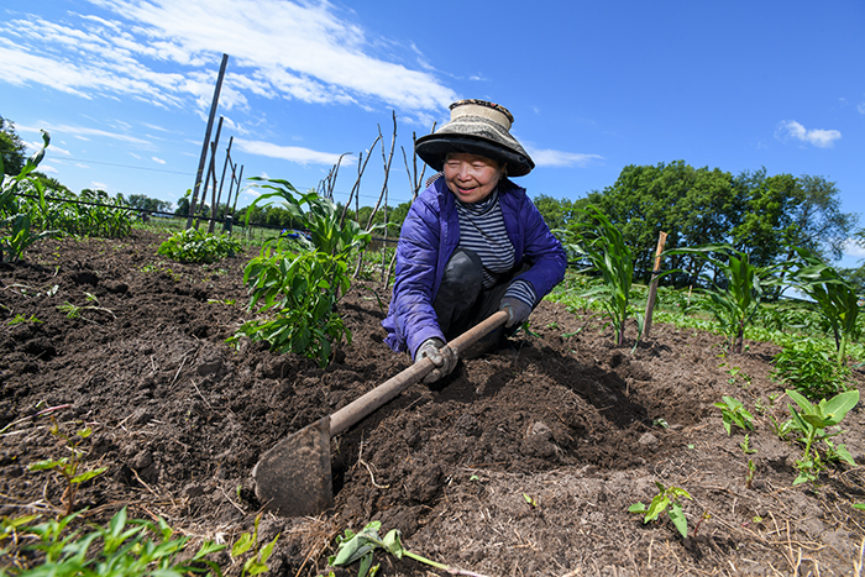
At both Westport and Pasley, a 35-acre property with 14 acres of farmland leased to Neighborhood Food Solutions for farmer training programs with youth and people who were formerly incarcerated, Groundswell also provides infrastructure including access to water sources. “Many times when people lease land it’s just land, there is nothing else,” Yang says. “We are slowly building out those basic infrastructural needs on the farm.” To meet the third stage, land ownership, Groundswell is currently working on a pilot project with American Farmland Trust and Dane County Land and Water Resources Department to purchase farmland in Dane County. “It’s farmland ownership by using the conservation easement tool that land trusts have. The idea is to make sure that farmland is affordable,” Yang says. Rooted is another Dane County nonprofit organization that is dedicated to providing equitable access to land. In addition to providing staff support for community gardens in Madison and Dane Country, in response to community demand, Rooted staff is also working with Dane County to manage and help expand the growing space at Anderson Farm County Park in nearby Oregon. “We've rented 23 ¼ acre plots, a mix of market and family production, and this year are expanding the site with 13 one-acre plots which will be mostly market farmers,” says Nicholas Leete, Rooted’s Community Gardens Network Director. This year Rooted is also renting and subleasing an 8-acre piece of land from the McFarland School District to provide growing space for a group of HMoob farmers who were recently displaced from another piece of land in McFarland.
“Our mission is to make land and food generally available to people who want it, as well as support learning around that,” Leete says. “We try to act in response to requests from the community and what we have seen are a lot of requests for areas larger than your standard community plot from HMoob farmers growing for their families or growing for market, that are also close to the city for access. That is what we have tried to supply at Anderson, as well as the land we are renting at McFarland.”
Rooted also leases several plots of land—in exchange for a fee or an agreement to offer educational programming to the public—to growers at Troy Farm, Rooted’s organic urban farm on the northside of Madison. “What we are offering at Troy Farm is really a very well set up space,” says Paul Huber, Rooted’s farm director. In addition to being located within the city on Madison’s rapid bus line, the farm provides manageable smaller plots, ranging in size from ¼ to ¾ acres, and important infrastructure. “We have nice road access, storage space, two different coolers, a building where people can wash and process vegetables, an irrigation system, well water, electricity, hand tools, power tools, a 2-wheel tractor, a 4-wheel tractor, greenhouse space…everything you would need,” Huber says.
Sei Kidau is one of the farmers leasing land at Troy Farm. Originally from Liberia in West Africa, Kidau has always planted seeds. “When I was 6 years old in my yard in Liberia, I ate a mango,” Kidau says. “It was very nice, so I planted that seed and that tree is still there today.” After immigrating to the United States with his family at a young age and relocating to Milwaukee, Kidau continued to grow food in a bucket on his apartment’s balcony just for fun. Unable to find any hot peppers like the ones they were used to at home, Kidau’s relatives in Liberia would hydrate the peppers, grind them, seal them and mail them to Kidau and his family in the states.
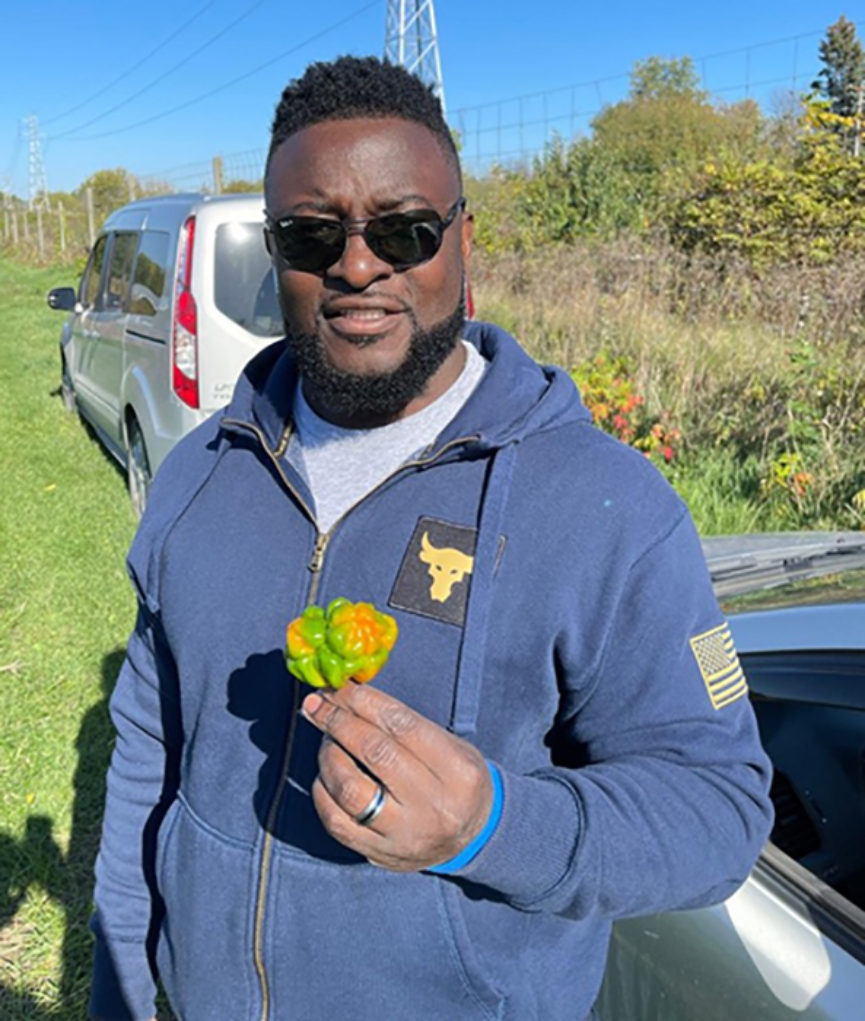
Kidau is no stranger to the issues facing young and BIPOC farmers when it comes to having land. “When we talk about equitable access to land, it’s all about finance. It’s all about knowledge. My background is as a mortgage banker so there is a parallel between minority home ownership and minority land ownership, it’s the same issue. Knowledge and understanding of the process to get land,” he says.
Even though he grew up in an agricultural family, when it came to a career Kidau first sought a different line of work. “When I moved to America the focus was, how do you survive in this economy? You go about your way, do your normal thing, but I’ve always been pulled back to the soil. It’s in my DNA.” After outgrowing his backyard garden space, Kidau now leases a ¾-acre plot at Troy Farm where he grows the types of vegetables he grew up eating but could never find in stores when he first moved to Wisconsin: Scotch bonnet peppers, garden eggs, certain types of okra. While Kidau would eventually like to own land, a homestead of up to 40 acres, he knows it might be hard. “It is more challenging to be within striking distance of the city to find affordable farmland. That is a reality,” he says. For now Troy Farm serves “as a very good experimental ground,” Kidau says. “Growing up and then coming to Wisconsin, farming wasn’t something that I thought of as a profession…But now that I have had my midlife crisis, I want to get back to the soil,” Kidau says with a laugh.
Despite the statistics, Yang remains optimistic. “As much as we are all saying, ‘Oh my gosh, the future of farming, kids don’t want to farm,’ I’m really hopeful that people of color want to farm and younger people of all colors want to farm,” Yang says. When she recently attended Marbleseed, an annual Midwest organic farming conference, Yang saw more young farmers from all different cultural backgrounds than she had ever seen there before. “There is hope,” Yang says. “If we can tailor USDA programs and services and other resources around diversity of agriculture and if we are able to facilitate ownership to current farmers who are looking to own land and future farmers, I think that we will be able to address the farming crisis.”
More Stories by This Author

Edible in your mailbox
