

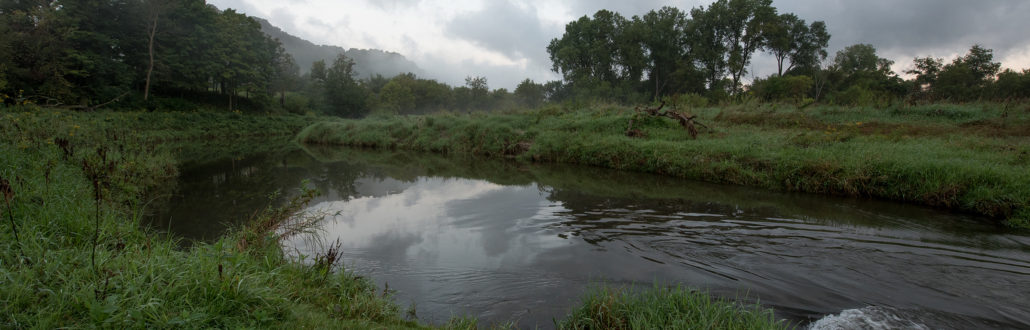
You can’t talk about water quality and agriculture without first defining the watershed, says Shelly Brenneman, Conservation Programs Coordinator for Valley Stewardship Network, a nonprofit organization based out of Viroqua. “Essentially the watershed is all the land that drains into a body of water, like a stream or river. Everything that happens on the lands upstream of the river matters to that river’s quality; everyone that lives, works, farms in that area is really managing water quality.”
The Kickapoo River Valley, located in the heart of Wisconsin’s Driftless Area, is known for its natural resources and biodiversity. The area is also home to a number of farming communities where Brenneman says farm families have been stewarding the land for generations. “And they’ve been taking care of the land in such a way that it’s supported generations of high-quality trout streams and fisheries, and the wildlife and biodiversity that we have here now.” Brenneman points out that unlike much of the country, including out West where land is managed by agencies, most of Wisconsin and the Midwest are privately owned so conservation efforts have to be voluntary. "Private land conservation is a labor of love,” she says. “[The farmers] want to do the right thing. They want to take care of their land for future generations, they want to take care of their land to protect the water quality in their area.”
Celebrating its 25th anniversary this year, about 15 years ago Valley Stewardship Network decided to turn its attention from studying water quality at the stream level to looking at the land in the watersheds. “That’s where the impacts come from, both positive and negative,” Brenneman says. With lots of steep areas making up the Kickapoo River Valley, two of the biggest factors impacting water quality in the Driftless Area include soil erosion and flooding. With soil erosion, “keeping [soil] on the farm helps keep the farm sustainable for years to come, but also keeping the soil out of the water is one of the main issues with water quality—keeping that sediment out,” Brenneman says. In order to help stop flooding, the goal is to prevent excess water from flowing into the streams and rivers by promoting practices that help to soak in more water on farm lands for crop, pasture and forest needs.
Brenneman, who has a background in sustainable agriculture, joined Valley Stewardship Network twelve years ago to help develop a program that would work in cooperation with farmers in the Kickapoo River Valley and neighboring watersheds to improve water quality. “And there are many ways for farmers to maintain or improve water quality,” she says. Cover crops, which are most often planted between crops or during periods when the main crop is not growing, are one way to prevent erosion while also enhancing soil quality. The planting of “prairie strips,” is another way. Developed at Iowa State University, prairie strips are areas of native, deep-rooted prairie vegetation that when planted along farm fields and waterways help to slow down the water, infiltrate the water, reduce erosion, improve soil quality and provide habitat for pollinators, birds and other wildlife. “So it’s kind of a win-win-win with the prairie strips,” says Brenneman.
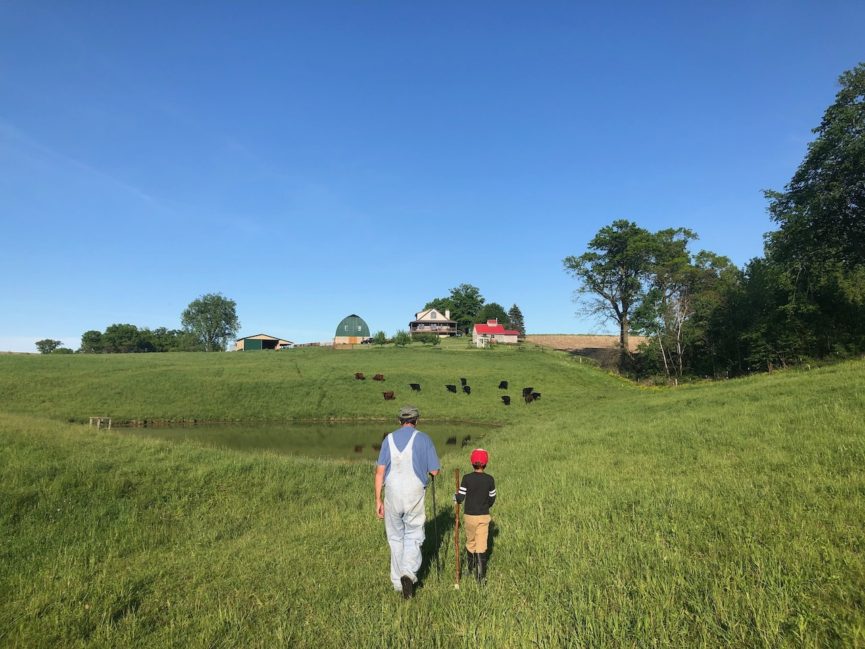
Knowing the benefits of cover crops, prairie strips, rotational grazing and many other conservation practices, Valley Stewardship Network’s goal was never to tell farmers what to do but instead find collaborative ways to support farmers to achieve their conservation goals. After researching successful models involving farmers and watershed projects, the organization decided to promote farmer-led watershed councils, voluntary organizations made up of farmers and landowners, and sometimes community members, organizations or businesses, with the goal of promoting watershed conservation efforts. Over the last ten years Valley Stewardship Network has helped create six different councils, says Brenneman. “When you have multigenerational farmers in the area taking leadership for watershed protection, watershed management, water quality and conservation practices on the land, that is really the best way to go about spreading the word about conservation, having it be farmer-to-farmer, neighbor-to-neighbor, community member-to-community member.”
Chuck Bolstad, owner of Stump Ridge Beef Farm in Vernon County, is one of the founding farmers of the Tainter Creek Farmer-led Watershed Council. Considering himself one of the most fortunate people in the world, Bolstad lives on the farm originally settled by his grandfather in 1896 after he emigrated to the United States from Norway. When describing the health of Tainter Creek which runs through his property, Bolstand takes the long view. “Water is life,” Bolstad says. “If you can keep pollution out of the [water] you are drinking, your children and grandchildren are drinking, then it's pretty straightforward.” At the rocky ridge-top farm where Bolstad raises cattle, he recognizes that his grandfather and father engaged in agricultural practices that would now be labeled as “regenerative agriculture.” In an effort to help maintain this level of care for the land and future generations, Bolstad has installed two erosion control dams and recently planted several prairie strips. “Prairie strips are a kind of learning from the past,” Bolstad says. “The reason why prairies were so successful is that native plants have deep roots and they were able to survive all sorts of atmospheric conditions like droughts and wet periods. They prevent erosion and they’re great for sequestering carbon, which wasn’t even a thing back then, and they provide a great habitat for pollinators and birds.”
Bolstad sees his work with the farmer-led watershed council as a way to help promote the practices he has implemented and seen success with on his own land. “I think that farmers by their nature are people that by choosing to live and make their living off the farm, they tend to have the perspective of being cooperators with the farm,” he says. “Sometimes farmers get a bad rap because we think that it's a one-sided transaction and it's not at all. With our watershed group we didn’t demonize farmers, we tried to persuade farmers of a better way.”
Brenneman echoes Bolstad when describing her work supporting farmers. “In mainstream media, a lot of times farmers are blamed for environmental problems,” she says. “[But] we’re really in an era right now where locally organized watershed conservation programs are more effective and maybe the most sustainable. There’s a lot we do locally to work cooperatively with each other, no matter what our political affiliation is, because we all live in the watershed and we all need good water.”
More Stories by This Author

Edible in your mailbox
