
Through many a cold season have I fervently extolled the virtues of locally grown winter radishes to customers at my food co-op in Viroqua, cajoling them into trying one of these big strange looking vegetables when what they came in for was a bunch of little red radishes from California. The trouble was, I wasn’t very convincing; sales pitches that start with, “I don’t really like them personally, but let me tell you, these are really great!” rarely work. Radishes were just too pungent and bitter for my palate. The co-op has always carried several varieties of these storage radishes through the winter, but the most popular one is always the “beauty heart” radish. And bless my heart, beauty hearts finally won me over. Now I can truly say I am a radish lover.

Before I go any further, you should know that there are two different kinds of radishes: spring and winter ones. Beauty hearts and the more commonly found long, white daikon belong to the winter type. Small bunching radishes like the ubiquitous red “cherry belle” or the more prized oblong, white and red “French breakfast” are spring varieties. They are quick to mature, have fairly thin skins and are best eaten within a week of harvest. Winter radishes are bigger, take much longer to mature, are usually harvested in the fall and can be stored far into the winter. Unlike spring radishes, winter ones are eaten pickled or cooked as often as they are eaten raw.
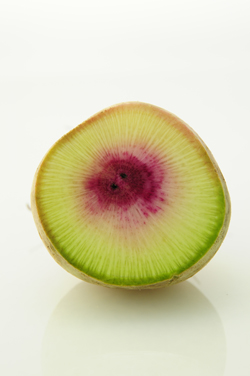
Back to beauty hearts: Just last winter I finally had that “Aha!” moment when I enjoyed the taste of a radish for the first time. That year my husband’s vegetable farm grew more beauty heart radishes than they could sell, and we seemed to always have some in our fridge. I have always thought beauty hearts were—duh— beautiful, and admired how winter radishes were one of those rare local vegetables that can store through the winter and still be eaten fresh, so I really wanted to like them. I kept trying them prepared in different ways, and wouldn’t you know it—bam! All of a sudden I was hooked. Next thing you know, I was eating them every day thinly sliced like crackers, grating them on salads, or simmering them in Asian-inspired soups. Beyond their hardiness and beauty, they are crisp and very mild, almost sweet.
I was definitely primed to fall in love with them, with all those years pushing them at the store and all. I have a special place in my heart for anything that can be grown locally and replace something shipped from afar, but beauty hearts are extra special. Winter radishes have an exotic allure to them I can’t help but be attracted to. Not your grandma’s radish, the entire family is strange looking and mysterious. Black Spanish winter radishes look like dragon eggs, daikons can be monstrously large, and beauty hearts are demure on the outside but raucous inside—each one filled with unique starbursts of vibrant fuchsia and white. Another name for them is “watermelon radish,” but they are far more gorgeous than watermelons, especially when you crack one open in the depths of white-gray winter, when you’re starved for color that reminds you you’re alive.
Part of the large broccoli family, radishes are probably native to China but have been in cultivation across Asia, the Middle East and the entire Mediterranean region since ancient times. Most of those radishes grown before the last 200 years weren’t the little spring globe radishes we’re used to in the States. In ancient times radishes were grown for their seed, which was pressed into valuable oil that predated olive oil in many cultures. They were also grown for their nutritious and tasty greens or their long, spicy seed pods that can be stir-fried or pickled (and are still popular in India). And when carried over to us here in the States, old school winter radishes were grown for their large roots that stored so well into the winter, providing necessary vitamins and minerals through dark times.
Winter radishes eventually fell out of favor in Europe and the Middle East, but they have survived the ages in the eastern Asia. Daikons may be Japan’s radish of choice, but beauty hearts are China’s darling. The name “beauty heart” comes from the Chinese name, Xin Li Mei, which translates literally to “heart – inside – beautiful”—appropriate, don’t you think? My friend Ping, who grew up in China, says they eat a lot of Xin Li Mei there, raw like apples, made into pickles or stir-fried. They are valued as a digestive aid as well as a detoxifier and blood cleanser.
Vegetables that keep a long time without any processing or preservatives are to be respected. Ones that are also super beautiful, crunchy, versatile and delicious are even better. Beauty heart radishes fit that bill. If you like radishes, skip those imported spring bunches and give a locally-raised beauty heart a try. If not, well, try them anyway—they just might be your gateway drug into the wonderful world of radishes.
Serving Suggestions:
- Grate onto salads or into coleslaw.
- Very, very thinly slice and roll around soft cheese and smoked fish.
- Pickle them! (See our recipe online.) Beauty Heart pickles are wonderful in sushi rolls.
- Ferment with other vegetables in kimchee.
- Slice into half-moons or matchsticks and use on veggie platters or as a cracker with dip.
- Use as a garnish.
- Slice thinly and eat with butter on crusty bread.
- Simmer in soups like hot and sour or miso.
- Stir-fry solo or with other vegetables.
- Boil or steam and mash with garlic and a bit of fresh ginger.
- Braise with shallots in sweet white wine or mirin (sweet rice cooking wine).
- Cube, toss in oil, and roast solo or with other winter radishes or roots.
Enjoy this Beauty Heart Radish and Black Sesame Seed Salad recipe by Dani.