
This past summer certainly looked different than any before, but on the bright side, many of us got to spend extra time in the garden. This may have left us more tired than summers of the past, but it also left us with an abundance of produce to use in new ways. And no use of produce may be more suited to these times than making herbal remedies—turning garden spoils or farmer’s market hauls into something healing and nourishing.
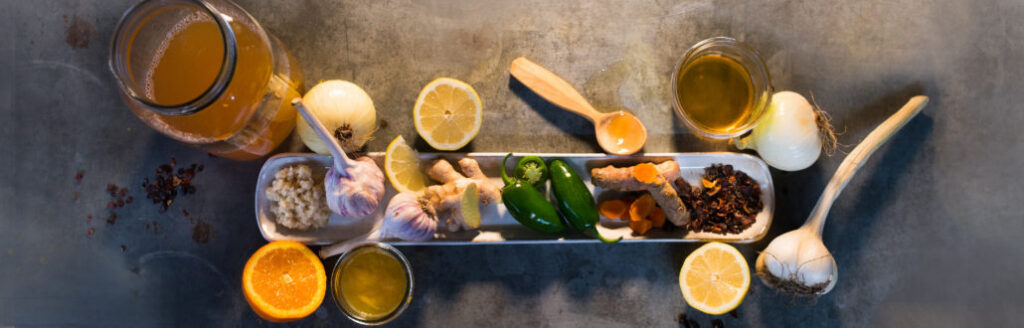
Fire Cider is one such remedy. I like to think of Fire Cider as the ultimate concoction to capture the heat of summer, storing it up for those cooler months, when our bodies really need it. This herbal medicinal is an infusion of hot and pungent herbs, vegetables, and fruits into raw apple cider vinegar. After four to six weeks of infusion, the liquid is strained off and a bit of honey is added at the end. Fire Cider is taken in small doses, either daily as a tonic or on an as-needed basis, whenever you feel your body could benefit. It is typically meant to support immune function and digestive health.
The recipe for Fire Cider has been passed around for ages, with no clear origin. Renowned herbalist Rosemary Gladstar popularized today’s best-known version. Her recent book, “Fire Cider!,” is entirely dedicated to this elixir and offers an in-depth look at the history and benefits of this simple remedy, as well as several variations on the recipe (1). While Fire Cider has been used for generations, it has gained popularity in the past several years, as many look to take a more active role in their health.
In 2012, Massachusetts-based Shire City Herbals trademarked the name Fire Cider, creating quite a controversy in the herbalist community. Producers were forced to find alternative names for a formula they felt belonged to everyone. If you have seen “Fire Tonic” or “Dragon Tonic” on the shelves in the past few years, this was simply the Fire Cider formula under a different name. After a great deal of pushback from natural health enthusiasts, this trademark was overturned earlier this year, and the original name can now be used by all.
Though Fire Cider may be a folk remedy, there is plenty of scientific evidence to support the therapeutic benefits of each of its ingredients. The mighty, pungent trio of garlic, onion, and horseradish all contain anti-microbial and anti-inflammatory compounds, plus they’re rich in sulfur, helping to promote detoxification and production of glutathione, the body’s “master antioxidant.” (2,3). Turmeric, ginger, and hot peppers have antimicrobial, anti-inflammatory, and immune-enhancing properties as well. (4, 5, 6). Citrus and rose hips bring their high vitamin C content and flavor (7). Raw honey,also high in antioxidants, soothes the throat, and adds a bit of sweet to cut the tart and spice of the vinegar infusion (8). Ginger, along with many of the other ingredients, has been linked to digestive wellness, and may soothe indigestion, decrease nausea, promote a healthy microbiome, and aid in healthy stomach acid production (5).
Apple cider vinegar, when left raw and unfiltered, is a folk remedy all its own, a nourishing and probiotic food full of beneficial bacteria, enzymes, and acetic acid that promote many aspects of health, including improved digestion, enhanced immune function, and balanced blood sugar. It also has antioxidant and antimicrobial properties and has been credited as an aid in weight management (9).
With all of these potential benefits packed into one concoction, it is easy to see how Fire Cider has come to hold near-mythical status among those familiar with natural remedies. It has a special place in my heart for its strong flavor, the potent combination of ingredients, and its long tradition of use as a tonic.
Click here to learn how to make your own Fire Cider.
Sources:
1. Gladstar, Rosemary. Fire Cider!: 101 Zesty Recipes for Health-Boosting Remedies Made with Apple Cider Vinegar. Storey Publishing, 2019.
2. Tripathi, P C, and K E Lawande. “Therapeutic and Medicinal Value of Onion and Garlic.” Jan. 2006, doi:DOI: 10.13140.
3. Marzocco, Stefania, et al. “Anti-Inflammatory Activity of Horseradish (Armoracia Rusticana) Root Extracts in LPS-Stimulated Macrophages.” Food & Function, vol. 6, no. 12, Dec. 2015, doi:10.1039/c5fo00475f.
4. Labban, Louay. “Medicinal and Pharmacological Properties of Turmeric (Curcuma Longa): A Review.” Int J Pharm Biomed Sci., 2014.
5. “The Amazing and Mighty Ginger.” Herbal Medicine: Biomolecular and Clinical Aspects, Second Edition, by Iris F. F. Benzie and Sissi Wachtel-Galor, 2nd ed., Taylor and Francis, 2011, www.ncbi.nlm.nih.gov/books/NBK92775/.
6. Yu, R et al. “Modulation of select immune responses by dietary capsaicin.” International journal for vitamin and nutrition research vol. 68,2 (1998): 114-9.
7. Lykkesfeldt, Jens et al. “Vitamin C.” Advances in nutrition (Bethesda, Md.) vol. 5,1 16-8. 1 Jan. 2014, doi:10.3945/an.113.005157.
8. Lykkesfeldt, Jens et al. “Vitamin C.” Advances in nutrition (Bethesda, Md.) vol. 5,1 16-8. 1 Jan. 2014, doi:10.3945/an.113.005157.
9. Johnston, Carol S, and Cindy A Gaas. “Vinegar: medicinal uses and antiglycemic effect.” MedGenMed : Medscape general medicine vol. 8,2 61. 30 May 2006.
Disclaimer: This information is provided for informational purposes only and is not intended to substitute for the advice provided by your doctor or other health care professional. You should not rely upon or follow information in the above article for decision-making without obtaining the advice of a physician or other health care professional. The nutritional and other information in this article are not intended to be and do not constitute health care or medical advice.