

Is it a creature from Mars? A model of the universe? A member of the cabbage family? If you guessed the latter, you’d be correct. But who could bear to eat such a beautiful vegetable as Romanesco?
If only I had a quarter for every time I’ve been asked “What is that?!” while selling this thing, I’d be rich. Could it be:
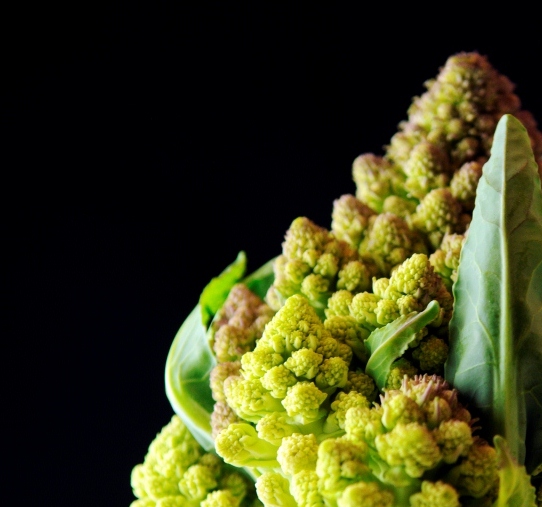
Looks like it could be any of them, but as far as I know, this is Romanesco, a descendent of wild Mediterranean cabbage first recognized outside of Rome in the 16th century. No vegetable I’ve ever sold has elicited more curiosity and wonder than this vegetable. How the heck did nature (or Italian Renaissance gardeners) come up with this crazy-beautiful vegetable?
Called cavolo broccolo romanesco (Roman cabbage broccoli) in its native Italy, Romanesco is indeed in the same species (Brassica oleracea) as broccoli, cauliflower, kale and cabbage. Some call it Romanesco broccoli and others Romanesco cauliflower, but it’s really its own vegetable, so I just call it Romanesco. I like to think of it as the beautiful genius of the brassica family, with its cool chartreuse color and perfect spiraled whorls made up of self-similar patterns–a work of art as worthy to come out of the Italian Renaissance as any the Great Masters produced.
Look a bit closer and you’ll see it’s so perfect it’s freaky. The whole head (actually, it’s a giant flower bud) is a spiral made up of spirals made up of spirals. Turns out Romanesco is one of nature’s best and closest examples of a natural fractal, a complex shape that looks the same whether seen close up or far away.
In Romanesco, each conical bud is made of smaller conical buds in the same spiral pattern, or in geeky scientific speak, a “recursive helical arrangement of cones.” Each of these is a perfect logarithmic spiral, the same kind that can be found throughout the natural world in things like mollusk shells, hurricanes and the arms of spiral galaxies. Maybe it is a model of the universe!
A big display of Romanesco at the farmers market certainly can stop people in their tracks, even from a distance. They have to see it up close and touch it and talk about it and write blogs about it—but so many of them are afraid to eat it! I've had customers say they couldn't eat Romanesco because it's too beautiful. One family had it as their dining room table centerpiece for a week, until it was shriveled and way too old to eat, because they simply didn’t want to stop looking at it. I get it. It is quite beautiful. But hey, it’s also very, very tasty!
More than most brassicas, Romanesco prefers growing in cool weather, so you’ll find local ones at market in the fall. Eat them now before they are gone!
Romanesco cooks up and tastes more like cauliflower than broccoli, but it is nuttier, sweeter, and crispy-crunchier than either. Its florets hold up better than cauliflower’s, too, leaving you with fewer crumbs and more whole florets. It is very versatile; you can eat it raw or just blanch, steam, stir-fry or roast it, or put it in soups and sauces. Its lovely shape holds up unless you really overcook (or puree it, of course). I love to serve it simply whole or quartered lengthwise, with just a drizzle of lemon and oil or served on top of sauce so you can really marvel at it before stuffing your face with it.
Romanesco is its own vegetable but shares most of the nutritional characteristics of its brassica brethren; in other words, it’s a cruciferous vegetable power-house! Brassicas are so often linked to cancer prevention and heart health because they contain such a large concentration of nutrients that are antioxidants, anti-inflammatories and detoxicants. Romanesco in particular is high in vitamins C, K, B9 and B6, potassium, and antioxidant phytonutrients. It’s also high in fiber and low in calories.
So don’t be afraid to eat Romanesco. It may be perfectly freakishly beautiful, but it’s darn good for you and delicious to boot. And unlike Italian Renaissance masterpieces, we can grow more of them next year.
Don't by shy. Check out these amazing Romanesco recipes:
Fresh Pasta with Lemon-Roasted Romanesco and Browned Butter
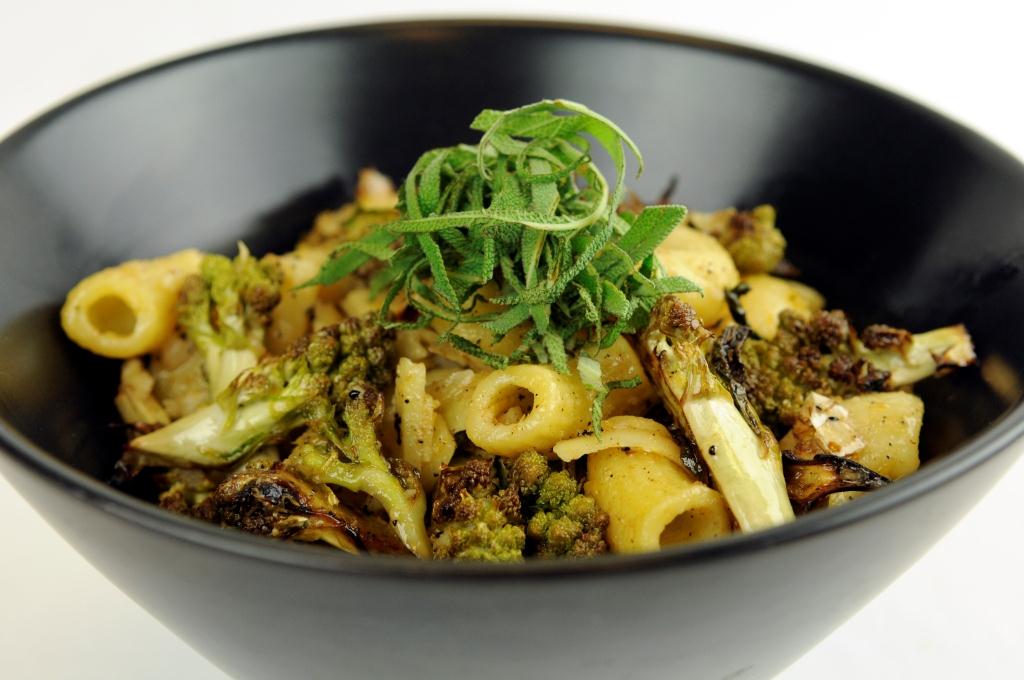
Need some ideas for Romanesco?
Raw: Separate into florets and eat plain or with dip.
Blanched: Separate into florets, boil in plenty of salted water for 3 to 5 minutes (3 minutes for al dente, 5 minutes for tender), then shock in ice water to cool. Add it to salads or blanched vegetable platters, or continue by sautéing in butter/oil with aromatics like garlic, shallots, or ginger to add to pasta.
Steamed: Trim leaves and stem, score a deep X into the stem, then place upright in broth or lemon water. Cover and steam for 10 to 15 minutes. Follow your X to quarter it lengthwise and serve with a drizzle of oil and lemon or a spoonful of herbed butter.
Stir-fried: Stir-fry florets like you would broccoli or cauliflower.
Simmered: Separate into bite-sized florets and simmer in soups, curries or other sauces. They’ll take 6 to 10 minutes to get tender. Roast ed: Toss bite-sized florets in oil and roast for about 20 minutes at 424 or until just starting to brown.
More Stories by This Author

Edible in your mailbox
