

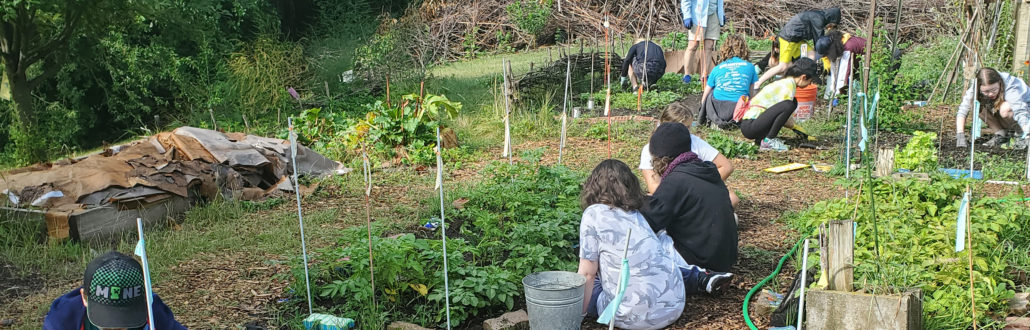
It’s a brisk Thursday in early December and the raspberries in Spring Harbor Middle School’s garden have been dormant for several months, but they haven’t been forgotten by Dave Ropa’s seventh-grade students.
As part of their “Food Science, Culture and Geography” unit, Ropa’s students have been tasked with developing a unique food product that contains two or more ingredients commonly grown at Spring Harbor, an environmental studies magnet middle school located on Madison’s west side. In addition to promotional materials, the students also must provide nutrition information for their product and investigate the food miles each ingredient travels in order to create the recipe. Tenzin Keyshong is a member of a group developing a chocolate candy bar with tart cherries and strawberries from their garden. “It’s more nutritious,” Keyshong says, “And other food might have weird pesticides in it.”
When Ropa started teaching at Spring Harbor 24 years ago all of the school grounds were mowed. Concerned about this lack of biodiversity, Ropa built a rain garden right outside his classroom. “It’s like getting a tattoo,” Ropa says. “Once you get one, you can’t stop. We just kept making gardens.” The school now has several rain gardens, a butterfly garden, a fruit orchard, a chicken coop and an acre of vegetable gardens. During the school year Ropa’s students visit the garden often. Keyshong says he appreciates this time. “In the middle of the school day you don’t [normally] get a lot of fresh air,” he says. “You might also really care about plants, and you can’t do that in a classroom.”
Spring Harbor also hosts a garden summer camp where kids get to cook, weed and tend to the chickens. James Russ, another seventh grader in Ropa’s class, has participated in the camp the past two summers. Hesitant at first—“My parents signed me up for it,” he says—he loved socializing and cutting down weeds. “My first summer I was in a thistle gang. I cut one down that was bigger than me,” he says. Russ believes gardening is an important skill that all children should have the opportunity to learn. “Kids can learn how plants work and take care of nature in general,” he says.
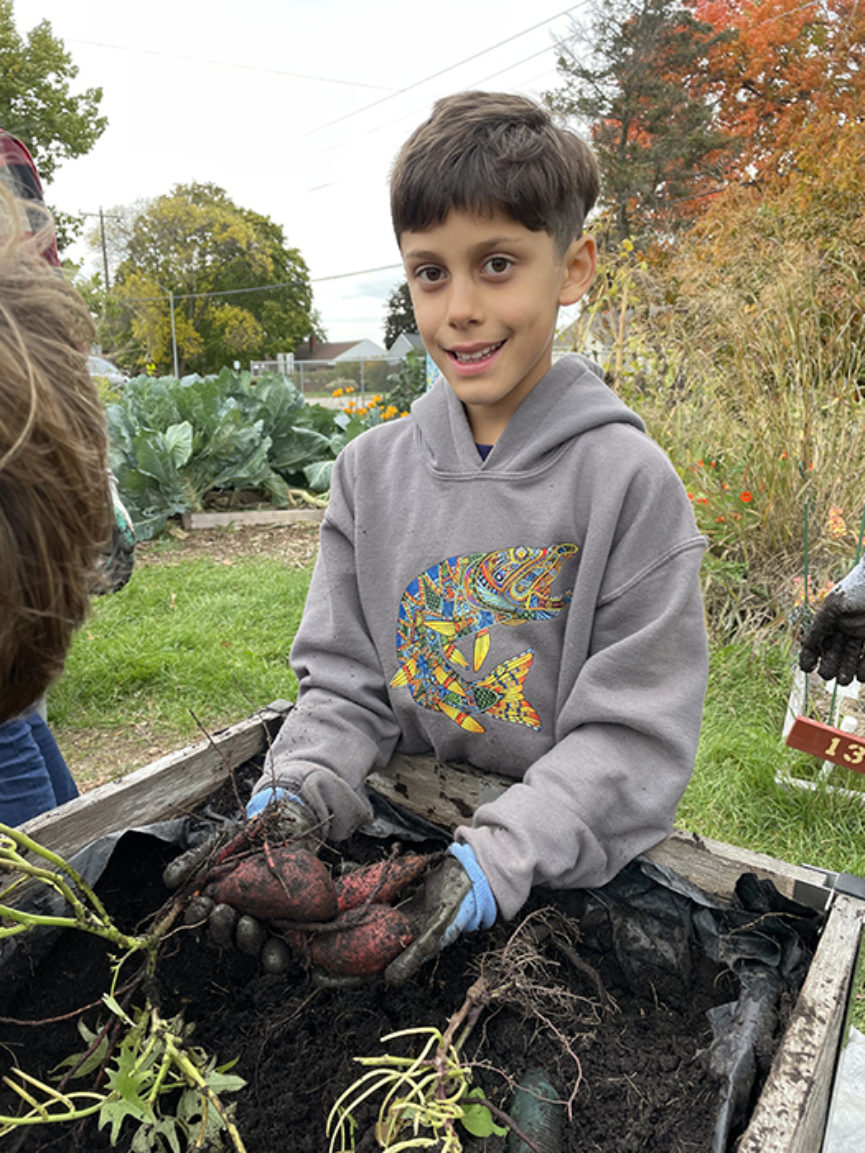
One of the ways that Spring Harbor students learn to care for plants is by growing food in their large vegetable garden filled with peppers, kale, squash, beets, sugar snap peas and more. Planted in the late spring and early summer, many of Spring Harbor’s seedlings, or young plants, are grown at Oakhill Correctional Institution and then donated to the school through its youth garden program.
Located just outside Madison in Oregon, Oakhill is a minimum-security prison with an emphasis on preparing its residents for release into the community by providing education and work opportunities. David Markle is a horticulture instructor who has been with the facility for six years. In addition to growing seedlings for youth garden sites, a program which began in 2014, Markle teaches a 20-week horticulture class to some of Oakhill’s PIOCs or “Persons In Our Care,” who receive a certificate from Madison College upon completion of the course. He also oversees the facility’s three greenhouses and two large vegetable gardens which produced 17,000 pounds of food last year for Oakhill’s kitchen.
Markle, who grew up in Waukesha, credits his piano teacher for introducing him to horticulture at an early age. “I started mowing lawns for her,” he says. “She had a humongous garden and her house was always on the [garden] walks. Slowly she started to teach me how to take care of it which led her to letting me design a garden for her yard.” After college Markle worked at several greenhouses before accepting the teaching position at Oakhill where he took over the program which now grows seedlings and provides them for free to 35 youth garden sites in Dane County. The project is funded entirely by donations with most of the money for supplies coming from a Mother’s Day hanging flower basket sale for Oakhill staff. One of the intentions of the program is to create awareness and appreciation for the restorative benefit that it achieves. “It’s a way for us to give back to the community and educate others,” Markle says.
Now in its 10th year, the process of starting the seedlings has become an exciting ritual that begins at the end of January when Markle and several of his horticulture students and paid workers start planting some of the 26,000 seeds—a combination of vegetables, herbs, annual and perennial flowers—that they will continue to plant weekly in Oakhill’s greenhouses through April. At first the activity takes a lot of faith for the PIOCs, many of whom don’t have any previous experience growing plants. “When you try to explain certain things, like why is this greenhouse completely bare right now? [I say,] ‘Wait four more weeks and this will be completely full, and wait four more weeks and the plants will be three times the size they are now.’ They don’t see that initially,” Markle says. “When it happens it’s almost a panic, they aren’t used to that, and then it’s a relief when they get all of the orders out of there; you can tell that there is an accomplishment that comes with it. I think that is awesome because a lot of times when you are in prison you don’t see positives. This is a humongous positive.”
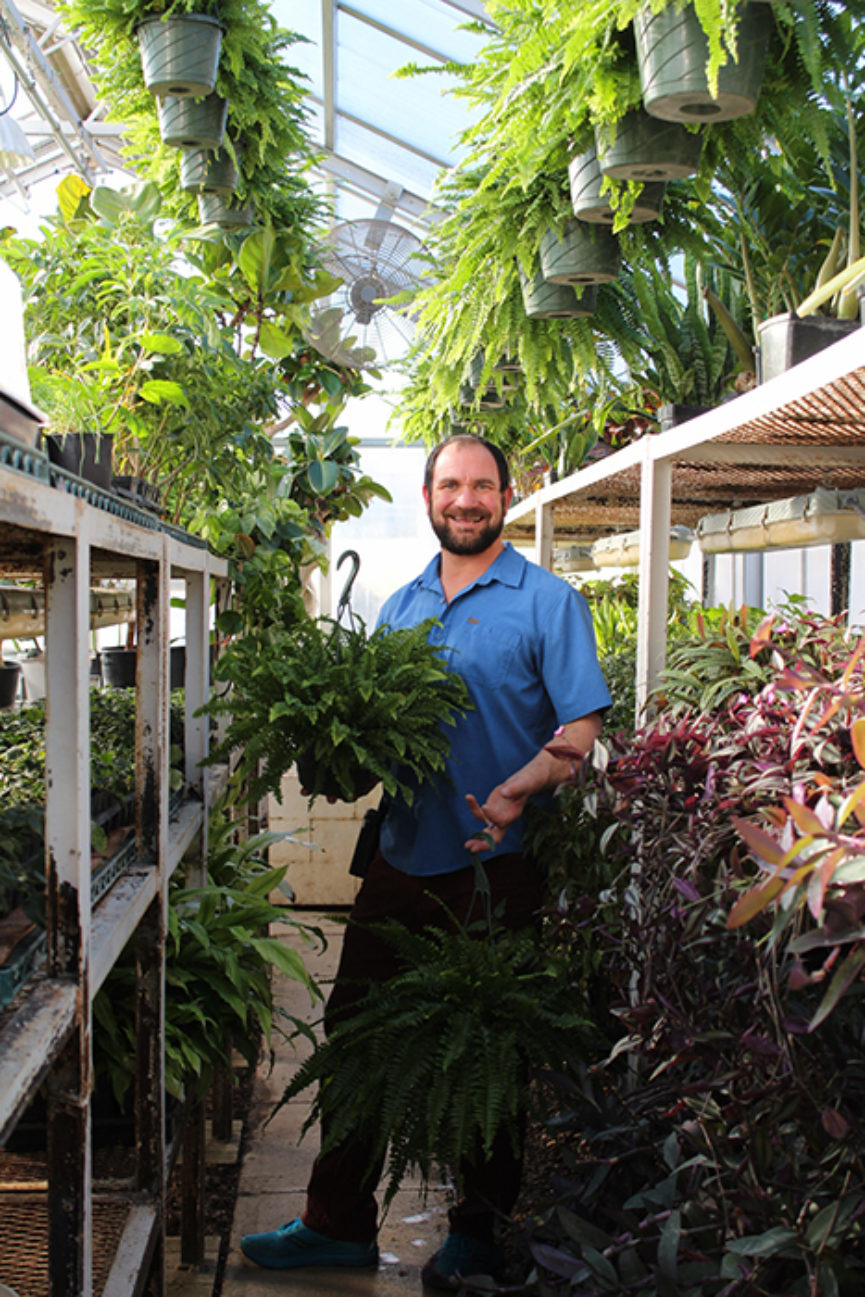
The orders Markle refers to are the plant request lists that he receives in late spring from the 35 youth garden sites, two-thirds of which are school gardens, who have established a relationship with Oakhill’s program. “We grow vegetables, herbs, annuals and perennials,” Markle says. “I think it’s important that we grow all of these because it also helps the kids learn what is going to be there this year, what won’t be there next year, and what might come back next year.” After Markle sends out a list of what is available, including about 20 different types of herbs, 60 types of vegetables—last year’s list had eight varieties of lettuce, three kinds of pumpkins and ten different tomato varieties—and 60 kinds of annual and perennial flowers, garden coordinators return their request forms and wait eagerly for mid-May when they can drive to Oakhill to pick up the plants.
Carol Troyer-Shank is the garden coordinator at Nuestro Mundo Elementary School (previously Allis Elementary) located on Buckeye Road on Madison’s east side where she says the Oakhill plants have renovated their garden. “Before that it was scrounging,” she says. “Where are we going to get the money for plants? How are we going to raise all these little seedlings, the tomatoes and the peppers and all these things? And then I found out about this program where you can pick and choose and say, ‘This is my list’ and you just go and fill up the back of your car and suddenly boom! You have a garden that you can plant! It’s really amazing.”
Troyer-Shank, who taught at Allis for years before retiring, says she loves telling the children about where the plants that they plant in late May came from. “These men made some mistakes but now they are making it right and helping the community,’” she says. “I love telling that restorative story about how you can give back because that philosophy of taking care of the land and taking care of each other is so important to me in gardening with children; that is one of the most important stories you can tell.”
Maya Kanke-Goss is a fourth-grade student at Nuestro Mundo who says she has “helped fix raised beds, made signs, planted things, pulled out weeds, and picked tomatoes,” but her favorite thing to do in the garden is pick and eat berries from the school’s strawberry and raspberry patches. She also enjoys learning about traditional Native American gardening practices. “We learned about the three sisters,” she says. “They are squash, corn and beans. They are grown together because they each help each other grow in a different way. You can do this kind of planting instead of using
chemicals that are bad for the Earth.”
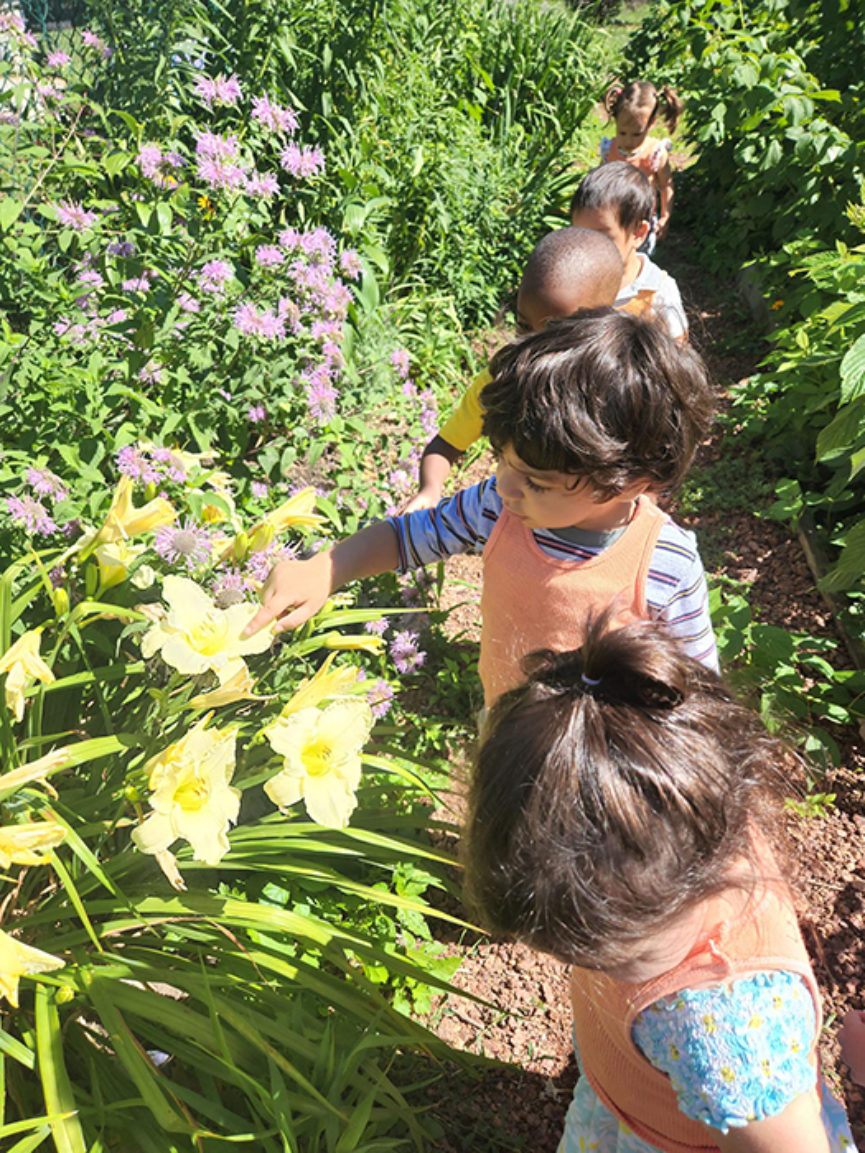
While Oakhill supplies plants mainly to schools, several early-childcare centers also receive the plants in May. One of these sites is Eagle’s Wing Child Care located in Eagle Heights, a UW–Madison housing complex with a large plot of community gardens where Asenna Bojilova Kitina is a teacher and garden coordinator. “I have always loved to be in nature, around plants and in the garden. When I was a child, I spent summers at my grandparents' house in the countryside where there was a lot of gardening and agricultural work,” Kitina says. She now loves bringing that experience to her work. “Toddlers can be actively involved in gardening, and they love it!” she says. “They can water using watering cans, they can carry weeds to the weed pile, pull smaller weeds, enjoy the flowers…It would be great if every daycare center and school could have a garden where children can go and explore, plant and observe and harvest.”
Kitina also observes how these experiences impact children’s food choices. “From my experience with young children, I can say that when you involve them in the garden, most of them are ready to try anything!” she says. She cites a chive plant located near the toddler playground as an example. “We get the toddlers to try it and we say, ‘This is chives.’ They love it, as garlicky as it is, and they learn the name before they could even say many other words and ask for chives every time we are out.” She says parents have also been surprised to learn at the end of the day that their child ate lettuce. “One time we offered the three-year-olds a salad of lettuce and plain yogurt with salt and olive oil—Bulgarian-style salad—and they loved it!”
The Oakhill plants have been integral to Eagle’s Wing’s Garden. “I don’t think we [could] have that much in our garden if it wasn't for that program,” Kitina says. “Mr. Markle and his team are constantly experimenting with new plants and varieties and every year they provide us with a great assortment of vegetables, seasonal and
perennial plants.”
Kitina is grateful for the plants and knows that involving children in the garden will stay with them their whole lives. “I believe that when someone, child or an adult, gets engaged in gardening and plants something, watches it grow and harvests it, then they start to appreciate the food even more. Homegrown food is tastier and dearer,” she says.
Troyer-Shank echoes Kitina in her appreciation for the Oakhill plant program because she believes gardening with children is one of the most important things you can do. In a world of immediate gratification which is not in tune with nature, gardening “teaches patience,” Troyer-Shank says. “It teaches real-time hopefulness… It’s really important for [children] to learn about the seasons of waiting and hoping and caring and enjoying and then waiting and hoping and caring and enjoying again. It’s really an important cycle.”
Photos courtesy of Oakhill Correctional Institution's horticulture program, Asenna Bojilova Kitina, Tera Sarow and David Ropa
More Stories by This Author

Edible in your mailbox
