

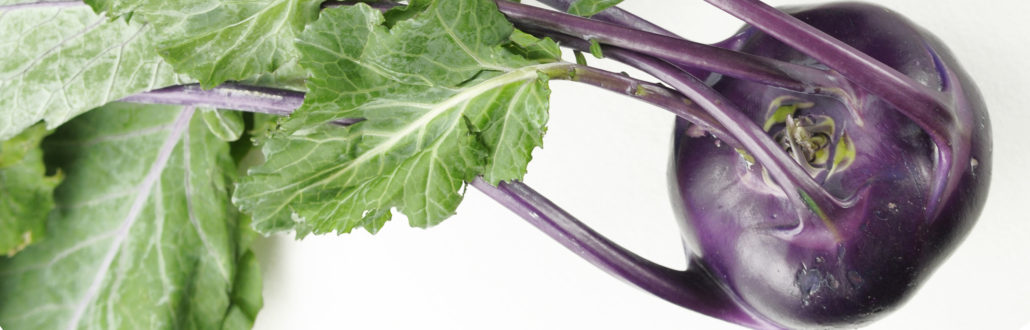
Certainly not an iconic, popular or even recognized American vegetable, kohlrabi has always been more of a home gardener’s secret darling.
Kohlrabi always reminds me of a favorite customer from when I worked at the food co-op in Viroqua. Hans was this old Norwegian farmer who’d come into the store with his muddy boots and dirty jeans held up with suspenders and talk to me while I stocked vegetables, all the while masterfully weaving jokes about Swedes (my heritage) into the conversation. He was much more interested in the old-fashioned, down-home veggies his mother grew in his childhood garden than the exotic ones, and I remember he told me that one of his favorite things was eating young kohlrabi straight out of the garden like an apple.
Because of Hans, I always think of kohlrabi as a sort of obscure and old-fashioned Old World vegetable that old men eat like apples.
Certainly not an iconic, popular or even recognized American vegetable, kohlrabi has always been more of a home gardener’s secret darling—unusual-looking but fun and easy to grow, tasty and nutritious. It’s never been a supermarket staple in the U.S., and ten years ago you’d be hard pressed to find it even at a farmers market. But now kohlrabi has exploded from home gardens into markets across the country.
As the community supported agriculture (CSA) and farmers market movements expand, more and more folks are being exposed to kohlrabi. It’s even becoming something of a cult vegetable in haute cuisine, with adventuresome chefs at fine restaurants finding more and more unusual things to do with it, like serving with oysters or roasted bone marrow, or making remoulade or risotto or lacto-fermented choucroute (that’s French for sauerkraut) out of it.
It turns out that my impression of kohlrabi is right: It really is an Old World vegetable. A descendant of wild European cabbage, kohlrabi is an old German word that combines cabbage (“kohl”) with turnip (“rabi/rube”). There’s controversy over whether it dates back to ancient Roman times or was developed a few hundred years later in northern Europe, but records show that its cultivation became widespread when Charlemagne ordered it grown throughout the Holy Roman Empire after 800 CE. It remains common across much of Europe to this day, especially Germany and eastern Europe. It was introduced to India sometime in the 17th century, where it is also still widely used, especially in northern regions like Kashmir where the cool weather produces ideal growing conditions.
Germany and India are definitely the two countries that most appreciate kohlrabi. Germany proclaims to be the world’s top grower and consumer of kohlrabi. There certainly are many traditional German kohlrabi dishes, most of them involving butter, cream and/or some sort of pork product: kohlrabi überbacken, kohlrabi schnitzel, kohlrabi eintopf, and kohlrabi mit schinken, just to name a few.
Kohlrabi has many names across India—knol kohl, ganth gobi, nookal, and moonji—and is used in everything from pickles to kormas to curries. Its sweet mildness is a perfect foil for pungent spices.
Kohlrabi grows well during the cooler parts of summer and into the fall, but I’ve always appreciated it best in early summer when it’s the first crunchy brassica to come on the scene (usually a few weeks before broccoli and a full month or more before cabbage or cauliflower). Its firmness, crunch and weight are welcome after a month or more of copious salad greens.
This is a truly versatile vegetable. Its “bulb” (technically not a bulb or a root but rather a swollen stem) is equally good raw or cooked, and its greens are tasty and ultra-nutritious. Raw kohlrabi has a nice crunch and a pleasantly earthy, sweet flavor with just a hint of turnip-y bite—nice on a crudité platter, as a veggie “cracker,” grated or thinly sliced on salads and in coleslaws or remoulade, pickled or fermented. Raw kohlrabi is almost as good as jicama tossed in lime juice and chipotle powder (but local!). Cooked, it has the sweetness and versatility of a potato without the starch. The greens can be used anywhere collards, kale or turnip greens would be.
This wonderful veggie is just as full of vitamins and minerals as the rest of its brassica relatives: lots of fiber, vitamins A and C, calcium, phosphorus, potassium and antioxidant phytonutrients. The greens are particularly rich in vitamins A, C and K.
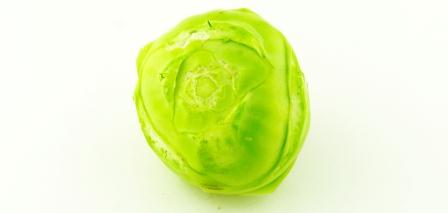
There are purple and green skinned varieties, but both are the same pale greenish-white inside. Look for smallish round bulbs about three inches in diameter with their leaves looking fresh and intact. Larger bulbs are likely to be woody and off-flavored, unless they’re a variety called “Gigante” or “Superschmelz” (both green varieties), which have been bred to be good even when large. The skin is tough unless it’s really young and straight out of the garden (like the ones Hans enjoyed), so you’ll need to peel it carefully with a sharp paring knife before eating.
Separated from the leaves, the bulbs will last three to four weeks in plastic in the fridge. The leaves are best used within a few days of purchase.
Have yet to take the plunge into kohlrabi?
Try these wonderful recipes and let us know what you think!
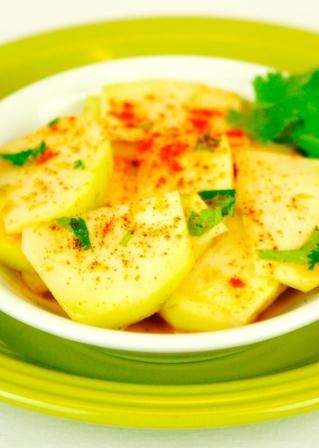
Spicy Kohlrabi Wedges with Lime & Chipotle
Featured Recipes
More Stories by This Author

Edible in your mailbox
