


Endives are so confusing - escarole, chicory, curly endive, radicchio, witloof and more. Let’s break them down together, shall wel?
Endives are so confusing. Escarole, chicory, curly endive, radicchio, witloof, frisée, Belgian endive—there are just so many of them and they’re all so different! I sold produce for a living for more than a decade and I still get befuddled by the various endives I see in well-stocked groceries and market stands.
The easy part: they’re all different varieties of cultivated chicories of the genus Chicorium, part of the aster family, and they all have elements of crunch and bitterness to highly varying degrees.
The confusing part: some “endives” are botanically endives but go by different common names; and some “endives” are commonly known as endive but are not actually endives botanically. Some are almost sweet and some can be outrageously bitter. Some are normally bitter but turn almost sweet if they’re deprived of sunlight while growing, or cooked, or harvested after a frost. Some go by many different names depending on where you are and which variety you’re talking about. Also depending on location and the variety, they may be pronounced ahn-DEEV or EN-dive, leaving you questioning whether you’re inadvertently coming off as stupid to a more-well-versed foodie than yourself (or to any European, where these cultivated chicories originate and where they are way more popular than here in the States).
See what I mean about confusing? So let’s break them down together, shall we?

First for the botanical or “true” endive (pronounced EN-dive), of the species Chicorium endivia: these include all the different varieties of curly endive and broad-leaved escarole, both usually with green leaves and light green/white stems and hearts. Both curly endive and escarole grow well as fall crops in Wisconsin, and both can be grown as baby salad greens as well.
Curly endive is also often called “frisée” or even simply “chicory.” The plants have an open growth habit, and their outer leaves can be very bitter, but they can be tied up around 5 days before harvest to “field-blanch” (i.e., deprive of sunlight while still in the field), a process that whitens and sweetens the center heart. Blanching causes the whole head to look like a sunburst on the market stand. Curly endive is more heat-tolerant than escarole, so you can sometimes find it in the summer as well as in the fall.
Escarole also goes by the names “Batavian,” “Bavarian” and “broad-leaved” endive. Its growth habit is denser than curly endive, causing the outer leaves to blanch its inner heart naturally. It resembles green leaf lettuce, and its leaves are a bit tenderer and a lot milder than its curly brethren. Escarole thrives in cool weather and is even mildly frost-tolerant (in fact, it has the best flavor when lightly frostkissed), so look for it at market into late fall.
The second cultivated species of chicory, Chicorium intybus, includes Belgian endive (pronounced “anh-DEEV”) and radicchio. Both have green and red varieties. Neither is botanically an endive, but both are closely related to true endive and commonly grouped with them. Both have crazy-interesting histories and methods of cultivation, too, so we just have to talk about them.

Belgian endive is also known as French endive or witloof. It didn’t exist before the mid-19th century, when a Belgian farmer discovered that the fall-harvested chicory roots he was storing in his root cellar for a winter coffee substitute (yes, another use for chicory!) had sprouted small, pale yellow-white secondary shoots that were deliciously mild and crunchy—so very unlike their super-bitter primary growth of the summer and fall. Thus, a brand new vegetable was born!
In modern cultivation, Belgian endive takes about five months to grow from seed to a plant with a large taproot, at which point the bitter primary greens are cut off and tossed, and the taproots are harvested and put into cold storage for a necessary dormant period. The roots are then stacked in a dark, cool, moist forcing chamber where the four-to-fiveinch vegetable known as Belgian endive grows to maturity completely without light. The dense leaves bruise easily, so they are typically packed between layers of waxed paper. They must be shipped, sold, and stored carefully, as they don’t keep long and any amount of light exposure will cause them to develop chlorophyll, changing their perfectly blanched leaves from yellow/white to light green. France grows the most Belgian endive for a mostly European market. California is the only state in the United States to grow it commercially. I sure wish someone in Wisconsin would, too (hint, hint), because I just love it. It is crunchy, beautiful, sweet and super versatile. But I get it—Belgian endive is a very expensive pain to produce.
Radicchio, however, is grown seasonally by quite a few farms in Wisconsin. They mainly grow only two types: the round-headed Chioggia and the elongated Treviso-type. But radicchio is almost a cult vegetable in northern Italy, especially in the Veneto province. This is where most modern varieties of radicchio were developed in the last few hundred years.
Years ago, while visiting a friend in a suburb of Venice, I went into a small neighborhood hardware store and noticed they had six different varieties of radicchio in their small seed display. When I commented how odd I thought that was, my friend’s Italian mother-in-law expounded the different culinary virtues of each variety for more than a half hour. Unfortunately it wasn’t radicchio season so I didn’t get to try the delicious dishes she described, but I could almost taste her various radicchio salads, braises, bean stews, risottos and pastas. Her favorite was to simply grill one particular kind brushed with lots of olive oil.

Turns out, certain varieties are even protected under the same strict Italian appellation laws (Indicazione Geografica Protetta, or “IGP”) that classify and regulate the country’s most famous regional wines and cheeses. For instance, in order to earn the name Radicchio Treviso IGP “Tardivo,” this variety must be grown near Treviso, Italy, harvested and then blanched in a dark shed, similar to Belgian endive but with some important differences. In the mid-19th century a botanist in Treviso discovered that if you carefully harvest a mature radicchio plant with its leafy head and roots intact and place it in a dark chamber with the roots submerged in fresh, cool water, then all green pigmentation in the leaves disappears, resulting in stunning, white-veined red leaves. These lovely leaves are also crunchier and sweeter than they were in the field. I don’t know of any farmers in Wisconsin who go through this extra step with their radicchio, but again—hint, hint!
Whatever their name or pronunciation, endives are always interesting and delicious, and they sure are good for you. The bitter properties of chicories have been appreciated as blood and liver cleansers since ancient Egyptian times, and we now know that they’re rich in fiber, vitamins A, B9, B5, E and K, as well as magnesium and potassium. Their bitter flavor complements lots of different flavors, balancing the sweetness of apples, pears, dried fruit or nuts in salads and braises; the tartness of citrus or vinegar; and the savory richness of aged cheeses, cream, butter, smoked meats, and nut oils when raw, roasted or added to stews or pastas.
Keeping the many different cultivated chicories known as ahn-DEEV or EN-dive straight may be a linguistic challenge, and you may have to hunt a bit or grow your own to find certain ones locally, but it’s a worthy endeavor to get to know them in all their contrasting textures, colors and flavors.
Try these wonderful fall recipes that include endives as leading players and supporting roles:
Italian Stew with Escarole, White Beans & Fresh Sausage (photo above)
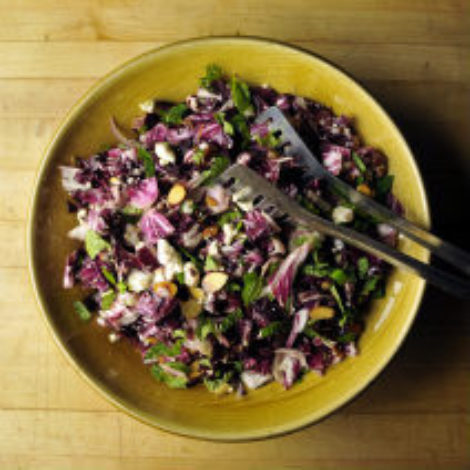
Frisée and Radicchio Salad with Hazelnuts, Dried Cherries and Parmesan

Featured Recipes

More Stories by This Author

Edible in your mailbox
