

People rarely get excited over turnips. But most folks don’t realize that turnips come in exciting varieties & colors, with intriguing culinary uses.

People rarely get excited over turnips, at least not over the ubiquitous white purple-topped storage kind. And to be fair, oftentimes the way they’re prepared is nothing to get excited about, either—they can have a watery, bitter, slightly sulfuric yuck when overcooked. But most folks don’t realize that turnips come in a bunch of exciting varieties and colors, with different intriguing culinary uses and flavors to maximize.
Take green-top baby salad turnips, for instance. They come in many colors, from pure snowy white to bright magenta. When harvested young and bunched with their big, bright green leaves, they’re a regular show-stopper on a market stand.
“What are those beautiful roots?” is the common question. But after answering “Baby salad turnips!” it’s usually a hard sell if the inquiring party has never tried them before. Often the response is a sneer with an “Oh, they’re turnips,” like turnip is a dirty word. People who are adventurous enough to try them, however, quickly realize that the roots are crisp, sweet, pretty, nutritious, and their skin is thin enough to not need peeling.
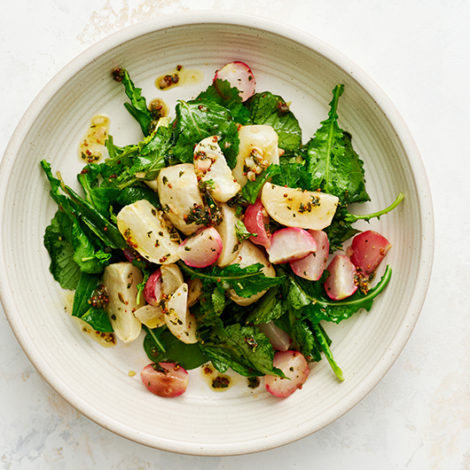
Baby turnip roots are delicious cooked whole or halved, but they’re exceptional raw—sliced or grated on salads, quartered or half-mooned on a crudité platter, or as a lovely, naturally gluten-free cracker topped with cheese or spreads. As a bonus, the leaves are tender, slightly spicy, ultra-nutritious, and can be prepared like any cooking green.
But green-top baby salad turnips aren’t always easy to find. They don’t grow well in hot weather and thanks to their thin skin, they don’t store long like the more common, thick-skinned storage types. You can usually only find baby turnips in a CSA box or at farmers markets in the late spring or early fall, or at winter markets from farms with hoop-houses.
Storage turnips, on the other hand, can be a locavore’s staple through the winter. When stored properly, turnips that are harvested in the late fall can last until spring. Some local farms, like Harmony Valley Farm outside Viroqua, have mastered the art of large-scale root storage and can ship pristine, clean, crisp roots to Midwestern food co-ops and grocery stores throughout the winter.
Branch out from the standard white purple-top storage turnip by seeking out other varieties. Gold turnips have golden flesh as well as skin, looking more like a rutabaga or golden potato when cooked. Scarlet turnips are magenta on the outside and snowy white streaked with magenta on the inside. Both varieties are a bit milder than purple-tops. The scarlet turnip is my go-to variety for raw applications through the winter: as a base for winter-time appetizers, grated onto salads or into slaws, or for dipping.
To store turnips, trim off their leaves about a half-inch above the root and store dirty in a cellar-like environment, or washed in plastic in your fridge for a few months.
With all this variety and potential, how did turnips end up with such a contemptuous reputation? Not only do modern Americans stick up their noses, but historically turnips have been maligned as well. Maybe it was their use as animal fodder that long ago caused nobles to scorn them as poor-man’s food. In medieval Europe, turnips were a popular vegetable to throw at bad performers and criminals in the stocks. Young women would present a turnip to a romantic suitor they wished to reject.
But it can be argued that turnips were one of the most important foodstuffs of ancient times. Native to Northern Europe, they were foraged by prehistoric peoples, and later, Ancient Greeks and Romans revered their utility as both a human and animal crop. The Finns had a turnip fertility god named Egres or Akras that helped protect many other crops. Turnip pickles are prized throughout the Middle East, and turnips have been popular throughout Asia and the Indian subcontinent for hundreds of years.
Ancient Celts considered turnips to not only give sustenance but to have spiritual powers of protection. For this reason, the Celts made them the original jack-o-lantern. Carved out with a candle lit inside and placed in windowsills or hung from eaves and carrying sticks, turnip lanterns were supposed to ward off spirits on Samhain, the Celtic precursor to Halloween. (Like potatoes and corn, pumpkins are native to the Americas and weren’t used as jack-o-lanterns until late-19th century American Halloweens.)
Turnips’ ease of growth, ability to survive freezing temperatures, and long storage capability before the introduction of New World crops like potatoes and corn undoubtedly saved countless peasants and their livestock through cold northern winters long ago. Even today turnip greens are an incredibly important part of Southern U.S. cuisine.
Turnips are a member of the super-good-for-you Brassica family. Botanically, Napa cabbage, rutabagas and bok choi were bred from the common turnip. The roots are full of vitamin C and many of the cancer-fighting phytonutrients of their more highly-esteemed cousins cabbage, broccoli and kale. Chinese medicine maintains that turnips can cleanse the blood and increase the flow of qi (energy) through the body. They can help break up mucus and treat bronchitis, asthma and the common cold. Turnip greens are a nutritional powerhouse, rivaling kale, chard and even watercress in levels of vitamins, minerals and antioxidant phytonutrients.
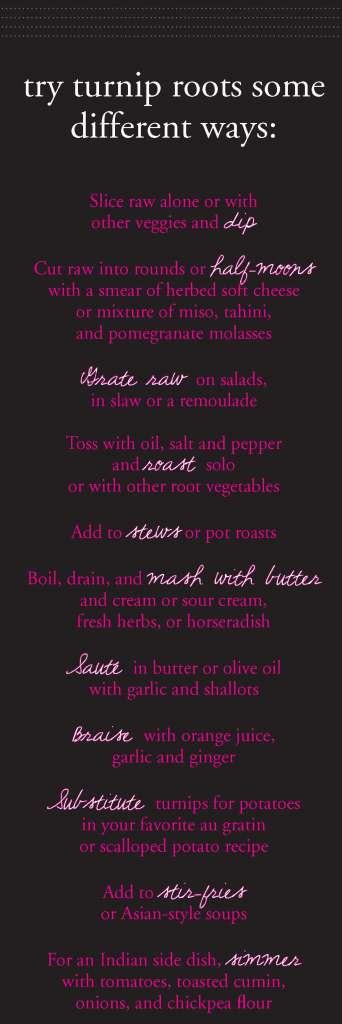
Try out these turnip recipes; who knows? You might just like them after all.
Ginger & Orange Glazed Turnips
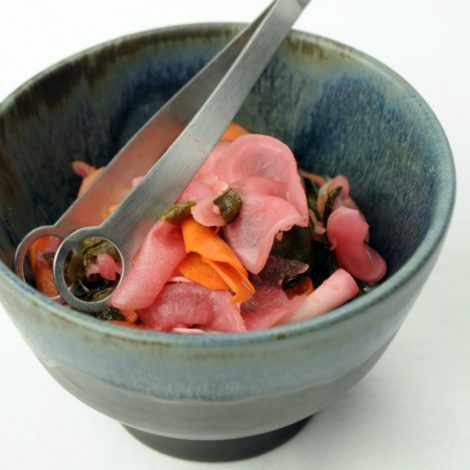
Middle-Eastern Salt-Pickled Turnips (lacto-fermented 'torshi left')
Featured Recipes
More Stories by This Author

Edible in your mailbox
