

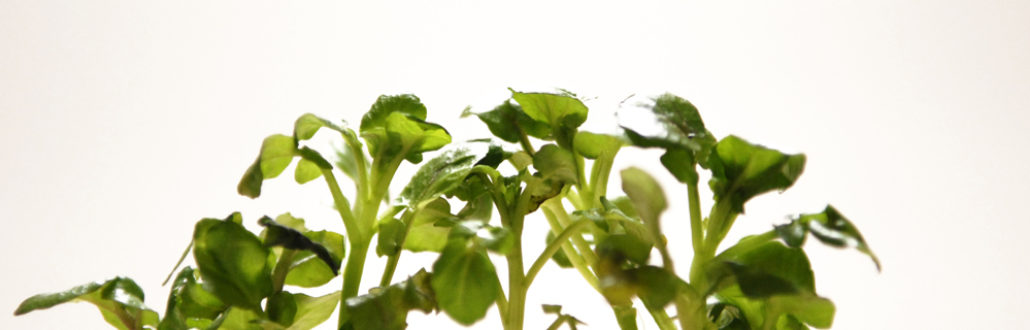
Call me crazy, but watercress never fails to elicit images of water-sprites and fairies dancing through my brain. Could be because its natural habitat is one such ethereal creatures would likely haunt: sparkling crystal-clean water, dappled green shade with shafts of golden sunlight streaking through, forest birds chirping, the gurgling, tinkling, plunking flow of water over mossy rocks. Or maybe its cute little clumping form is what makes me think of them—perfect for fairy furniture. Or its spunky spicy clean flavor—water-sprite food if ever there was any. Or maybe watercress reminds me of magical folk because, like fairies, it’s as old as the hills.
Watercress, Nasturtium officianale (of no relation to nasturtium flowers, which are of the Tropaeolum genus), is one of the oldest green foods known to humans. Native to Europe and Western Asia, it is a semi-aquatic, hardy perennial that naturalizes easily in just about any clean, flowing water. Known as a fortifying herb that builds strength and good health, it was a staple part of a soldier’s diet in ancient Persia, Greece, and Rome. Supposedly the Egyptian slaves who built the great pyramids were fed juiced watercress daily to keep up the good work. Even Zeus ate it from a spring at a famous cave in Crete while getting ready for some epic battle or another. Ancient lore also says watercress can make you witty, cure insanity, migraines and eczema, and even make your hair grow if you rub it on your head—any one of which may also explain its reputation as an aphrodisiac.
No one has loved watercress (or fairies for that matter) more than the British. After naturalizing throughout the British Isles, watercress became commonplace in 17th century England after a famous herbalist reported watercress soup to be a very effective blood cleanser and spring tonic. British explorers like Captain Cook used it and its vitamin C content to ward off scurvy on long journeys. Beloved by rich and poor alike, it was as likely to be eaten by a Victorian duchess in a delicate sandwich at high tea as munched by a working class bloke on the street. When one couldn’t afford to buy it, one might always pick some, hence its nickname of “poor man’s bread.” Irish monks supposedly lived for long stretches on watercress and bread alone.
And you really could almost live on watercress and bread alone. High in vitamins A, C, E and K, calcium, iron and potassium, as well as numerous trace minerals and phytochemicals, watercress truly is a powerhouse of nutrition. A member of the Cruciferae family, which also includes such superstars as broccoli, kale and mustard greens, watercress is increasingly lauded as an “anti-cancer superfood.” Herbalists can tell you that that watercress is effective as a liver, kidney and blood detoxifier, amucus decongestant and a diuretic. They’ll also tell you to juice or steep it as tea, but I prefer to simply eat it.
Watercress’s peppery pungency is refreshing and lively in fresh salads, sandwiches, pesto, dips and as garnish. It pairs well in salads with apples, pears or oranges and in sandwiches with cured meat or smoked fish. If you’re going to cook it, just barely cook it—add it at the end of cooking soups (such as traditional British or French potato-watercress soup, Chinese egg-drop or wonton soup), stir-fries, eggs, sauces and such. It also makes a beautiful and tasty wilted bed for serving roasted or grilled meats.
Watercress has been thoroughly naturalized throughout the U.S. since the mid-19th century, where it preceded settlers on their journey west when soldiers planted it alongside their new forts and outposts. In Wisconsin, wild watercress’s growth cycle is at its peak of deliciousness in March through May, after which heat usually causes it to flower and get bitter. It can be harvested again in the cool of fall and even into the depths of winter. The popularity of watercress in England and the rest of Europe since the 19th century has led to the development of a huge cultivated watercress industry that is currently unmatched in the U.S. except on the East Coast, so it can be hard to find at the store here in the Midwest. It has a notoriously short shelf life, which makes it hard to ship across long distances, and growing it commercially on any kind of scale isn’t easy. Large pools and complicated irrigation canals must be constructed, and the watercress must be seeded into drained but damp beds of sandy gravel with clean flowing water added as it grows. I’m unaware of anyone producing it commercially in the Midwest besides Growing Power in Milwaukee, so for local watercress your best bet is finding it at the farmers market in spring or hunting it down yourself. Look for clean, cool running streams or springs—ID watercress once and you’ll see it everywhere. Harvest it above or just below water level with scissors or a knife (watch out for water-sprites!) rather than pulling out the roots. That way you’ll be sure to find more the next time you look.
If you really love it like I do, it’s easier to grow on a small scale, like alongside the little spring on our farm where I’ve successfully transplanted stems and sowed seeds. Seeds are available from many seed companies (don’t confuse it with garden or pepper cress, which are good but different), or it is easily transplanted from rooted stems. All you need is a shallow, natural or manmade pool lined with sand and gravel with clean water running through it.
Give it a try! We desperately need more fairy habitat in our world these days.
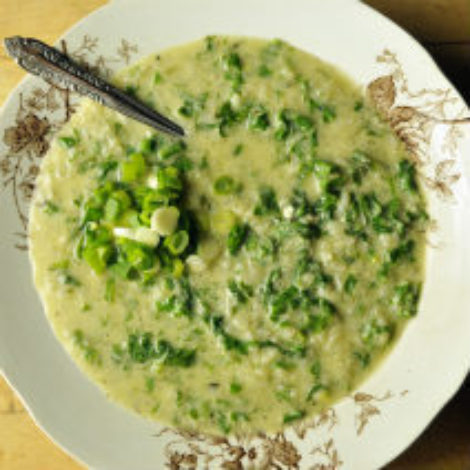
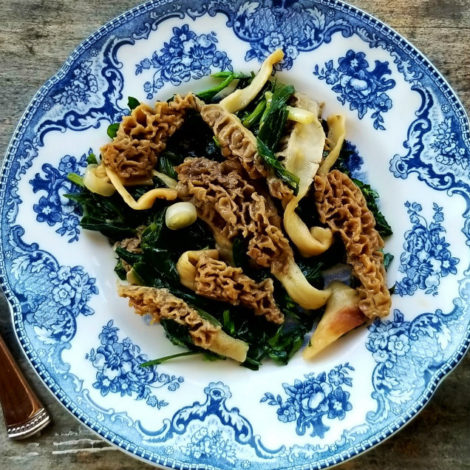
We hope you enjoy these watercress recipes by Dani Lind:
Featured Recipes

More Stories by This Author

Edible in your mailbox
